Week-6 Challenge: EV Drivetrain
1. There are 3 types of power converter circuits used in EVs and HEVs:
a. DC-DC converter
- It converts fixed DC input to a regulated DC output.
- It consists of three types: isolated, non-isolated, and resonant converters.
- Non-isolated converters consist of Buck, Boost, and Buck-boost converters.
- Isolated converters consist of Flyback, Forward, Half-bridge, and Full-bridge.
- Resonant converters consist of different families of DC-DC converters, used for high-power conversion.
- This type of converter is used in Auxiliary loads such as air-conditioning systems, music systems, headlights, dimmers, etc.
b. AC-DC converter
- It is commonly called a rectifier.
- This type of converter is widely used in battery charging.
- Rectifiers with power factor correction are popular in the industry.
c. DC-AC converter
- It is commonly called an inverter.
- It can control both the magnitude & frequency of output AC voltage.
- This converter is widely used to control AC motors (eg. Induction motors).
2. Given:
Battery pack voltage, Vb= 72V
Rated armature current, Ia = 400 A
Armature Resistance, Ra = 0.5Ω
Motor constant, KΦ = 0.7 V/sec
Chopper Switching frequency, fs = 400 Hz
Duty Cycle, D = 70% = 0.7
Vehicle output voltage (Vv) is given by:
Vv = Vb * D = 72 * 0.7 = 50.4 V
Now, the equation of torque is given by
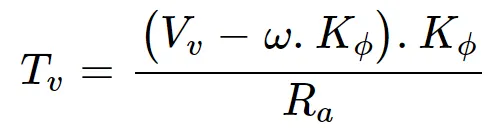
where,
Tv = Vehicle torque (N-m)
Vv = Vehicle voltage (V)
ω = Steady-state speed of the vehicle (rad/sec)
KΦ = Motor constant
Ra = Armature resistance
Substituting all these values in the above equation, we get
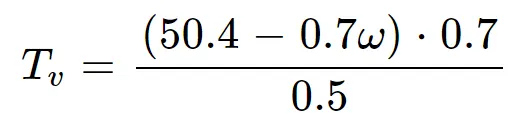
Tv = 70.56 - 0.98 ω --- (i)
According to the question, the vehicle speed-torque characteristics are given by the equation

Comparing equations (i) & (ii), we get

Solving these equations, we get

Solving this quadratic equation, we get
ω = 38.91 rad/sec, -231.072 rad/sec
For a steady-state speed, the ω value should be positive.
∴ Steady-state speed of vehicle = 38.91 rad/sec
3.
The following points can be concluded from the above topic:
- In the beginning, the author describes the dominance of Internal Combustion Engines (ICE) in the world of the automobile industry and also discusses different types of engines. He explains that all engines were similar and it was up to the user to select according to their requirement. He also speaks about induction motors and brushless DC motors and presents his view that these two technologies will be widely used in the coming years.
- Then he explains the working of both a 3-phase induction motor and a brushless DC motor.
- Now the author has done a comparison between these two technologies and stated some advantages and disadvantages of each.
- The induction motor has some advantages like it has no magnets. The motor has the ability to start under load. No inverter is needed. Some disadvantages of Induction motors are: They cannot operate from DC; AC is a must. Shaft speed is proportionate to line frequency. Hence, when used with utility power, they are constant-speed machines. When operated from utility power, they have limited starting torque and somewhat limited running peak torque capabilities, when compared to DC-type machines.
- Brushless DC motors have some advantages like as much less rotor heat is generated with the DC brushless drive. The peak point energy efficiency for a DC brushless drive will typically be a few percentage points higher than for an induction drive. Some disadvantages of a Brushless DC motor are: as machine size grows, the magnetic losses increase proportionately and part load efficiency drops. Permanent magnets are expensive and difficult to handle due to the very large forces that come into play when anything ferromagnetic gets close to them.
- Finally, the author couldn’t choose which drive is better than the other but makes it clear that DC brushless drives will likely continue to dominate in the hybrid and coming plug-in hybrid markets, and that induction drives will likely maintain dominance for the high-performance pure electrics.