Project 4
AIM:
- To calculate the capacity of the battery pack required and the number of series-parallel connections. The motor ratings for a vehicle with a gross weight of 300 kg are 1200Wh, and 65V. The range is 225km and the maximum speed is 60kmph.
- To give a stepwise discussion on how a battery pack is built.
Calculations:
Given data:
Vehicle Weight=300 kg
Motor Rating=1200 Wh, 65V
Range=225 km
Max Speed=50 kmph
To find motor current, Power = V * I
1200 = 65 * I,
I = 1200 / 65 = 18.4615 A
I = 18.46 A
The current withdrawn by the motor is 18.46 A.
Assume a current loss of 10%.
∴ New motor current = 18.46 * 1.1 = 20.306 A
Now, let us calculate the power required at maximum speed i.e. at 60 kmph
P = 65 * 20.306 = 1319.89 W
P = 1320 W
Now, let us calculate Travel Factor
Travel Factor, TF = Total range / Total speed
= 225 / 60
= 3.75
To calculate power based on the travel factor,
Power required = P * TF = 1320 * 3.75 = 4950 W = 4.95 kW
Now, let us calculate battery pack capacity based on efficiency
We know that the lithium-ion battery pack efficiency is 85-95%. Let us consider its efficiency to be 85%.
Total battery pack efficiency = 4.95 / 0.85 = 5.82 kW
To calculate Battery pack efficiency based on motor efficiency
Total Battery Pack capacity = 5.82/0.85 = 6.85 kWh
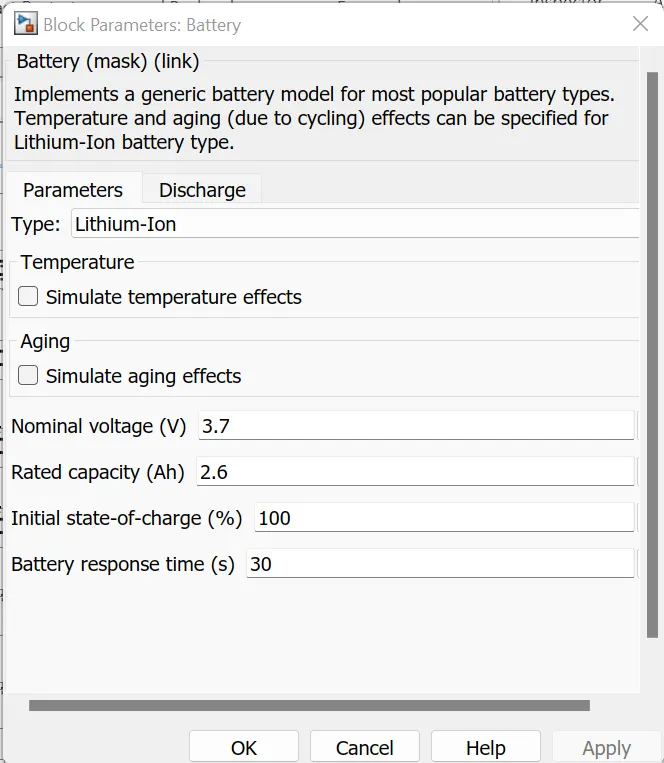
Now, we have to find no. of cells in series and parallel. The values of the lithium-ion battery parameters are referred from the Lithium-ion battery datasheet.
Series connections (Ns)
Motor voltage = 65 V
Cell nominal voltage = 3.7 V
Ns = 65/3.7 = 17.58 ≈ 18 cells
Parallel connections (Np)
Motor current = 20.306 A
Cell nominal current = 2.6 A
Np = 20.306 / 2.6 = 7.81 ≈ 8 cells
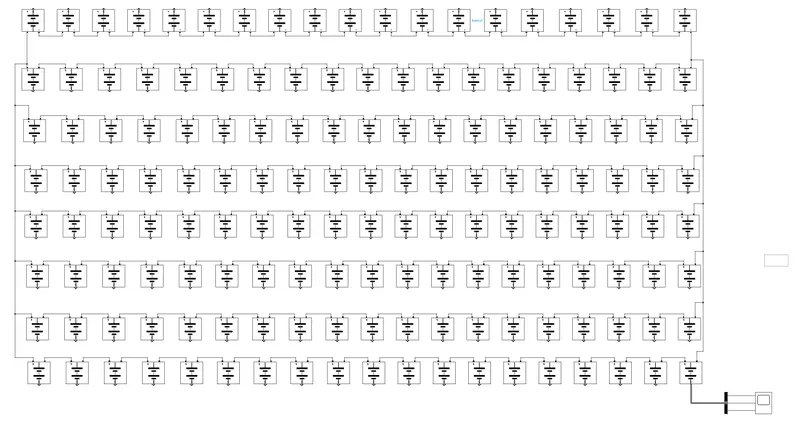
Cell Architecture: 18S8P
Simulink model:
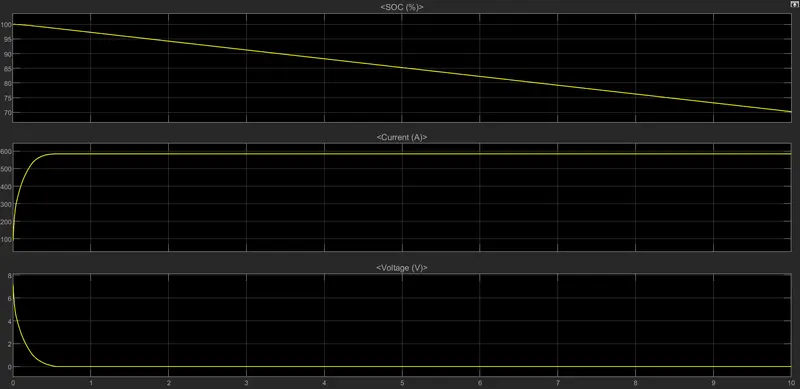
Result:
Steps for building a battery pack:
- For designing a 6.85 kWh capacity battery pack we can take lithium-ion cells.
- As per the above calculation, we have to use 18 cells in series and 8 cells in parallel, do the parallel connection first, and then connect all parallel connected cells in series this eases the process to find a faulty cell while maintenance time.
- But before connecting them we have to check whether all are in balanced condition or not. If the cells are not in a balanced condition, then we have to Place a capping on the cell.
- Take a cell holder and put a cell on it select the size of the cell holder as per the size of the cell.
- After placing cells in the cell holder, do the series-parallel connection.
- For connection use a nickel strip and connect the nickel strip to the cells or battery pack use spot welding (if you do not have spot welding then use the soldering method but it is not recommended because it produces more heat).
- Now connect the Battery management system (BMS) to a battery pack.
- By connecting the voltmeter measure the voltage across BMS and check required voltage is getting or not.
- After that, enclose the battery pack by using an epoxy sheet for safety purposes.
Conclusion: