EV Drivetrain
OBJECTIVE -1:
To find out types of power converter circuits are employed in electric and hybrid electric vehicles?
The types of power converters used in EV/HEV are
Inverter(DC-AC)
Rectifier(AC-DC)
Chopper(DC-DC)
Regulator(AC-AC)
DC-AC CONVERTER(inverter)
The inverter which converts the DC-AC power ,which is mainly used in induction motor based cars.
The PWM ,multilevel inverter is mostly used in the electric vehicle.
USES :Controlling the inverter can control the speed of the vehicle
The multilevel inverter has the highest efficiency.
PWM inverter
- Single Pulse Width modulation (single PWM)
- Multiple Pulse Width Modulation (MPWM)
- Sinusoidal Pulse Width Modulation (SPWM)
- Modified Sinusoidal Pulse Width Modulation (MSPWM)
Multilevel inverter
- Flying capacitor Inverter
- Diode-clamped Inverter
- Hybrid Inverter
- Cascade H-type Inverter
AC-DC CONVERTOR(rectifier):
The rectifier which converts the AC to DC power, this is commonly used in all EV/HEV.
Active converters are used for fast charging.
USES : Used for slow charging (7KW) with 1 phase, fast charging (11KW) with 3 phase , regenerative action.
- 1 phase converter
- 3 phase converter
Full wave, semi , dual converts are available in both 1&3 phase.
DC-DC CONVERTER:
The DC toDC converter converts one level of dc voltage to the other level of DC voltage.
USES: This converter is used to power up monitors , AC , lamb , headlight etc.
Unidirectional converter used for powering sensor , lamb , utilities , safety equipment.
Bi-directional converter used for regenerative braking , charging , power backup.
Based on voltage regulation the types are
- Linear-Only step-downs.
- Switched-Can step-up & step-down.
Non-isolated converters
USES : used to step-up and step-down for a small ratio.
- Buck
- Boost
- Buck-boost
Isolated converters
USES : used to step-up and step-down for a high ratio.
- Half-bridge
- Full bridge
- fly -back
- push-pull
All the converters are available in unidirectional & bi-directional , converters are preferred based on the application.
-----------------------------------------------------------------------------------------------------------------------------------------------------------------------------------------------------------
OBJECTIVE -2:
To find out the EV steady state speed of the separately excited dc motor if the duty cycle is 70% ?
Given data:
V=72V , I=400A , Ra= 0.5Ω , KΦ= 0.7 Volt second
vehicle speed-torque characteristics are given by the below equation

Finding the motor torque:
T=(PZ/A)*(Ia/2)
T=KIa =0.7*400 =280Nm
If the duty cycle is 70% then :
V*dc =72*0.7 =50.4V
Substituting T, V in vehicle speed torque equation:
Tv=24.7+(0.0051)`omega^2`
280*50.4=24.7+(0.0051)`omega^2`
`omega`=1662
The vehicle steady state speed in 1662 rad
--------------------------------------------------------------------------------------------------------------------------------------------------------------------------------------------------------
OBJECTIVE-3:
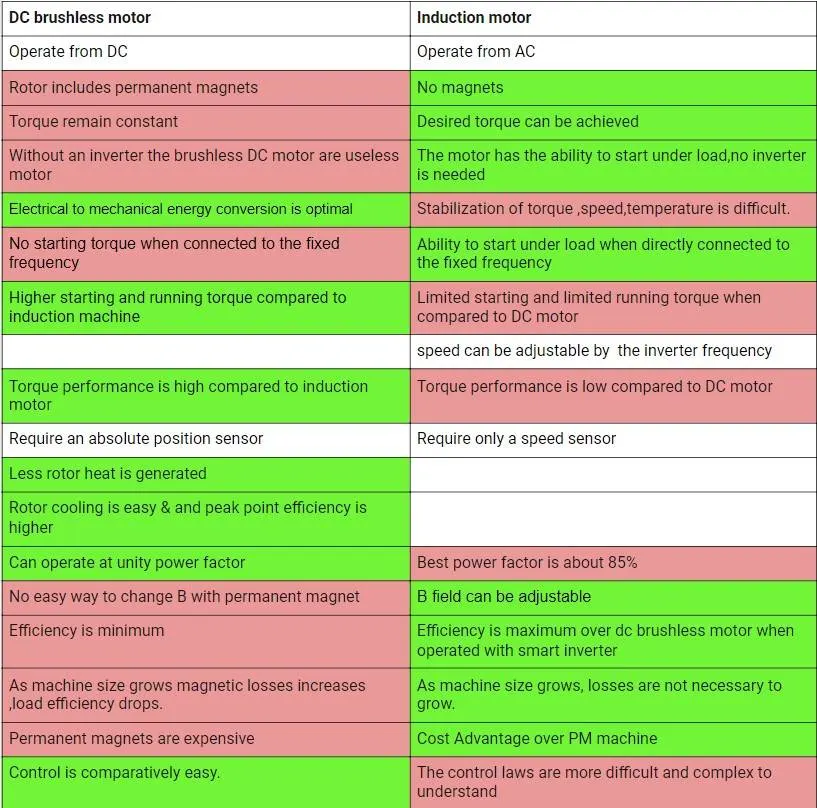
To find out to the blog on below topic Induction Versus DC brushless motors by Wally Rippel, Tesla
Wally Rippel, author writing this blog ,has experience in the General Motors,jet propulsion laboratory, Tesla. In this blog he is saying that there is no best motor for all EV/HEV applications. He starts with the construction and working of DC brushless motor ,induction motor also said the various positive and negative points on both the motors
This differentiation is purely bared on the Wally Rippel blog
Conclusion:
After analysing positive and negative of both the motor Wally Rippel's conclusion is that DC brushless dominates in the hybrid and coming plug-in hybrid , and induction drives will likely maintain dominante for the high-performance pure electrics.we shall see the results in the green future.
---------------------------------------------------------------------------------------------------------------------------------------------------------------------------------------------------------------------------------------------------------------------------------