Week-6 Challenge: EV Drivetrain
Answer:
1)
I think all four types of power converter circuits are employed in electric and hybrid electric vehicles.
They are:
1. AC/DC converter(Rectifier) - used for battery charging.
2. DC/AC converter(Inverter) - used to drive AC induction motors.
3. DC/DC converter(Step-up/Step-down converter) - used to change the voltage levels of supply from battery to motor and vice versa.
4. AC/AC converter - used to control the motor speed.
2)
When the vehicle is at steady state speed, Torque of the Vehicle = Torque of the motor.
The vehicle torque is given as

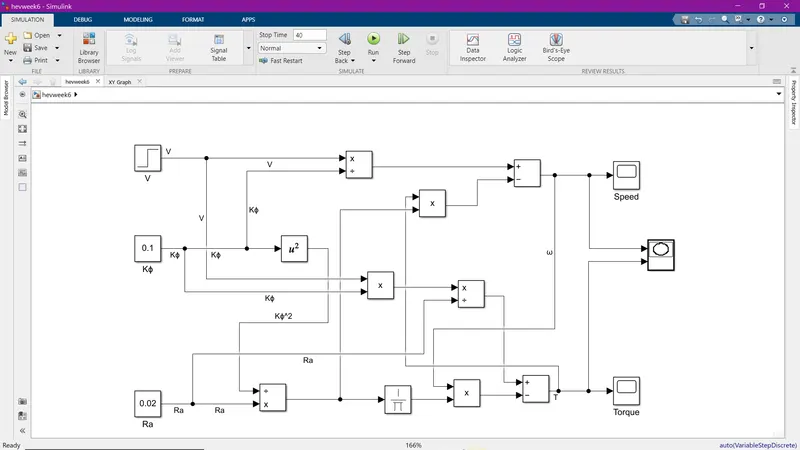
we know the motor torque equation, T = (V*Kϕ/Ra)-(Kϕ^2/Ra)*ω
For V, we know that voltage applied to the motor = Vbat * duty cycle
V = 72*0.7 = 50.4 V
Kϕ = 0.7
Ra = 0.5 ohm
Substituting the values in the motor torque equation, we get
T = (50.4*0.7/0.5) - (0.7^2/0.5)*ω
T = 70.56 - 0.98*ω
Equating the torque equations,
70.56 - 0.98*ω = 24.7 + 0.0051*(ω^2)
0.0051*(ω^2) + 0.98*ω + 24.7 - 70.56 = 0
0.0051*(ω^2) + 0.98*ω - 45.86 = 0
`ω` can be found by the 'roots' command in MATLAB.
ω = -231.0718 or 38.915 rad/sec
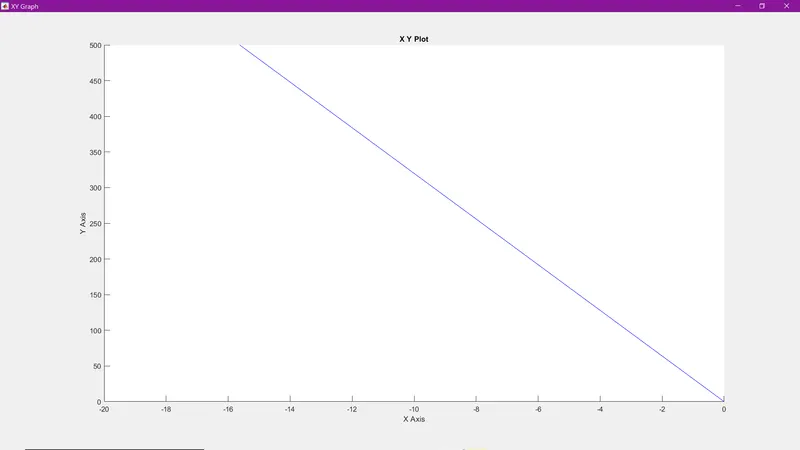
But torque-speed characteristics are plotted in the positive region of the speed.
Therefore, the Steady-state speed of the EV ω = 38.915 rad/sec or 371.61 rpm.
- In this author's writing, he tells that the world hasn't had the best engine type and best drive type.
- He also says that the technology has changed in both batteries ( Replacing lead with lithium ) and motors ( Replacing brushed DC motors with brushless DC motors ).
- The author explains the working of a Brushless DC motor. The Brushless DC motor has two or more permanent magnets.
- These magnets provide the necessary magnetic field. When rotating, the magnetic field interacts with the currents flowing in the windings placed in the stator core.
- This produces torque between the stator and the rotor. It is necessary that the magnitude and polarity of the stator currents should be continuously varied when the rotor rotates.
- He also says that the inverters are used to provide current control.
- Then he started to tell the difference between brushless and induction motors.
- The stators for the 3-phase induction motor and the DC brushless motor are identical. The difference is the rotor. The induction rotor has no magnets. Stator currents provide the necessary magnetic field. Currents interact with the original magnetic field to produce forces.
- The main reason for the success of 3-phase induction motors is no inverters are needed when they are connected to 3-phase power. But the power is a DC supply, inverters are needed.
- The control codes are also different for both brushless and induction motors. The brushless motor requires a position sensor, while the induction motor requires a speed sensor.
- Another difference is that the heat is less generated in the brushless motor.
- At light loads, the inverter in the induction motor can reduce voltage such that magnetic losses are reduced and efficiency is maximized.
- The induction motors are cost-effective over brushless motors because of the higher cost of permanent magnets.
- He concludes his writing by saying that both brushless motors and induction motors work side by side during the coming golden era of hybrid and electric vehicles.