Week-6 Challenge: EV Drivetrain
1................
Power Electronic Converters: -
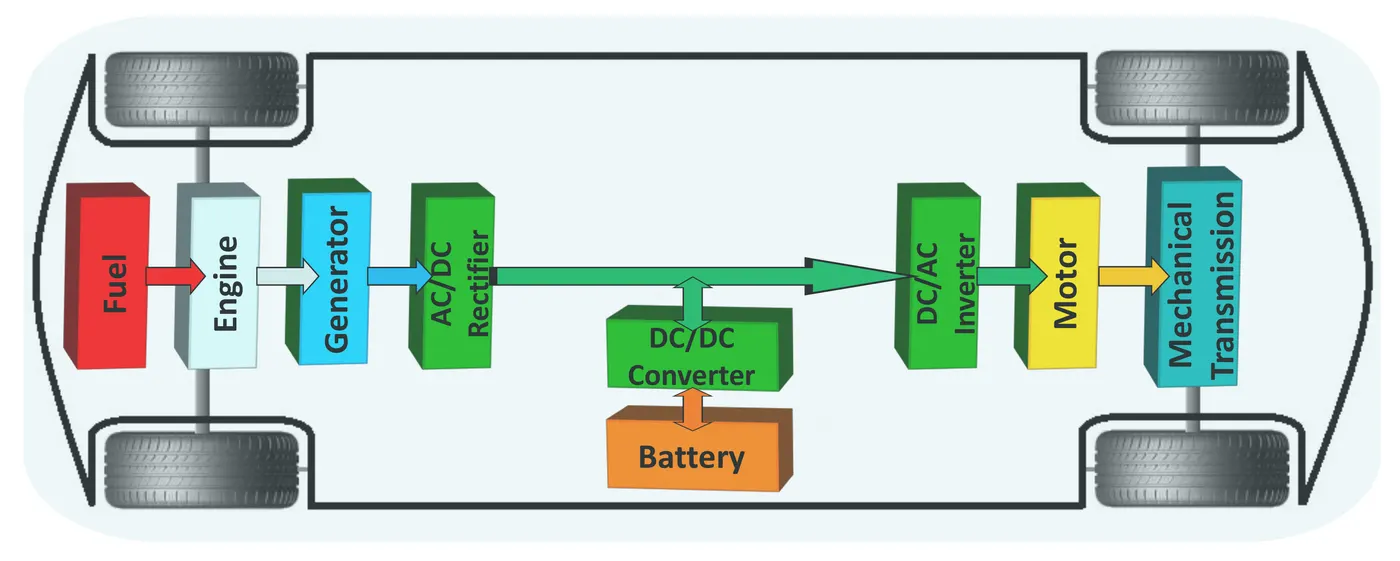
In Electric and Hybrid Electric Vehicles (EV/HEV), the power electronic converters are considered as the key factors that interface their power sources to the drivetrain of the EVs.
the 3 types of converters that are widely used in an Electric Vehicle are:
AC – DC Converter (On Board Charger)
DC-DC Converter (chopper)
DC – AC Converter (Inverter)
AC – DC Converter (On Board Charger)-;
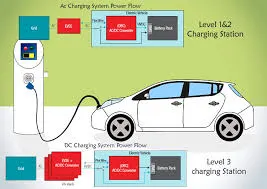
An AC-DC Converter is a device that converts an AC voltage to a DC voltage.
AC to DC converters is most commonly used in Plug-in Hybrid Electric Vehicles (PHEV) & Plug-in Electric Vehicles (PEV). These vehicles get their propulsion power from an external electricity source (charging stations) which is alternating current.
DC-DC Converter: -
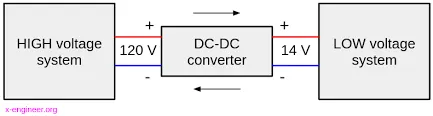
By presenting DC/DC converters one can choose the voltage variation of the devices and the power of each device can be controlled. The power of the DC/DC converter depends on the characteristics of the vehicle such as top speed, acceleration time from 0 to 100 Km/h, weight, maximum torque, and power
DC – AC Converter (Inverter): -
The DC/AC converter is needed to convert the dc power to suitable ac power for the electrical machine. The power output from the battery pack (DC current) is converted using an inverter to be used in an electric motor (AC current).
2.........
The following input parameters are given: -
Rated Armature voltage (V) = 72V
Rated armature current = 400 A
Armature Resistance (Ra) = 0.5Ω
Motor constant (KΦ) = 0.7
Chopper Switching frequency= 400 Hz
Duty Cycle = 70%ω">ω
ω">solving using these given perameter
Vv = Battery Voltage (V) * Duty Cycle
v(output vol) = 72 * 70/100
V(output vol)= 50.4V
Vehicle voltage = 50.4V
Tv=[(Vv−ω.K∅)/ra]K∅
Where;
Tv">Tv= Vehicle Torque (N-m)
Vv">Vv = Vehicle voltage (Volts)
ω">ω= steady state speed of the vehicle (rps)
K∅">K∅= Motor constant
Ra">Ra= Armature Resistance
putting the values we have obtained in the equation
Vv=54.54
K∅=0.7
Tv = ( (50.54 − 0.7 ⋅ ω ) /0.50)0.7
Tv = (101.08 - 1.4 .ω )
Tv=70.56−0.98⋅ω
and the given equation in the question is

we will solve both the equation to get the speed.............................................
70.56−0.98⋅ω = 24.7+0.0051⋅ω2
We get a quadratic equation:
0.0051⋅ω2+0.98⋅ω-46.94=0">0.0051⋅ω2+0.98⋅ω−46.054=0
0.0051⋅ω2+0.98⋅ω-46.94=0">we got two values
0.0051⋅ω2+0.98⋅ω-46.94=0">ω">ωω= 38.25 rad/s and ω">ωω = -230.25 rad/s
0.0051⋅ω2+0.98⋅ω-46.94=0">so answer would be consider as
0.0051⋅ω2+0.98⋅ω-46.94=0">ω">ωω= 38.25 rad/s ...................
3...................
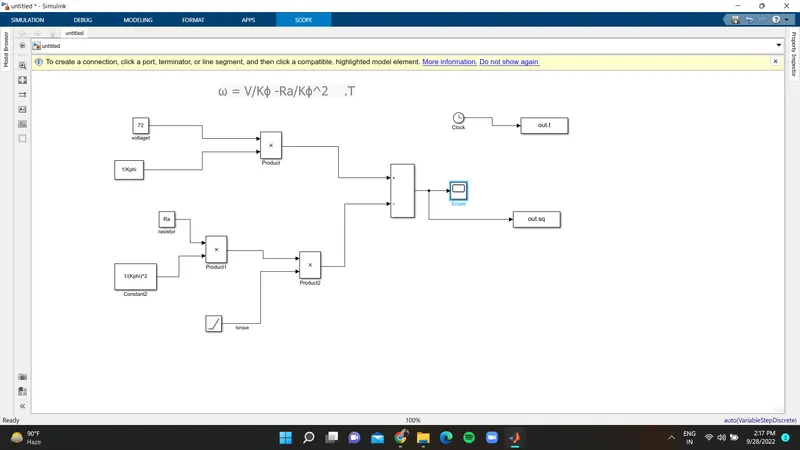
%Develop a mathematical model of a DC Motor for the below equation using Simulink.
%Armaturevoltage
v = 72
%kphi modeling constant
Kphi = 0.7
%armature resistance
Ra = 0.5
%speed calculated is
w = 38.25 %rad/sec
%torque equation
T1 = 32.16
T2 = 34.27
given in matfile
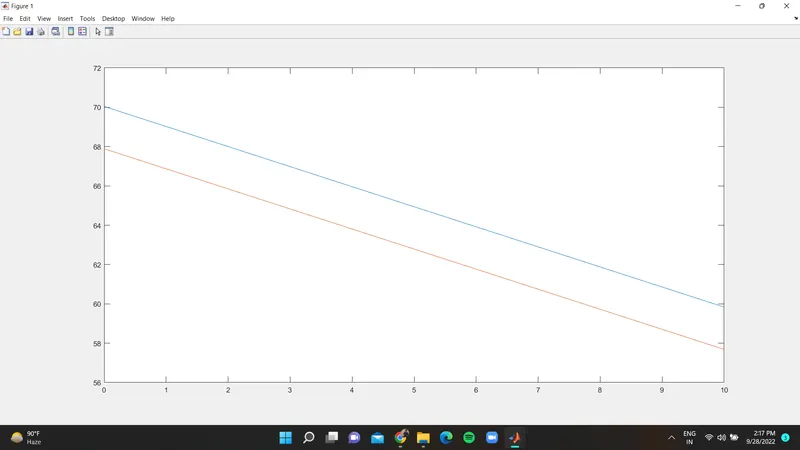
bule and red line represent torque vs speed graph at diffrent values
4........................
- In the beginning, the author describes the dominance of Internal Combustion Engines (ICE) in the world of the automobile industry and also discusses different types of engines. He explains that all engines were similar and it was up to the user to select according to their requirement. He also speaks about induction motors and brushless DC motors and presents his view that these two technologies will be widely used for the coming years.
- Then he explains the working of both a 3-phase induction motor and a brushless DC motor.
- Now the author has done a comparison between these two technologies and stated some advantages and disadvantages of each.
- An induction motor have some advantages like: it has no magnets. The motor has the ability to start under load. No inverter is needed. Some disadvantages of Induction motors are: They cannot operate from DC; AC is a must. Shaft speed is proportionate to line frequency. Hence, when used with utility power, they are constant-speed machines. When operated from utility power, they have limited starting torque and somewhat limited running peak torque capabilities, when compared to DC-type machines.
- Brushless DC motors have some advantages like much less rotor heat is generated with the DC brushless drive. The peak point energy efficiency for a DC brushless drive will typically be a few percentage points higher than for an induction drive. Some disadvantages of a Brushless DC motor are: as machine size grows, the magnetic losses increase proportionately and part load efficiency drops. Permanent magnets are expensive and difficult to handle due to very large forces that come into play when anything ferromagnetic gets close to them.
-
DC Brushless Induction motor require an absolute position sensor require an absolute position sensor less rotor heat is generated, Rotor cooling is easier and peak point efficiency higher.
operate at unity power factor
power factor is about 85 %,
peak point efficiency higher compare to DC Brushless
strength of the magnetic field produced by the permanent magnets would be adjustable.
to get max torque the magnetic field should max at low speed maintained by the inverter and motor current low
no magnets and B fields are “adjustable,” since B is proportionate to V/f (voltage to frequency).efficiency is maximized due to low magnetic losses Average efficiency is low Average efficiency is high Permanent magnets are expensive no magnet there is an advantage in cost
....Conclusion :
- we explain the type of power converter used in HEV and EV
- we create the Simulink model in Simulink
- we give the Explain in brief about the author’s perspective on DC brushless motor and induction moto