Week-6 Challenge: EV Drivetrain
- Aim:
- To get to know the types of converters used in HEV and EV vehicles.
- To find the speed using torque-speed relation.
- To get to know about induction and DC brushless motors.
- Objectives:
- To get information on converters for HEV and EV vehicles.
- Find the speed using torque-speed expression.
- Try to find the best options for motors for HEV or EV vehicles.
- Method :
1. Which types of power converter circuits are employed in an electric and hybrid electric vehicle?
- A motor drive consists of a power converter and the controller. The power electronic converter handles the flow of bulk power from the source to the motor input terminals. The controller process the command input and the feedback information to generate the switching signals for power converter semiconductor switches.
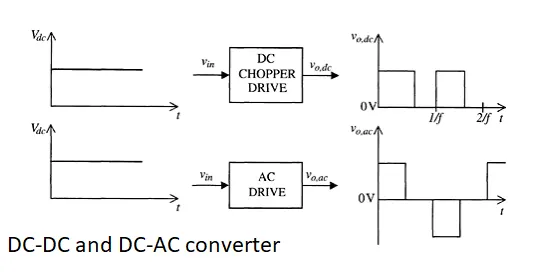
- The power converter can be a DC drive supplying a CD motor or an AC drive supplying an AC motor.
- A DC/DC converter in its basic form converts unregulated DC input voltage at a certain level to regulated DC output voltage at a different level with very high conversion efficiency. These are operated at very high frequency. The switches are turned ON and OFF by pulse width modulation(PWM).
- The power converter is made of high power fast-acting semiconductors devices, such as a bipolar junction transistor. There are some other transistors such as MOSFET, IGBT, SCR, GTO, MCT. These devices are used as on-off electronics switch to convert the fixed supply voltage into a variable voltage and variable frequency supply.
- All these devices have a control input gate or base through which the devices are turned on and off as per the command generated by the controller.
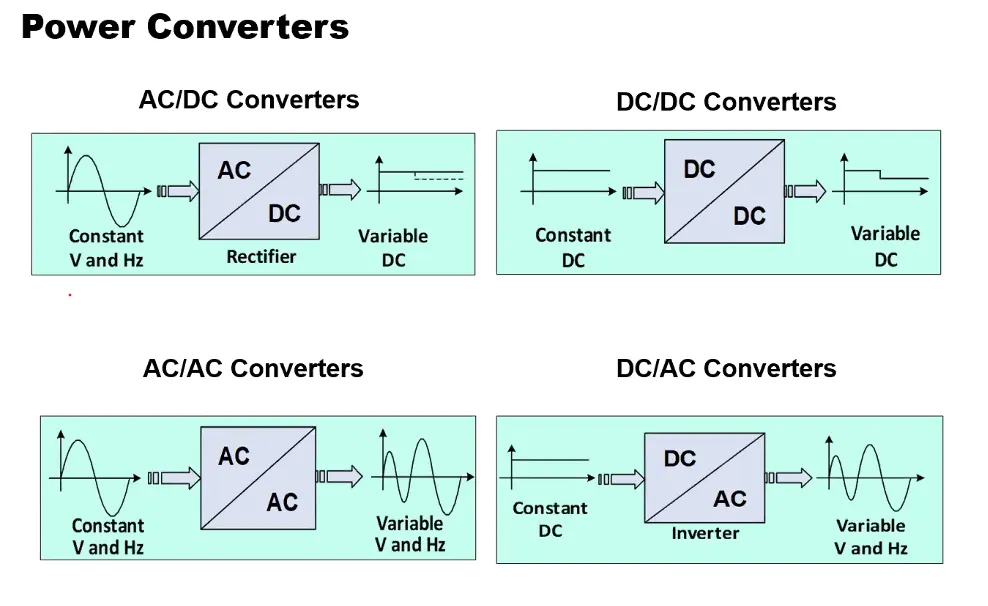
- There are two types of step converters. When a low voltage input is converted into a high voltage output it is a step-up converter. Whereas when a high voltage input is converted into a low voltage output it is a step down converter.
|
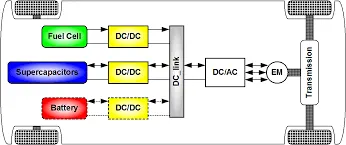
The figure is showing a DC-DC converter for Electric vehicle. |
 |
|
|
2. An Electric Vehicle's powertrain with 72V battery pack in shown in the diagram below. The duty ratio for acceleration operation is 'd1' and for the braking operation the duty ratio is 'd2'.
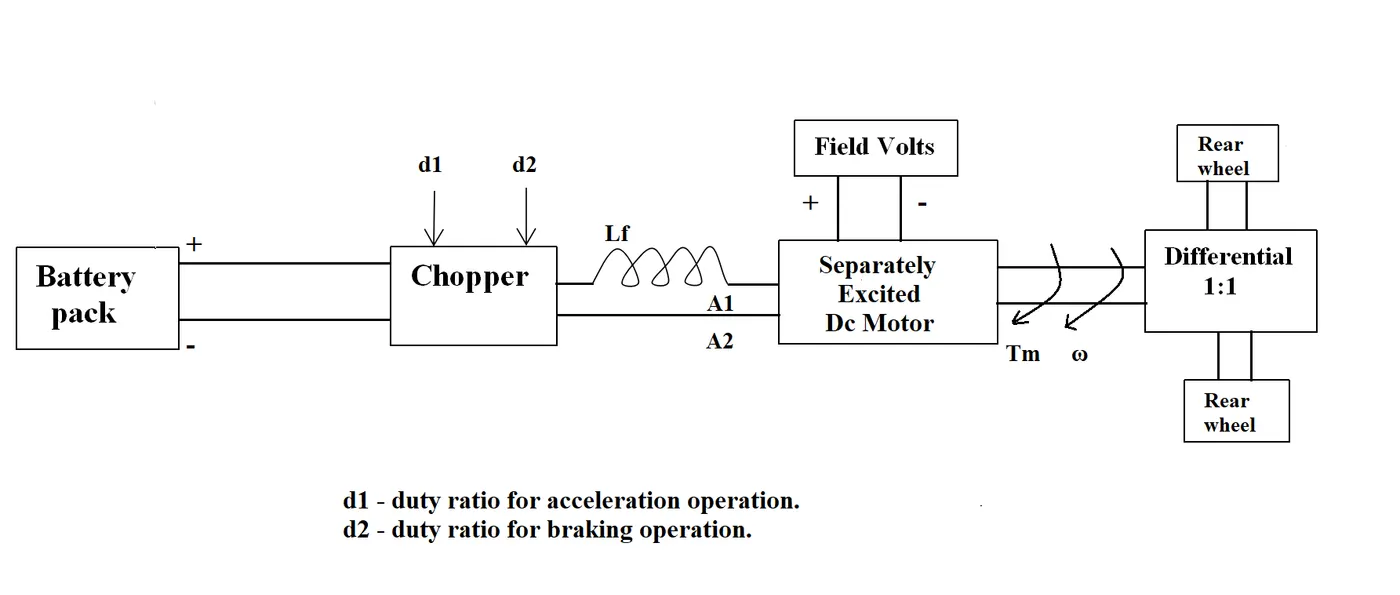
The other parameters of the electric vehicle are given below,
Motor and Controller Parameters:
Rated Armature voltage= 72 V
Rated armature current= 400 A
Ra= 0.5Ω, KΦ= 0.7 Volt second
Chopper Switching frequency= 400 Hz
The vehicle speed-torque characteristics are given by the below equation

What is EV steady-state speed if the duty cycle is 70%?
As the torque formula is given, we need to find the speed in rad/sec. Use the other expression available which is given below:
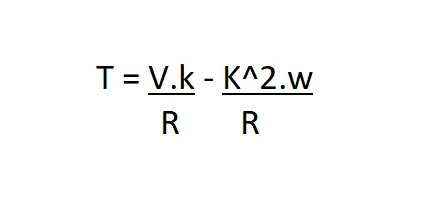
T = torque
V = armature voltage
R = resistance
w = speed rad/sec
Compare the two equations:
24.7 + 0.0051*w^2 = ((v*k)/R) - ((k^2)*w/R)
24.7 + 0.0051*w^2 = (72*0.7*0.7)/0.5 - (0.7^2/0.5)*w = 24.7 + 0.0051*w^2
70.56 - 0.98*w = 24.7 + 0.0051*W^2
w^2 + 192.15*w - 8992.15 = 0
In order to find the roots use following formula

As the speed value can not be negative
w = 38.95 rad/sec
3. Explain in brief about the author’s perspective.
- In the blog of induction and DC brushless motor, the author has mentioned about positives and negative side of both the induction and DC motor. In the blog, the basic construction of both the induction and DC brushless motor is explained.
- In case of DC brushless motor, permanent magnets are used which produces a rotating magnetic field. This magnetic field when induces a current in the conductor. This current results in force generation in the rotor and this results in rotation of the rotor.
- Whereas in case of induction motor, the current is supplied to the stator which results in the generation of emf, when this emf comes in contact with the rotor which is generally a squirrel cage type, this results in current induced in the rotor. Unlike the DC motor, the rotor consists of conductors plates and placed in a cage-like structure. This also consists of bars around them in which current get induced and the rotor starts rotating.
- One of the main differences is that much less rotor heat is generated with the DC brushless drive. Rotor cooling is easier and peak point efficiency is generally higher for this drive. It is mentioned that the DC brushless can drive at unit power factor, whereas the best power factor for the induction drive is about 85%.
- In case of DC brushless motor, the strength of the magnetic field is adjustable. When at low speed the maximum torque is required magnetic field should be maximum, i.e. inverter and motor current maintained at their lowest optimize efficiency. Whereas there is no such adjustment in case of induction motor.
- As machine size grows, magnetic losses increases proportionally and part load efficiency drops. In case of induction motor, as machine size grows, losses do not necessarily grow.
- The construction of DC brushless motor is costly compared with an induction motor, due to the use of permanent magnets.
- However thought the speed variation of induction motor depends upon the frequency input, it is difficult to control.
- Learning Outcome:
- Types of converters used in HEV and EV vehicles.
- To find the velocity using the torque-speed expression.
- To get to know about the induction and DC motor and try to find the best options available.