Week-6 Challenge: EV Drivetrain
Question No.: 01
Which types of power converter circuits are employed in an electric and hybrid electric vehicle?
We know generally, there are three types of Electrical vehicles.
- Hybrid Electric vehicle
- Plugin Hybrid Electric vehicle
- Battery Electric vehicle
1. Hybrid Electric vehicle:
Hybrid Electric Vehicles, or HEVs, have both an Internal Combustion (IC) engine and an electric motor to drive the car.
All energy for the battery is gained through regenerative braking, which recoups otherwise lost energy in braking to assist the IC engine during acceleration.
In a traditional IC engine vehicle, this braking energy is normally lost as heat in the brake pads and rotors
Regular hybrids cannot plug into the grid to recharge and cannot charge externally.
2. Plug-in Hybrid Electric vehicle:
Plug-in Hybrid Electric Vehicles, or PHEVs, have both an IC engine and electric motor to drive the car.
Like regular hybrids, they can recharge their battery through regenerative braking.
They differ from regular hybrids by having a much larger battery and being able to plug into the grid to recharge.
3. Battery Electric vehicle:
Battery Electric Vehicles also called BEVs and more frequently called EVs, are fully electric vehicles with rechargeable batteries and no IC engine.
BEVs are zero-emissions vehicles, as they do not generate any harmful tailpipe emissions or air pollution hazards caused by traditional IC-powered vehicles.
All energy to run the vehicle comes from the battery pack which is recharged from the grid.
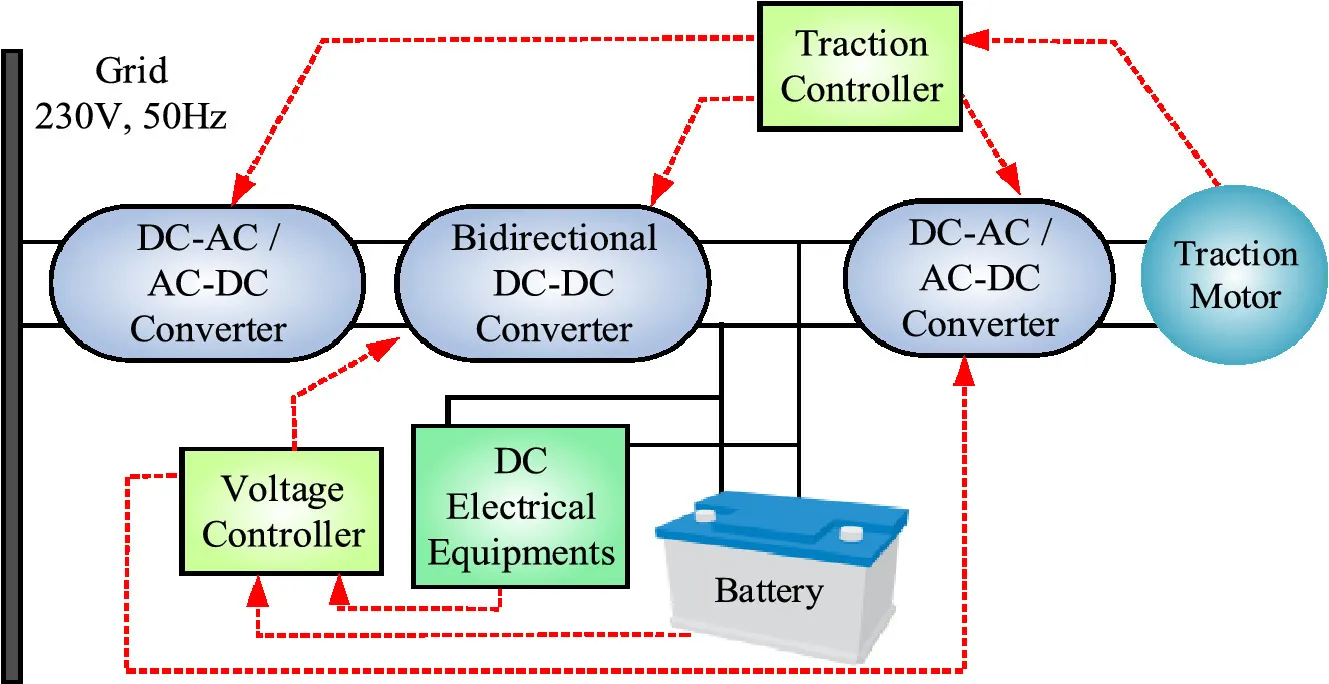
The above image show the Control scheme of the EV
But in all these types of vehicles, we use basically 3 types of power converters. They are
- AC-DC converter
- DC-DC converter
- DC-AC converter
1. AC-DC Converter:
AC-DC converter (Onboard charger) is used for charging the vehicle.
As the battery stores energy in the form of DC, so AC-DC power converter is required. They are generally used in PHEV and PEV-type vehicles
2. DC-DC Converter (Chopper):
We know lights, indicators, and other signal generators require only low voltage (12V or 24 V) So the battery energy (DC type high range) will be converted into Low voltage DC by a DC-to-DC converter (Chopper).
3. DC-AC Converter (Inverter):
DC-AC converter is used to convert the battery energy (DC type) to AC to supply the motor (AC motor used).
Therefore, the converted energy (AC) is used for motor operation.
--------------------------------------------------------------------------------------------------------------------
Question No.:02
An Electric Vehicle's powertrain with a 72V battery pack in shown in the diagram below. The duty ratio for acceleration operation is 'd1'; for the braking operation, the duty ratio is 'd2'.
Given:
Motor and controller parameters,
Rated Armature voltage= 72 V
Rated Armature current= 400 A Ra= 0.5 Ω
KØ= 0.7 Voltage Seconds
Chopper Switching frequency= 400 Hz
The vehicle Speed Torque equation is given as: Tv: 24.7+ (0.0051) ω^2
Solution:
Given Duty cycle = 70% = 0.7
Voltage = Rated Armature Voltage * Duty Cycle
= 72*0.7 = 50.4 Volts
T-motor Torque
KØ=Motor Constant
ω">ω-Angular Speed of Motor
Torque-Speed characteristics of DC motor: Tm = (V KØ/Ra) -(((KØ)^2/Ra) *ω">ω
Tm = ((50.4) *0.7)/0.5 – ((0.7) ^2/(0.5))*ω">ω
Tm = 70.56 – 0.98 ω">ω EQ (1)
Tv = 24.7 + (0.0051) ω">ω^2 EQ (2)
Equating the above the equations (1) & (2) 24.7 + (0.0051) ω">ω^2 = 70.56 – 0.98
So, we get quadratic equation
0.0051 ω ^2 + 0.98 ω – 45.86 = 0
To find roots to Solve the above equation which is in form of a quadratic equation
ax^2 + bx + c = 0 by using these formulae:
x= (-b±√b2-4ac)/2a
Substituting the equations values in above formula:
ω = 0.98± ((√ (0.98) ^2 – 4*0.0051 * 45.8) / 2*0.0051
Here we get ω = 38.92 rad/sec or 231.02 rad /sec
Steady-state of the angular speed is 38.915 rad. /sec. or 371.68 RPM (Approx.).
(0.1047 radians per second is equal to approximately 1 rpm)
---------------------------------------------------------------------------------------------------------
Question No.: 03
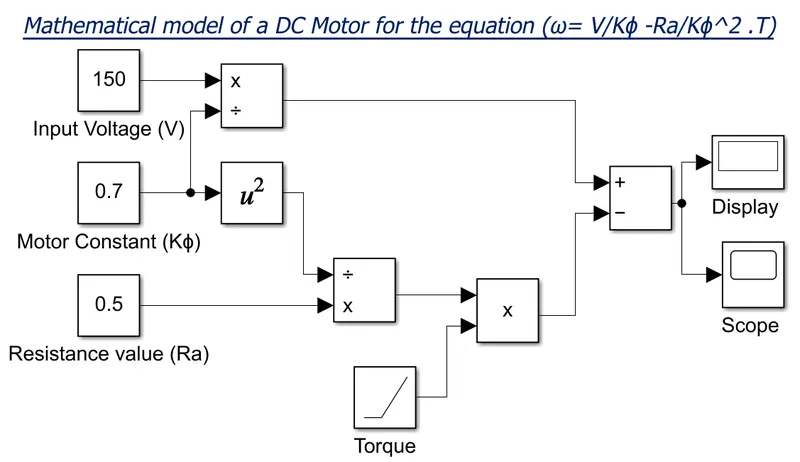
3. Develop a mathematical model of a DC Motor for the below equation using Simulink.
ω">ω= V/Kϕ">ϕ -Ra/Kϕ">ϕ^2 .T
Please refer the file name "MathematicalModel2019a.slx" from the attachment files.
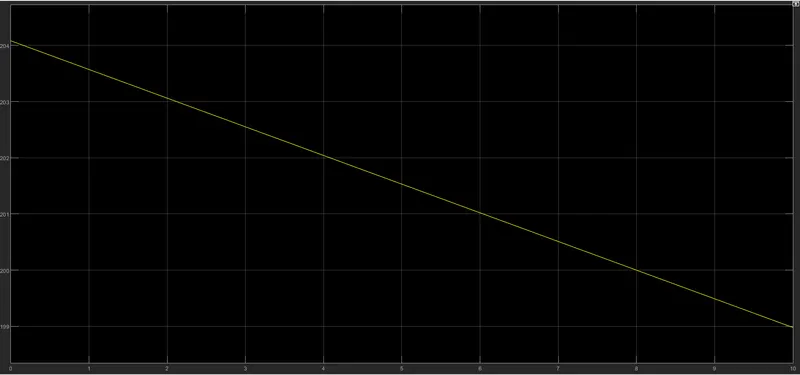
Scope Output:
Please refer the file name "Scope Output.fig" from the attachment files.
----------------------------------------------------------------------------------------------------------
Question No.:04
Refer to the blog on below topic & Explain in brief about author’s perspective.
Induction Versus DC brushless motors by Wally Rippel, Tesla
Brief note on author’s perspective:
Induction Motor Vs BLDC
The author discusses the two technologies with its feature in the operations.
- DC Brushless Drives and
- Induction Motor
The electric vehicles’ future technology cannot be predicted easily. Gas-powered vehicles’ engines are not all same and there are no best engine types of people choose according to their requirements such as price and performance these also come under electric vehicles but in nearby future EVs, drives may get stability.
The author said that both induction motors and BLDC have advantages as well as disadvantages.
The induction motor does not have permanent magnets and it is connected to 3-phase utility power; torque is produced at the outset the motor can start under load, so the inverter is not needed so it can be compatible with the conventional vehicles. If induction motor size increases the losses will not increase. With the help of an induction motor drive, we can achieve the required high performance.
Permanent magnets are expensive and permanent magnet rotors are also difficult to handle due to very large forces that come into play when anything ferromagnetic gets close to them. This means that induction motors will likely retain a cost advantage over PM machines.
Induction machines have no magnets and B fields are “adjustable,” since B is proportionate to V/f (voltage to frequency). This means that at light loads the inverter can reduce voltage such that magnetic losses are reduced, and efficiency is maximized
Conclusion:
He concludes that DC brushless drives will likely continue to dominate in the hybrid and coming plug-in hybrid markets, and that induction drives will likely maintain dominance for the high-performance pure electrics.
The hardware is common for both drives could mean that we will see induction and DC brushless live and work side by side during the coming golden era of hybrid and electric vehicles.
-------------------------------------------------------------------------------------------------------------