Week-3 Challenge: ADVISOR Tool
Introduction to ADVISOR tool:
A powerful tool for the analysis of advanced and conventional vehicles just got better with the release of ADVISOR 2002.
ADVISOR (ADvanced VehIcle SimulatOR) was created by the U.S. Department of Energy's National Renewable Energy Laboratory's (NREL) Centre, for Transportation Technologies and Systems. It's a flexible modeling tool that rapidly assesses the performance and fuel economy of conventional, electric, hybrid, and fuel cell vehicles. The user changes component and vehicle specifications-such as electric motors, batteries, engines, and fuel cells-and ADVISOR simulates the vehicle's response under different driving conditions. This cutting-edge tool runs in the MATLAB/Simulink software environment.
------------------------------------------------------------------------------------------------------------------------------
Question No.: 01
For EV_defaults_in file, if cargo mass is 500 kg with all other default conditions, can the vehicle travel for 45 km with FTP drive cycle? Conclude your observations.
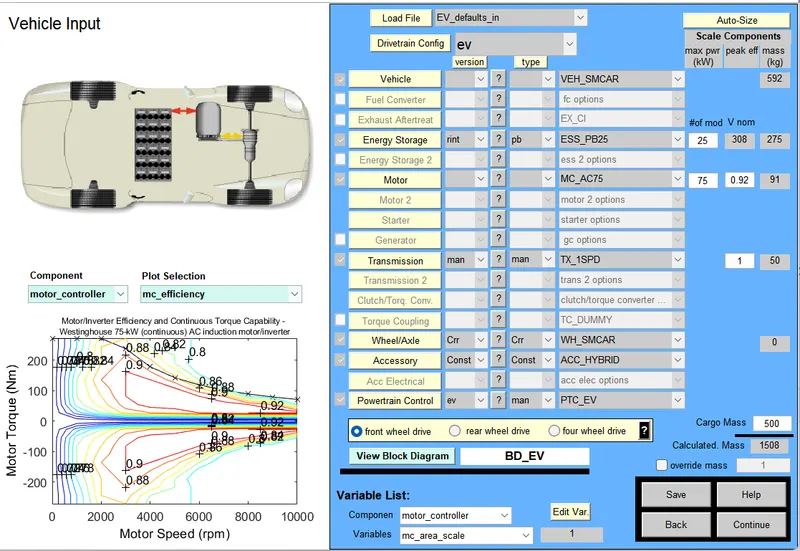
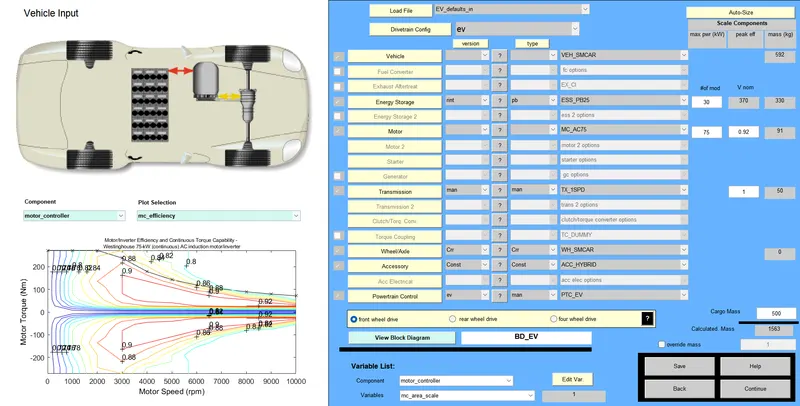
i) Load file the "EV_default_in" and change the cargo mass as 500kg as shown below and keep all default values as it is.
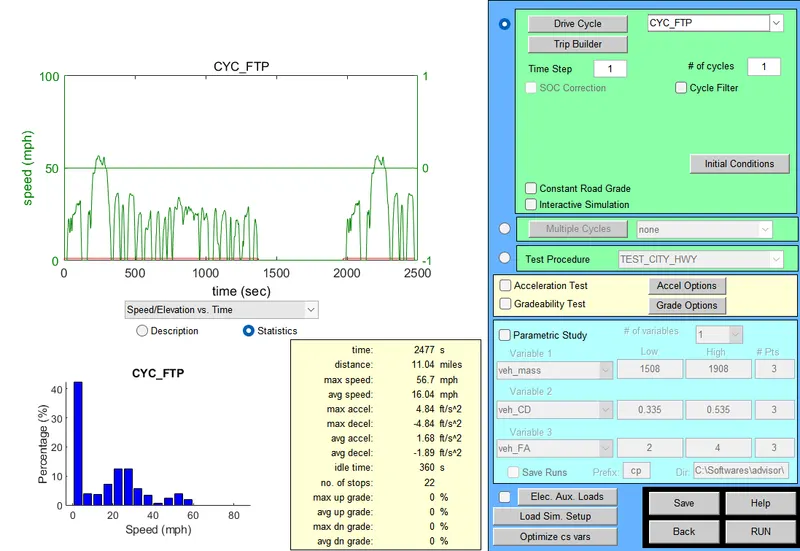
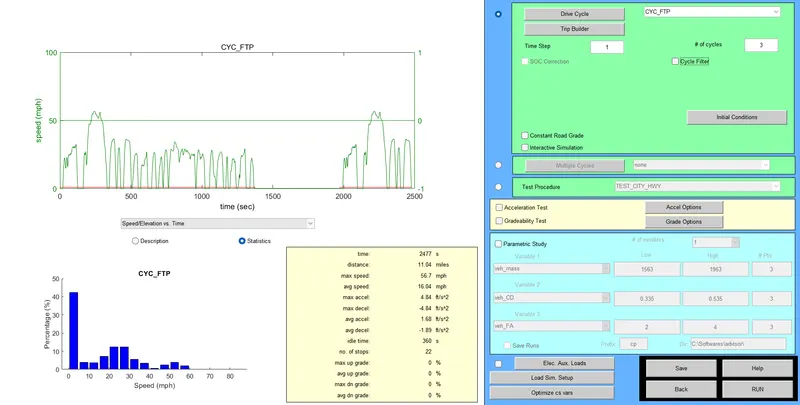
ii) First we will run with one "CYC_FTP" cycle as shown in below.
Results figure (01):
(Refer file name "cycle1 output")
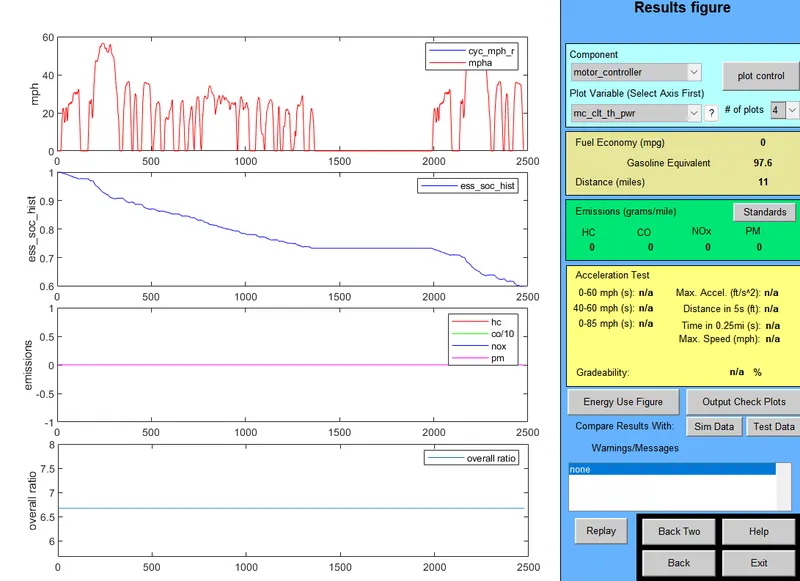
From the above image, it is clear that the electric vehicle travels a distance of 11 miles which is equal to 17.7km for one complete cycle, so we may increase the number of cycles to 3 as shown below.
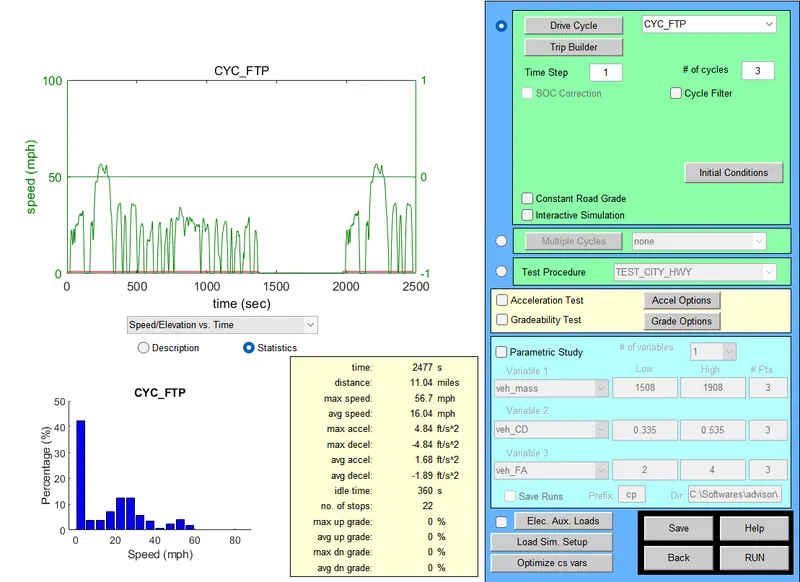
Results figure (02): [for 3 driving cycle]
(Refer file name "cycle3 output")
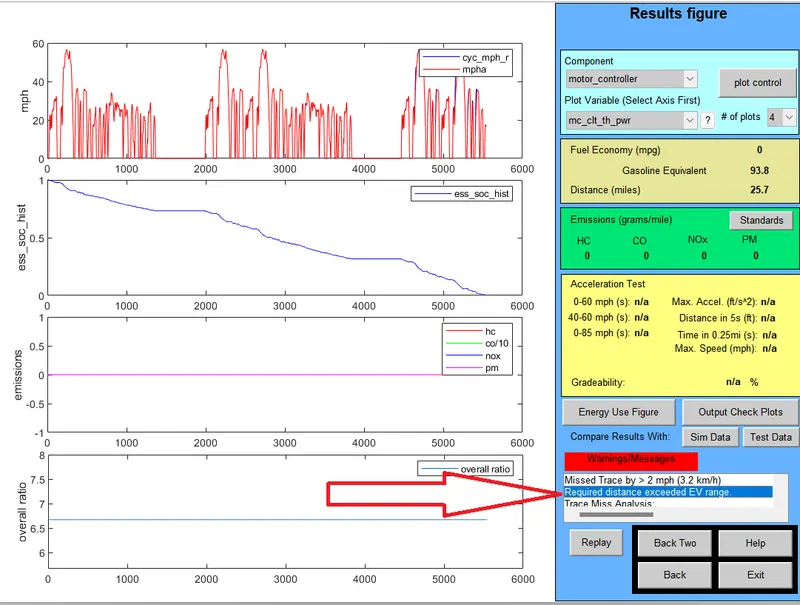
From the above image, found that the electric vehicle traveled to a distance of 25.7 miles or 41.36km and the 100 percentage of battery capacity is not sufficient to complete the three diving cycles. we received the warning message as "Required distance exceeded EV range, which means that the battery was fully discharged before completing the three-cycle. so let's conclude that the electric vehicle travel up to the maximum distance of 41.36km in the FTP driving cycle.
--------------------------------------------------------------------------------------------------------------------------------------------------------------------
Question 02:
In the above case, try changing the battery capacity and repeat the simulation.
i) Increasing the battery module from 25(Default value) to 30.
ii) Due to increasing the battery module the Vnom, is also increased from 308 VDC to 370 VDC as shown in the below image.
Results Figure: (for the battery module capacity of 30 No's)
Refer file name "cycle3 battery module 30 output.pdf"
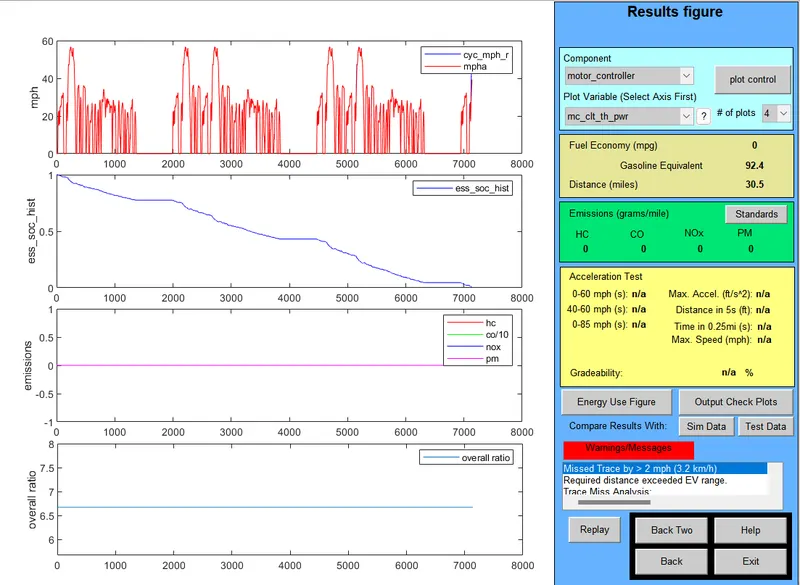
From the above image, found that the electric vehicle traveled to a distance of 30.5 miles or 49.08 km and the 100 percentage of battery capacity is not sufficient to complete the three diving cycles.
Results Figure: (for the battery module capacity of 28 No's)
Refer file name "cycle3 battery module 28 output.pdf"
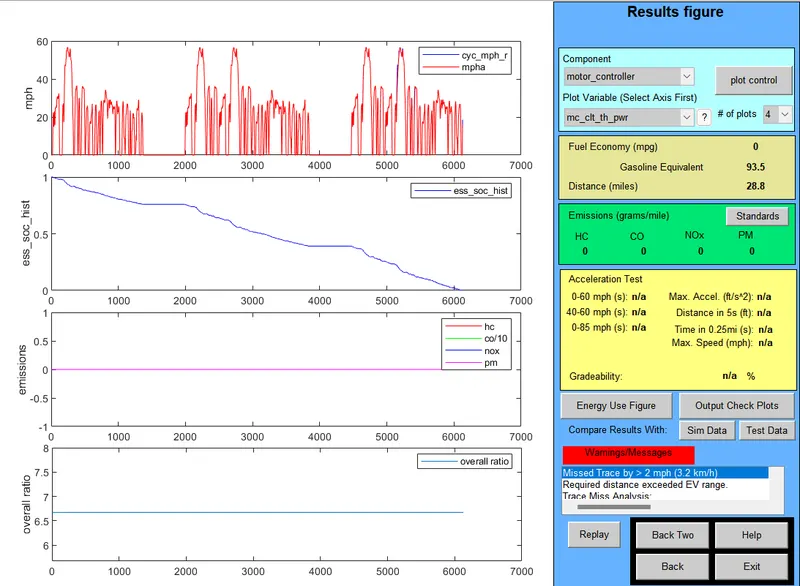
From the above image, found that the electric vehicle traveled to a distance of 28.8 miles or 46.35 km. so, a minimum of 28 battery modules is required to cover the distance of 45km in the FTP driving cycle.
the following results were observed for the Electric Vehicle "EV_default_in" with a cargo mass of 500kg
| Sl.No | No. of Battery Module | Vnom | Driving Cycle count | Electric Vehicle travelled distance (Max.) in km |
| 1 | 25 | 308 VDC | 1 | 17.7 |
| 2 | 25 | 308 VDC | 3 | 41.36 |
| 3 | 28 | 345 VDC | 3 | 46.35 |
| 4 | 30 | 370 VDC | 3 | 49.08 |
--------------------------------------------------------------------------------------------------------------------------------------------------------------------
Question No.:03
Perform gradeability test with PRIUS_Jpn_defaults_in file
Compare your results in table and conclude.
About Prius:
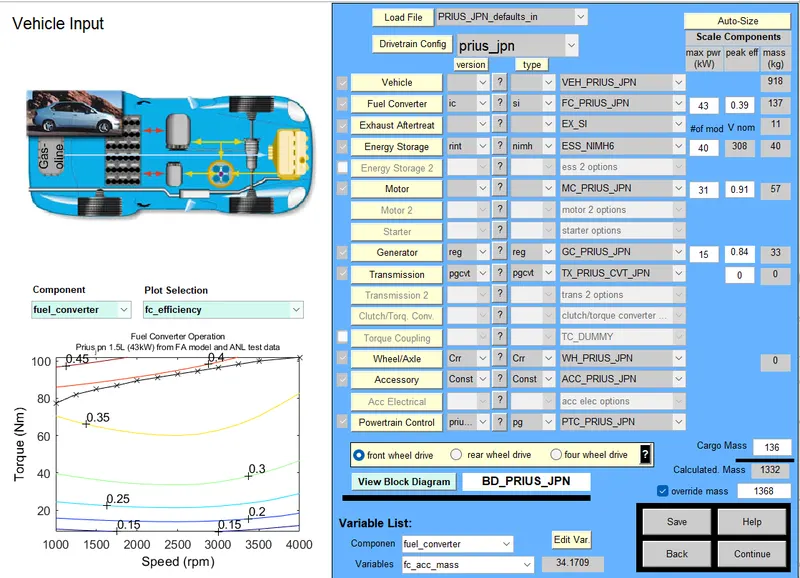
The Prius is a power-split or series-parallel (full) hybrid, sometimes referred to as a combined hybrid, a vehicle that can be propelled by gasoline or electric power or both. Wind resistance is reduced by a drag coefficient of Cd=0.25 (0.29 for 2000 model) with a Kammback design to reduce air resistance. Lower rolling-resistance tires are used to reduce road friction.
The below image shows the default parameter for the "PRIUS_JPN_defaults_in" Vehicle.
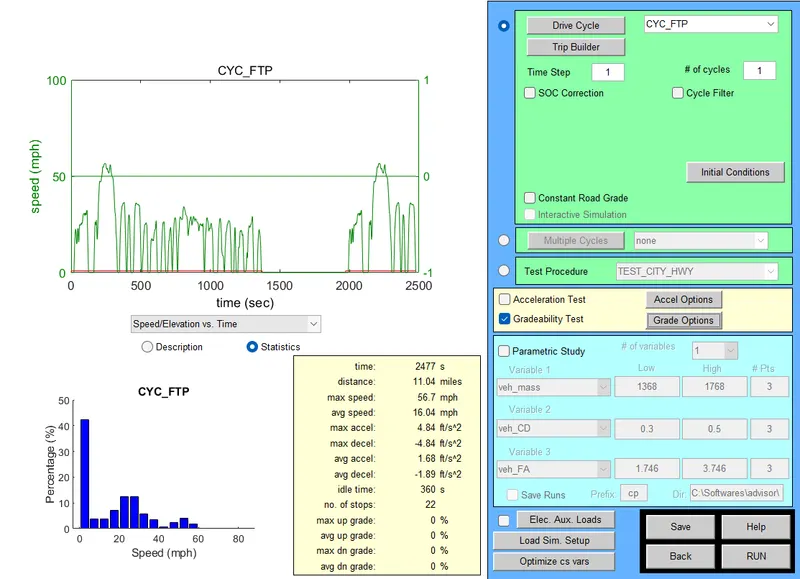
Drive Cycle : ("CYC_FTP")
For our gradeability test, we are using the FTP drive cycle, as shown in the below image.
From the "Grade Test Advance Option" window we are going to set the Speed value and duration: (as shown below image)
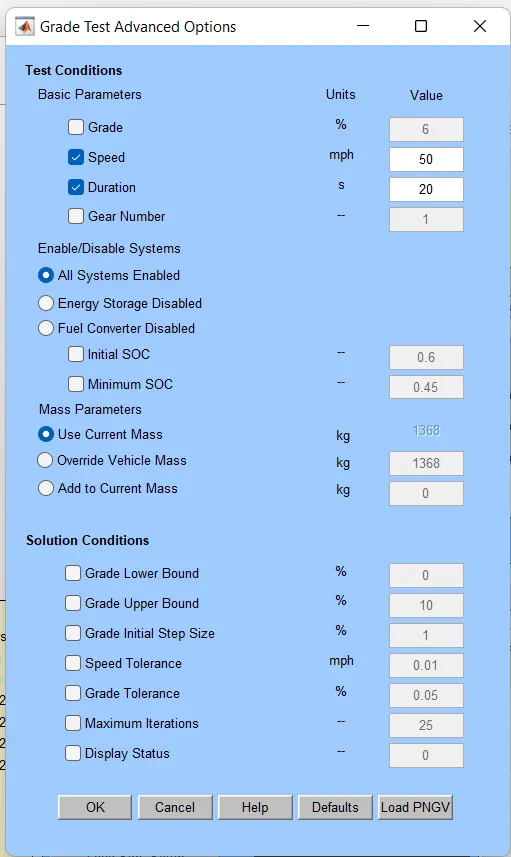
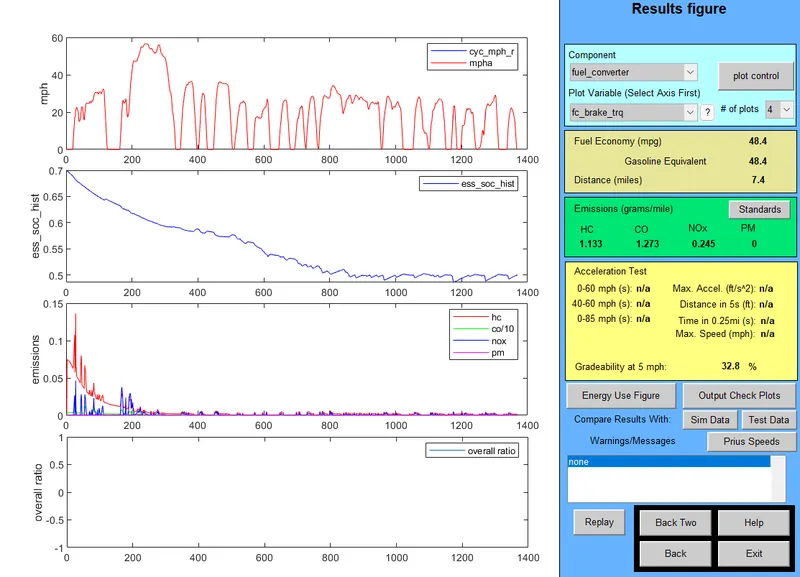
The below Results figure shows the result for the speed 5mph and duration of 10sec.
(Refer file name "gradeability at 5mph 10sec.pdf")
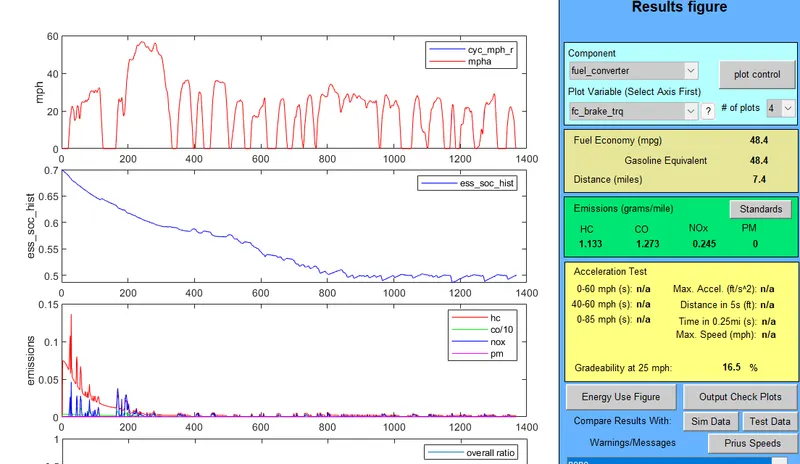
The below Results figure shows the result for the speed 25mph and duration of 10sec.
(Refer file name "gradeability at 25mph 10sec.pdf")
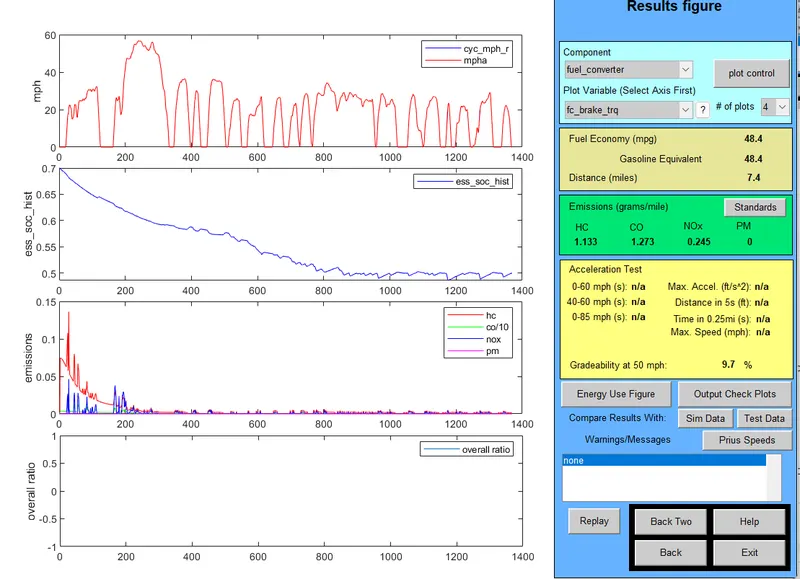
The below Results figure shows the result for the speed 50mph and duration of 10sec.
(Refer file name "gradeability at 50mph 10sec.pdf")
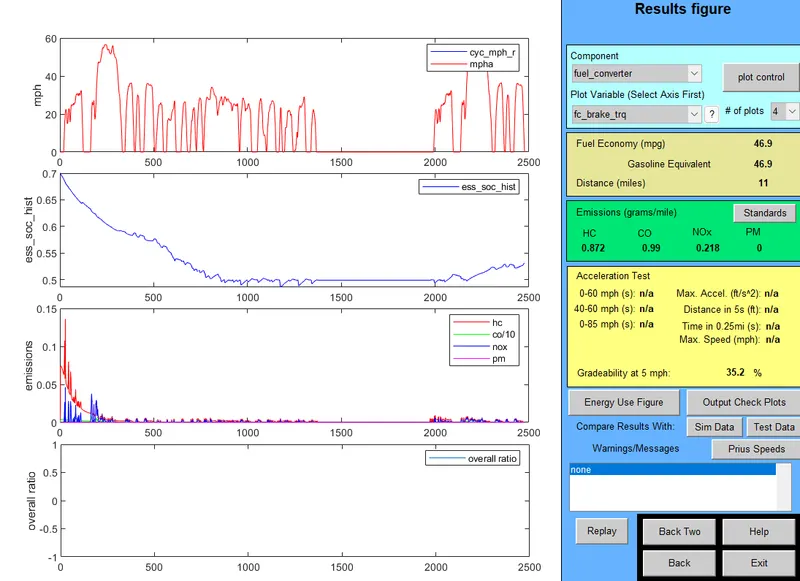
The below Results figure shows the result for the speed 5mph and duration of 20sec.
(Refer file name "gradeability at 5mph 20sec.pdf")
The below Results figure shows the result for the speed 25mph and duration of 20sec.
(Refer file name "gradeability at 25mph 20sec.pdf")
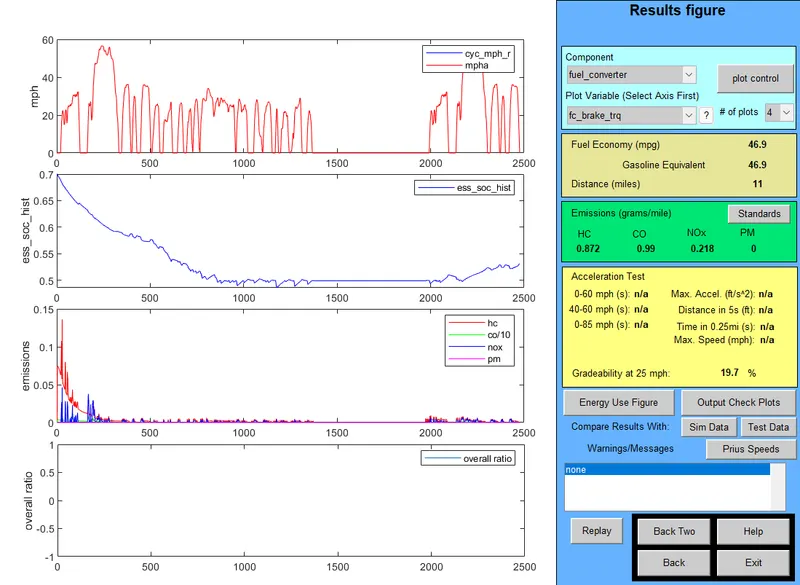
The below Results figure shows the result for the speed 50mph and duration of 20sec.
(Refer file name "gradeability at 50mph 20sec.pdf")
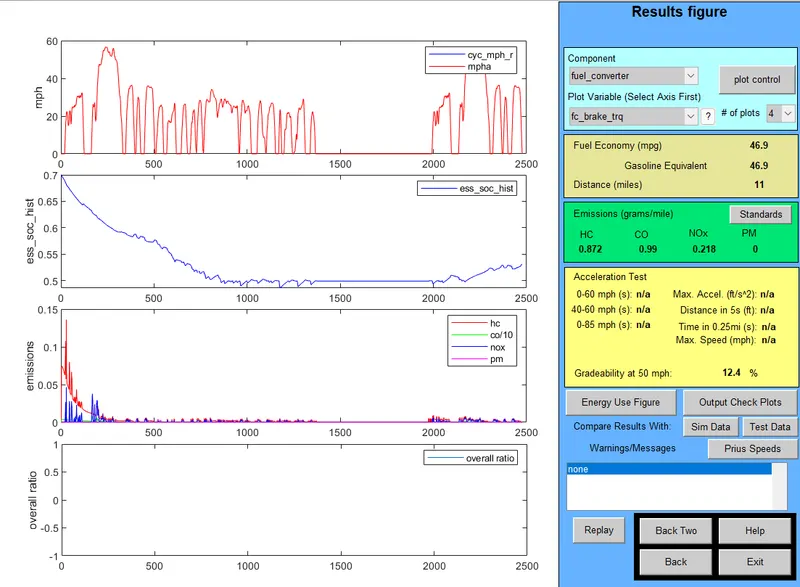
The Gradeability test was conducted from the speed 5mph to 50mph (with 5mph interval) for the duration 10Sec., and 20Sec.
The observations from the test were tabulated for clear understandings
| Sl.No. | Speed in mph | Speed in kmph | Gradeability (%) at 10s Duration | Gradeability (%) at 20s Duration |
| 1 | 5 | 8.04 | 32.8% | 35.2% |
| 2 | 10 | 16.09 | 30.3% | 33.7% |
| 3 | 15 | 24.14 | 24.4% | 27.7% |
| 4 | 20 | 32.18 | 19.8% | 22.9% |
| 5 | 25 | 40.23 | 16.5% | 19.7% |
| 6 | 30 | 48.28 | 14.7% | 17.7% |
| 7 | 35 | 56.32 | 13.0% | 16.0% |
| 8 | 40 | 64.37 | 11.7% | 14.6% |
| 9 | 45 | 72.42 | 10.7% | 13.4% |
| 10 | 50 | 80.46 | 09.7% | 12.4% |
Conclusion:
From the results, it is clear that the vehicle gradeability decreases when the speed of the vehicle increases (for both 10Sec. & 20Sec duration)
---------------------------------------------------------------------------------------------------------------------------------------------------------------