Week-6 Challenge: EV Drivetrain
AIM:
1. Which types of power converter circuits are employed in electric and hybrid electric vehicle?
2. An Electric Vehicle's powertrain with 72V battery pack in shown in the diagram below. The duty ratio for acceleration operation is 'd1' and for the braking operation the duty ratio is 'd2'.
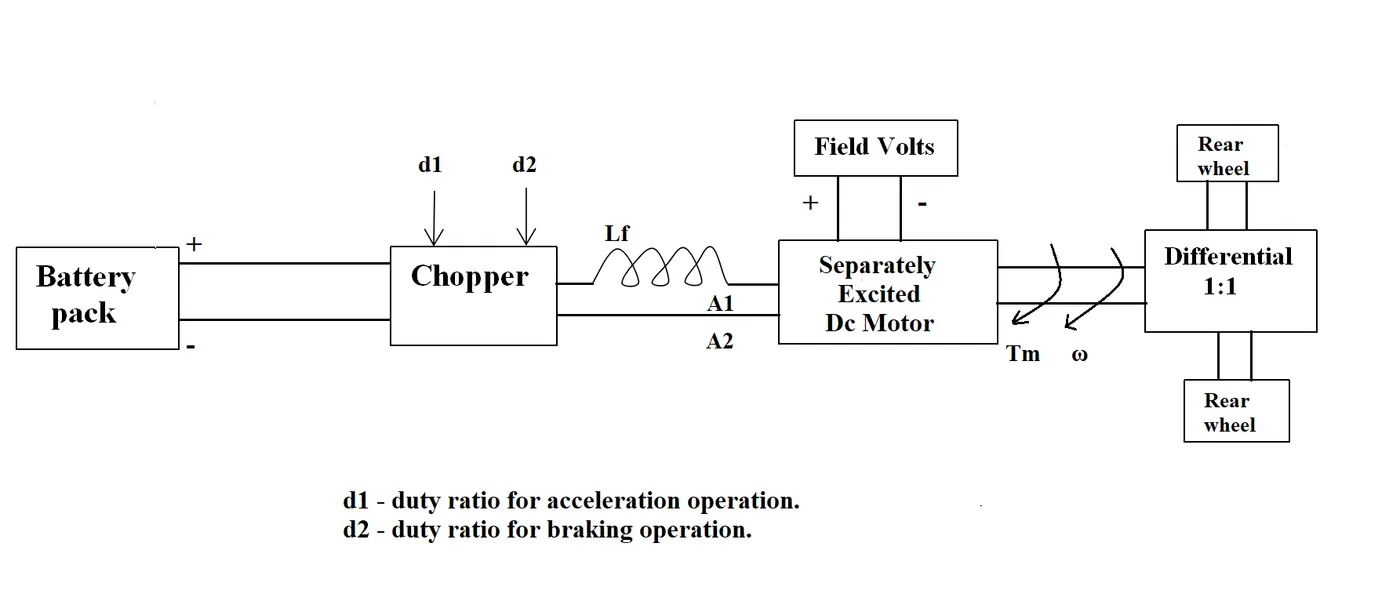
The other parameters of the electric vehicle is given below,
Motor and Controller Parameters:
Rated Armature voltage= 72 V
Rated armature current= 400 A
Ra= 0.5Ω, KΦ= 0.7 Volt second
Chopper Switching frequency= 400 Hz
The vehicle speed-torque characteristics are given by the below equation

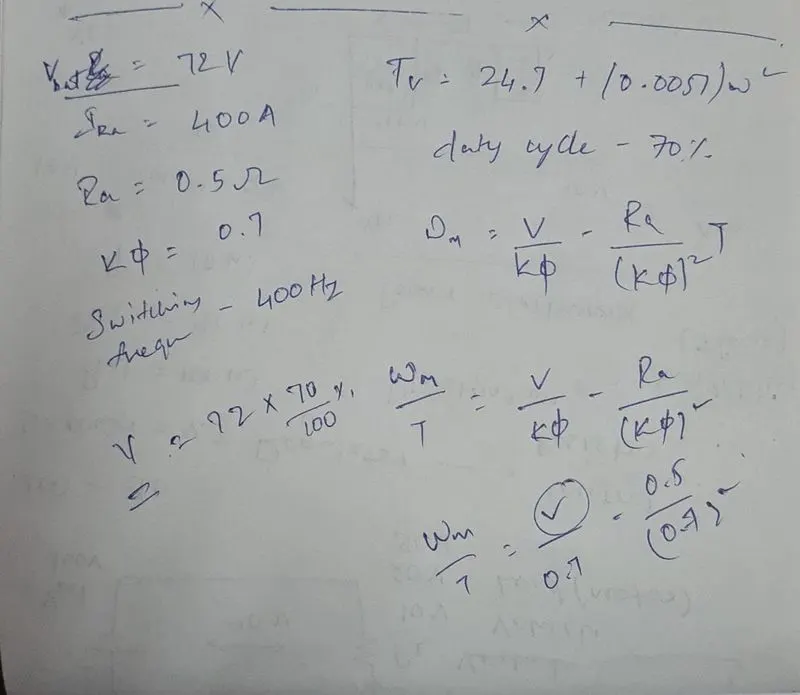
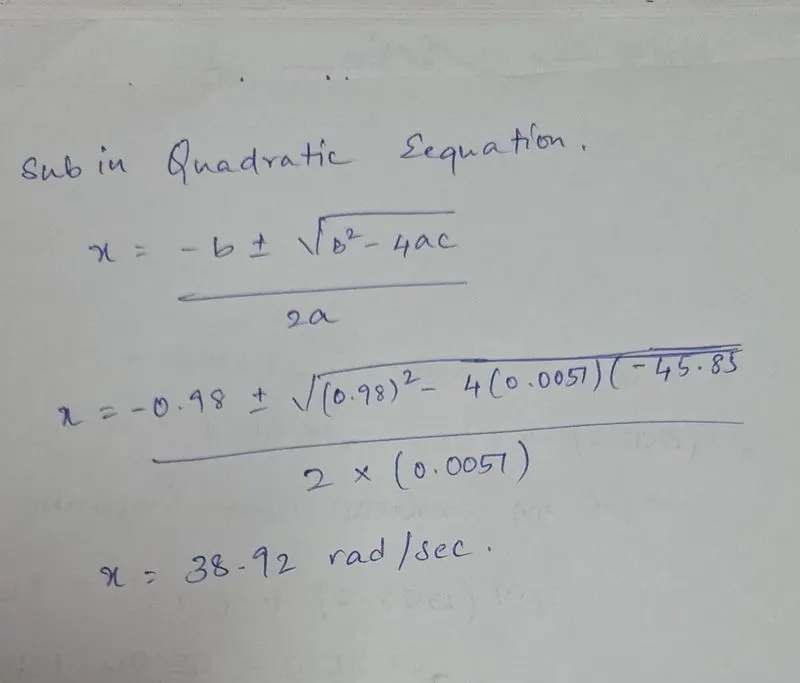
What is EV steady state speed if duty cycle is 70%?
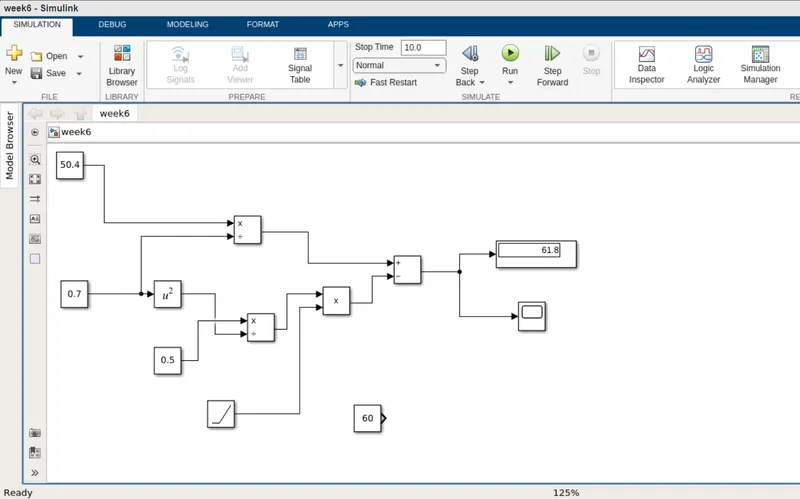
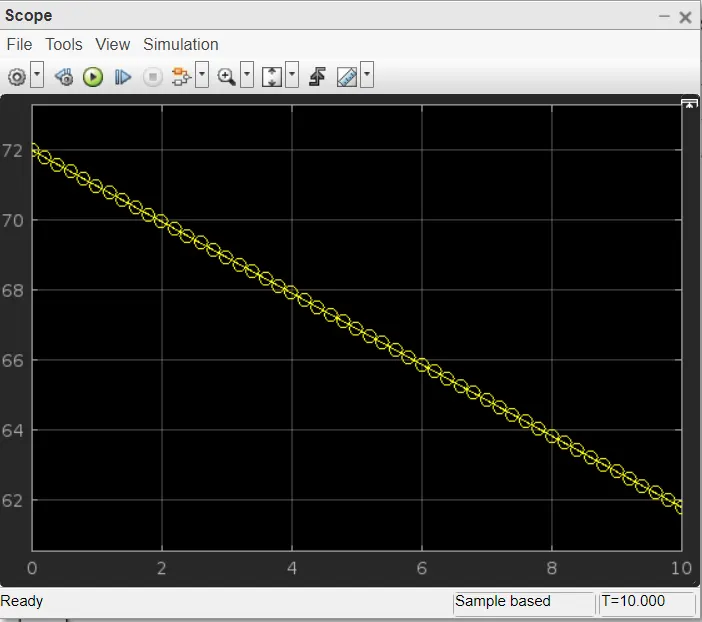
3. Develop a mathematical model of a DC Motor for the below equation using Simulink.
ωω= V/Kϕϕ -Ra/Kϕϕ^2 .T
4. Refer to the blog on below topic:
Induction Versus DC brushless motors by Wally Rippel, Tesla
Explain in brief about author’s perspective.
ANSWER:
1.
Types of power converter circuits are employed in electric and hybrid electric vehicle.
DC/DC converters for electric vehicles
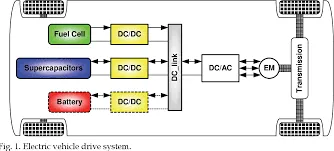
The different configurations of EV power supply show that at least one DC/DC converter is necessary to interface the FC, the Battery or the Supercapacitors module to the DC-link.
In electric engineering, a DC to DC converter is a category of power converters and it is an electric circuit which converts a source of direct current (DC) from one voltage level to another, by storing the input energy temporarily and then releasing that energy to the output at a different voltage. The storage may be in either magnetic field storage components (inductors, transformers) or electric field storage components (capacitors).
DC/DC converters can be designed to transfer power in only one direction, from the input to the output. However, almost all DC/DC converter topologies can be made bi-directional. A bi-directional converter can move power in either direction, which is useful in applications requiring regenerative braking.
The amount of power flow between the input and the output can be controlled by adjusting the duty cycle (ratio of on/off time of the switch). Usually, this is done to control the output voltage, the input current, the output current, or to maintain a constant power. Transformer-based converters may provide isolation between the input and the output. The main drawbacks of switching converters include complexity, electronic noise and high cost for some topologies.
AC/DC converters for electric vehicles
The AC/DC converter consists of a power factor correction (PFC) which converts input AC voltage into DC voltage, an H-bridge circuit which converts the DC voltage into high-frequency AC voltage, a
high-frequency transformer which regulates transformation and insulation, and a circuit which rectifies and smooths high-frequency AC voltage. This circuit diagram has two problems. One is that the
coil parts, such as the transformer and the choke coil, contribute to an increase in the volume and weight of the AC/DC converter. Generally, an AC/DC converter has higher output power than that of a DC/DC converter for driving auxiliaries, and accordingly AC/DC converter’s coil parts occupy a larger space. As the AC/DC converter is alsoequipped with a reactor for the PFC, the coil parts alone weigh as much as 20-30% of the total weight of the AC/DC converter.
A high-efficiency isolated bidirectional AC-DC converter is proposed for a 380-V DC power-distribution system to control bidirectional power flow and to improve its power-conversion efficiency. In addition, design and control methodology of a bidirectional full-bridge CLLC resonant converter is suggested for the galvanic isolation of the DC distribution system. A dead-band control algorithm for the bidirectional DC-DC converter is developed to smoothly change power-conversion directions only by the use of output voltage information. Since most of the output of renewable energy sources is DC, the DC distribution system is mostly used in home appliances because it merges many renewable energy resources. The isolated bidirectional AC-DC converter is proposed for the 380-V DC power-distribution system to control the bidirectional power flow and to improve its power-conversion efficiency. In addition to future works, the isolated bidirectional AC-DC converter is proposed for the high voltage DC power-distribution system to control the bidirectional power flow and to improve its power-conversion efficiency.
2.
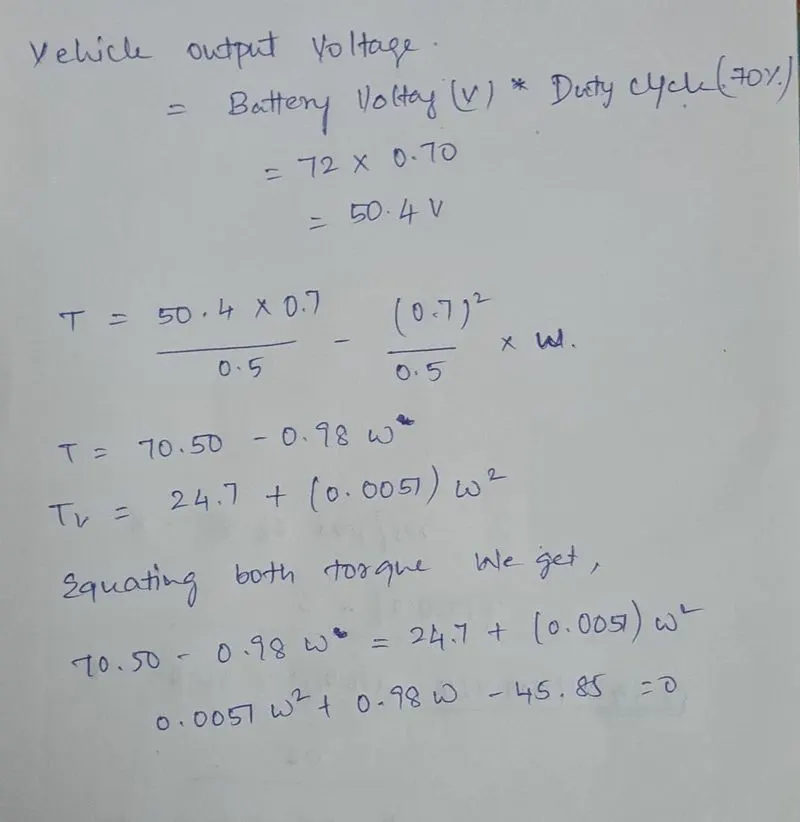
EV steady state speed if duty cycle is 70%.
3.
Mathematical model of a DC Motor for the below equation using Simulink.
ωω= V/Kϕϕ -Ra/Kϕϕ^2 .T
4.
Explain in brief about author’s perspective.
The author starts the blog with comparing the electric vehicle drive with the engine types that are currently available in the market. He stats the proper engine doesn't exsist only choices with priority and this will be the situatiion with the electric vehicle also. As he entail the difference between the most commonly used motor drive in the the automobile industry: the DC brushless motor drive and the induction motor drive.
For DC brushless drive, we are told that their construction implements 2 or more permanat magnet at the rotor to generate a dc magnectic feild it also consist of a stator core. It also uses an inveter for the current control, meaning that it cannot run on a DC power supply as the current direction has to be changed repeatedly in to manitain a constant torque.
For induction motor drive , their rotor has no magnet but instead stacked lamination with buried peripheral conductor which form a 'shorted structure'. It is the current in the stator winding thaat generates a rotating magnetic feild that interacts with the rotor.
Accordingly, an induced voltage exists across the shorted structure that is proportionate to this speed difference between the rotor and electrical frequency. In response to this voltage, currents are produced within the rotor conductors that are approximately proportionate to the voltage, hence the speed difference. Finally, these currents interact with the original magnetic field to produce forces – a component of which is the desired rotor torque.
Both DC brushless and induction drives use motors having similar stators. Both drives use 3-phase modulating inverters. The only differences are the rotors and the inverter controls. And with digital controllers, the only control differences are with control code. (DC brushless drives require an absolute position sensor, while induction drives require only a speed sensor; these differences are relatively small.
On the other hand, induction drive do not have permanent magnets and so they can vary their magnetic feild strength. I used wiht a smart inverter, they can be operated with minimum hysteresis and eddy current losses and maximum efficiency as the magnetic feild strength can be changed according to the requirement by the rotor. These losses do not increase if the size of the induction drive also increasebut as a DC brushless drive it gets bigger. The induction motor can operate up to a approximately 85%.
In conclusion, the author has elobrated the different aspects to compare the induction and DC brushless drive and detailed the advantaged and the disadvantage of both type. As mentoined earlier at the end of the day there is no winner and the winner depends on the customer preference. If a user requires high performance with lesser cost than induction is the best choice. In case if the user wants high peak point efficiency, high power factor and easy control then DC brushless drive would be the smarter choice. Both will have their place in the automobile industry with respective to their application. Rippel believes that due to increase peformance of vehicle, one day both may be used side by side under the hood of vehicle in order to get the best of both drives.