Week 9 - FVM Literature Review
Finite Volume Method (FVM)
Form of discretization based on the integral form of conservation equation over a volume. The method is used in many computational fluid dynamics solvers. "Finite volume" refers to the small volume surrounding each node point on a mesh. These terms are then evaluated as fluxes at the surfaces of each finite volume.
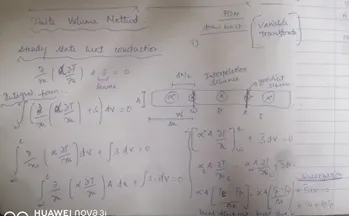
A finite volume method (FVM) discretization is based upon an integral form of the PDE to be solved (e.g. conservation of mass, momentum, or energy). The PDE is written in a form which can be solved for a given finite volume. The computational domain is discretized into finite volumes and then for every volume the governing equations are solved. The resulting system of equations usually involves fluxes of the conserved variable, and thus the calculation of fluxes is very important in FVM.
The step‘s to solve:
- Get the integral form of the equation.
- Apply gauss divergence theorem.
- Apply the discretized from in coding.
Difference:
- The basic advantage of this method over FDM is it does not require the use of structured grids, and the effort to convert the given mesh in to structured numerical grid internally is completely avoided. As with FDM, the resulting approximate solution is a discrete, but the variables are typically placed at cell centers rather than at nodal points. This is not always true, as there are also face-centered finite volume methods. In any case, the values of field variables at vertices are obtained using interpolation.
- FVM and FDM provide discrete solutions. FVM and FDM are generally considered easier to program. FVM are generally expected to provide better conservation properties, but opinions vary on this point also. If you are trying to decide which method to use, then the best path is probably found by consulting the literature in the specific problem area.
Types of interpolation scheme:
1.Upwind interpolation scheme:
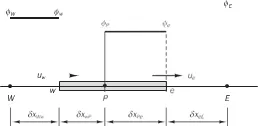
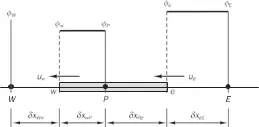
Here, upwind refers to the upstream interpolation.
When the flow is in the positive direction, uw > 0, ue > 0 (Fw > 0, Fe > 0), the upwind scheme sets
[(Dw + Fw) + De + (Fe - Fw)]fP = (Dw + Fw)fW + DefE
When the flow is in the negative direction, uw < 0, ue < 0 (Fw < 0, Fe < 0), the scheme takes
[Dw + (De - Fe) + (Fe - Fw)]fP = DwfW + (De - Fe)fE
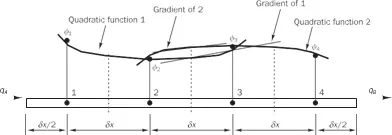
2.QUICK interpolation scheme:
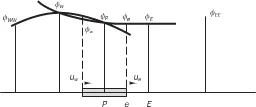
In this case we have to approximate the value of the variable at control volume face centred by quadradic interpolatipon of the values at the three nearest computational node (one down stream and two up stream nodes).
3.The HYBRID interpolation scheme:
The hybrid differencing scheme can easily be extended to two- and three- dimensional problems by repeated application of the derivation in each new co-ordinate direction. It is based on a combination of central and upwind differencing schemes. The central differencing scheme, which is second-order accurate, is employed for small Peclet num- bers (Pe < 2) and the upwind scheme, which is first-order accurate but accounts for transportiveness, is employed for large Peclet numbers (Pe ³ 2). As before, we develop the discretisation of the one-dimensional convection diffusion equation without source terms. This equation can be interpreted as a flux balance equation. The hybrid differencing scheme uses piecewise formulae based on the local Peclet number to evaluate the net flux through each control volume face. The Peclet number is evaluated at the face of the control volume.
4.The POWER-LAW interpolation scheme:
It is a more accurate approximation to the one-dimensional exact solution and produces better results than the hybrid scheme. In this scheme diffusion is set to zero when cell Pe exceeds 10. If 0 < Pe < 10 the flux is evaluated by using a polynomial expression. For example, the net flux per unit area at the west control volume face is evaluated using
qw = Fw[fW - bw(fP - fW)]
5. TVD scheme:
The class of TVD (total variation diminishing) schemes has been specially formulated to achieve oscillation-free solutions and has proved to be useful in CFD calculations.TVD is a property used in the discretisation of equations governing time-dependent gas dynamics problems. More recently, schemes with this property have also become popular in general-purpose CFD solvers. Fundamentals of the development of TVD methodology involves a fair amount of mathematical background.
FLUX LIMITERS:
Flux limiters are used in high resolution scheme and numerical schemes used to solve problems in science and engineering, particularly fluid dynamics, described by partial differential equation (PDE's). They are used in high resolution schemes, such as the MUSCL scheme, to avoid the spurious oscillations that would otherwise occur with high order spatial discretization schemes due to shocks, discontinuities or sharp changes in the solution domain. Uses of flux limiters, together with an appropriate high resolution scheme, make the solutions total variation diminising.

where,  and
and  represent edge fluxes for the ith cell. If these edge fluxes can be represented by low and high resolution schemes, then a flux limiter can switch between these schemes depending upon the gradients close to the particular cell, as follows,
 ,
, ,
,
where
 low resolution flux,
 high resolution flux,
 flux limiter function,
and  represents the ratio of successive gradients on the solution mesh, i.e.,
 .
.
CONCLUSION:
The main advantage of the interpolation scheme is that it allows numerical approximations. As we convert the divergence term into surface integrals and divergence theorem, the theorem states that the outward flux at closed suface is equal to that of the volume integral.It is also used to convert volume integrals in governing equations into the surface intergrals. A special way of discretization by, constructing new data points within the range of a discrete set of points.Each term can be treated differently to yeild different accuracies.