Week-6 Challenge: EV Drivetrain
TASK-1
TYPES OF POWER CONVERTERS EMPLOYED IN EV AND HEV
TYPES OF POWER CONVERTERS USED IN EV AND HEV:
Types of power electronic converters are used in electric vehicles and hybrid electric vehicles are Rectifier, Chopper, Inverter.
RECTIFIER:
Rectifier is used to convert AC power to pulsating DC power. In EV and HEV vehicles to charge the battery required DC power so, we will use rectifier in charging circuit for convert AC power to DC power.
Different types of rectifiers are
- Half wave rectifier
- Full wave rectifier
Full wave bridge type rectifier is used in the charging application.
CHOPPER:
Chopper circuits are known as DC-to-DC converters. Similar to transformers of the AC circuit, Choppers are use to step up and step down the voltages. They change the fixed DC power to Variable DC power. Using these, DC power supplied to the devices can be adjusted to the required amount.
Different types of Choppers are
- Buck type chopper (step down chopper)
- Boost type chopper (step up chopper)
- Buck Boost type chopper (step up and step-down chopper)
Choppers are also used in battery charging circuit of EV and HEV vehicles and also used to control the speed of the DC motors.
Used for much lower voltage applications like radio, displays, dashboard read outs, air conditioning.
INVERTER:
Inverter is a power electronic device which is used to convert DC voltage into AC voltage.
Different types of Inverters are
- Square wave inverter
- Modified sine wave inverter
- Sine wave inverter
In EV and HEV vehicles Inverter is used to give AC supply to induction motor from Battery. And also it is used to connect to 3- terminal DC motor from a two terminal battery supply.
TASK-2
EV STEADY STATE SPEED
SOLUTION:
Given data
Rated armature voltage= 72V
Rated armature current= 400A
Ra= 0.5ohm
Kφ= 0.7volt sec
Chopper switching frequency= 400Hz
Duty cycle (d)= 0.7
The average output voltage is
Vo= Vi*d
Vo= 72*0.7
Vo=50.4V
The vehicle speed torque characteristics are given by the equation
TV=24.7+(0.0051) w2 -------------- Let eqn-1
But we know that the derived formula for torque-speed characteristics equation is
T= (V* Kφ/ Ra)- (w* (Kφ)2/ Ra)
T= (50.4*0.7/0.5) -(w*(0.7)2/0.5)
T= 70.56 -0.98w -------------- Let eqn-2
By solving the eqn-1 and eqn-2 we get,
24.7+(0.0051) w2 = 70.56 -0.98w
(0.0051) w2+0.98w-45.86=0
Above equation is like quadratic equation ax2+bx+c=0,
We know that x= (-b±(sqrt(b2-4ac)))/2a
So, W1= (-0.98+(sqrt (0.982-4*0.0051*(-45.86))))/ (2*0.0051)
W1= 38.9 rad/sec.
W2= (-0.98-(sqrt (0.982-4*0.0051*(-45.86))))/ (2*0.0051)
W2= -231.07 rad/sec.
But speed we consider positive direction only
So, steady state speed if duty cycle 70% is 38.9 rad/sec.
TASK-3
MATHEMATICAL MODEL OF DC MOTOR
DESCRIPTION:
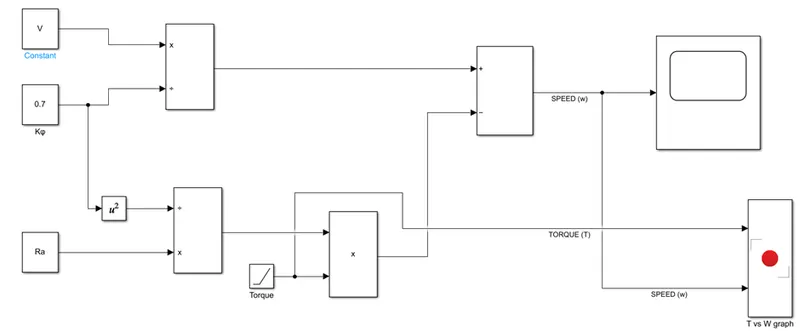
Given equation to develop the mathematical model using Simulink.
ω= V/Kϕ -Ra/Kϕ^2* T
let V=72V
Ra=0.5ohm
Kϕ=0.7
MODEL:
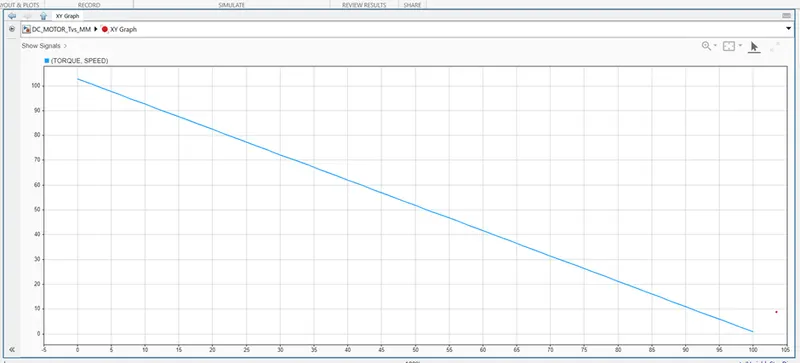
SPEED vs TORQUE GRAPH:
OBSERVATION:
From the above graph we can observe that as the torque increases speed is reducing.
TASK-4
INDUCTION vs BRUSHLESS DC MOTORS
From the author’s perspective with brushless DC motors, the rotor includes permanent magnet to generate magnetic field. In BDC it is necessary to vary the magnitude and polarity of stator currents continuously to maintain the torque constant. Then only electrical to mechanical conversion is optimally efficient. The device used to control the magnitude and polarity of currents is “INVERTER” without this brushless motor is a useless motor.
The stator of 3-ph induction motor and brushless DC motor are identical. Both have the 3 sets of distributed winding that are inserted with in the stator core. The essential difference between the two machines is with rotor.
Whenever 3-ph induction motor is connected to utility 3-ph power supply, torque is produced and the has the ability to star under no load. No inverter is needed for induction motor like BDC. But induction motors can’t operate wit DC supply they must need AC power supply to operate. When these are operating with utility AC supply shaft speeds are proportionate to line frequency so, when used with utility supply these are constant speed machines. Induction machines have low starting toque and low running peak torque while using with utility, when compared to DC machines.
But when we give supply from Battery or DC source through inverter (without any feedback) variable speed is possible induction machine with by varying the inverter frequency. Still torque performance is low compared to DC brushless motors. By adding feedback loop the inverter produces exact frequency that the motor desires and induction motor is now capable to competing with DC brushless motor in EV applications.
In BDC motor due to permanent magnets we can’t change the magnetic fields So, reduction of copper losses and core losses is not possible. But in induction motor there is no permanent magnets in the rotor and magnetic fields are adjustable, since B is proportionate to v/f (voltage to frequency). This means that at light loads the inverter can reduce voltage such that magnetic losses are reduced and efficiency is maximized. Thus, induction machine when operated with a smart inverter has an advantage over a DC brushless machine. losses can be reducible in induction motor so, efficiency is optimized. Peak efficiency is little less than with DC brushless but average efficiency is better than BDC motor.
BDC motor is expensive compared to induction motor due to permanent magnets are expensive. Also due to the field weakening capabilities of induction machines, inverter rating and cost is less.
Induction motors are more difficult to control. Achieving stability over the entire torque-speed range and temperature is more difficult in induction motor than BDC motor.
CONCLUSION:
Both motors have their limitations and advantages. In HEV and PHEV applications BDC motors will dominate and the induction motors are dominate in pure electric vehicles. But now mostly BDC motors are using in vehicles. Both motors have the capability to operate in EV, HEV and PHEV type of vehicles. In some BDC motors have advantages and in some other cases induction motors have advantages. So we can conclude that both are almost similar it’s hard to choose one over other.