Week-6 Challenge: EV Drivetrain
Q1. Which types of power converter circuits are employed in electric and hybrid electric vehicle?
Ans:
In electric and hybrid vehicle, power electronics is responsible for the coverting and controlling electric power in system. Some of the major power eletronic componenets and funtionalities are used in the electric vehicle system. These includes invertor convertor and on board charger. Operations at high voltage or high current can be efficiently executed by utilizing the power electronic devices, as they deliver fast swiitching rate at higher efficieny. In addition, power electronics control both unidirectional as well as bidirectional flow of energy, depanding on the usage, and the regenerated energy can be send back to utility.
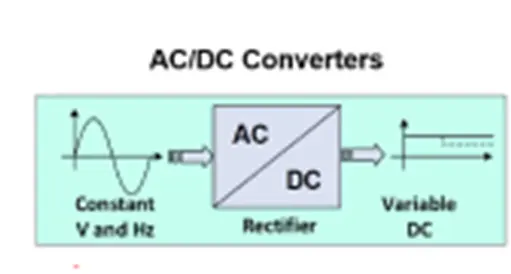
AC to DC converter:
AC to DC converters are most commanly used in plug-in Hybrid Electric Vehicles(PEV). These vehicles get their propulsion power from an external elctricity source (charging stations) which is alternating current. The battery needs to be changed using a direct current source. For this purpose, AC to DC converter is employed in a PHEV and PEV.
DC to DC converter:
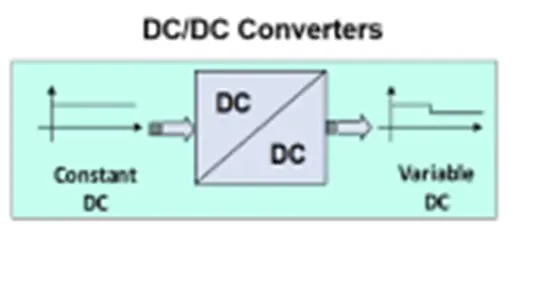
A Dc-to-DC converter is a category of power converters and it is an electric circuit which converts a source of direct current (DC) from one voltage to another, by storing the input energy temporarily and then releasing that energy to the output at a different voltage. The storage may be either magnetic field storage components (inductors, transformers) or electric field storage components (capacitors).
DC/DC converters can be designed to transfer power in only one direction, from the input to the output. However, almost all DC/DC converter topologies can be made Bi-directional. A Bi-directional converter can be move power I either direction, which is useful in applications requiring regenerative braking.
DC to AC converter:
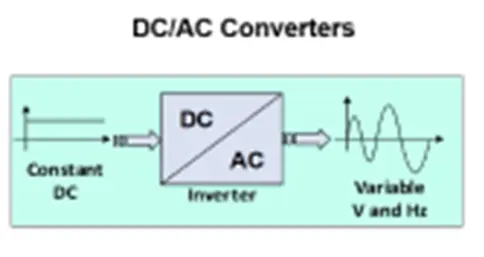
An inverter is a device that converts DC power to the AC power used in electric Vehicle motor. The inverter can change the speed at which the motor rotates by adjusting the frequency of the alternating current. It can also increase and decrease the power or torque of the motor by adjusting the amplitude of the signal.
Q2. An Electric Vehicle's powertrain with 72V battery pack in shown in the diagram below. The duty ratio for acceleration operation is 'd1' and for the braking operation the duty ratio is 'd2'.
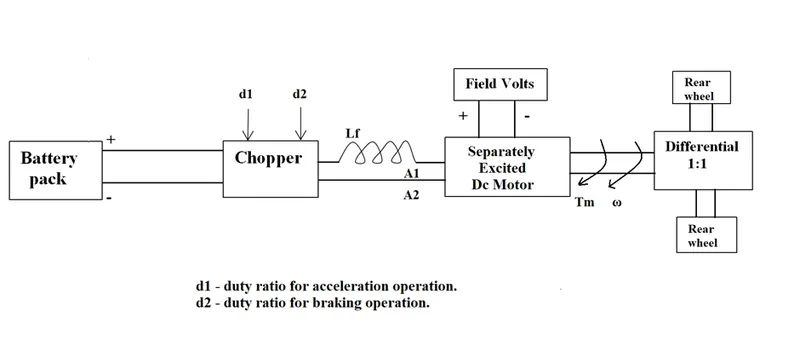
The other parameters of the electric vehicle are given below,
Motor and Controller Parameters:
Rated Armature voltage= 72 V
Rated armature current= 400 A
Ra= 0.5Ω, KΦ= 0.7 Volt second
Chopper Switching frequency= 400 Hz
The vehicle speed-torque characteristics are given by the below
What is EV steady state speed if duty cycle is 70%?
Solution:
Battery pack voltage (V) = 72 V
Rated armature current = 400 A
Armature resistance (Ra) = 0.50
Motor constant (KΦ) = 0.7
Chopper switching frequency = 400 Hz
Duty cycle = 70%
Tv = 24.7+(0.0051) ω²…………………. eqn1
Vehicle output voltage is given by:
Vv = battery voltage (V) * Duty cycle
V = 72*0.70
Thus, vehicle voltage = 50.4V
Now, torque equation for motor,
T = VKΦ/Ra-((KΦ) ²/Ra) *ω
T = 50.4*0.7/0.5-((0.7) ²/0.5) * ω
T = 70.56 – 0.98ω………………………. eqn2
Solving eqn1 and eqn2:
Comparing both torque of the vehicle and torque of the motor,
24.7 + (0.0051) * ω² = 70.56 – (0.98) * ω
0.0051ω² + 0.98ω – 45.86 = 0
By solving the quadratic equation we get,
We get 2 values of ω
ω = 38.915 rad/sec
and
ω = 231.072 rad/sec
so, the EV steady state speed if duty cycle is 70% = 38.915 rad/sec.
Q3. Develop a mathematical model of a DC Motor for the below equation using Simulink.
ω = V/KΦ – Ra/KΦ^2.T
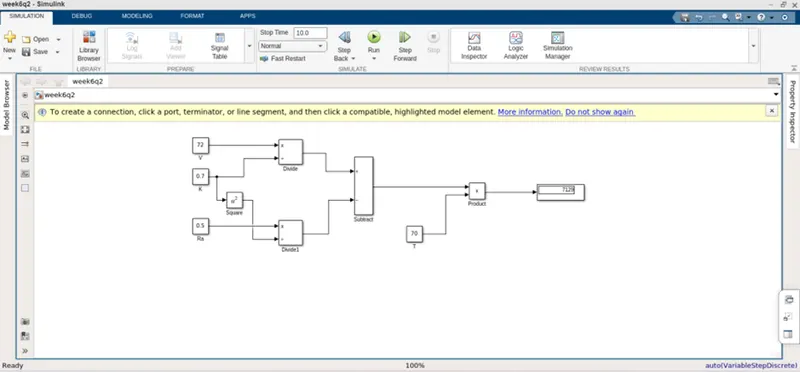
The above figure shows the block diagram of the above equation for a DC motor
Here, we have taken the values from the above equation:
ω = V/KΦ – Ra/KΦ^2.T
whereas,
V = 72v
Ra = 0.5Ω
K = 0.7v
T = 70
Thus, we found the result ω = 7129.
Q4. Explain in brief about author’s perspective.
Answer:
- In the course of time, lead – acid batteries are replaced by lithium-ion batteries.
- There is no such thing called best engine. According to the personal requirements, we need to adopt the engine type.
- In the course of time, DC brush motors are replaced by DC brushless or induction motors.
- In the course of time, contractor controllers are replaced by modulating inverters.
- There is a bigger concern regarding the stable use of these elements mentioned over the next few decades.
- The author discusses the two technologies such as:1. DC brushless drives and 2. Induction motors with its feature of operation.
- He says brushless motors are useless motors without the inverter.
- He also mentioned that the 3-phase induction motor has great utility but with several limitations.
- The major limitation being, the induction motor can operate from DC, and AC is a must.
- Further, he compares the future trends which may occur in DC brushless as well as in induction motor.