Power Converters in EV Drivetrain
AIM:
- To know the types of power converter circuits employed in electric and hybrid electric vehicles.
- To calculate EV steady-state speed for given constraints.
- To refer to the blog: Induction Versus DC brushless motors by Wally Rippel, Tesla and explain in brief about the author’s perspective.
SOLUTION:
- To know the types of power converter circuits employed in electric and hybrid electric vehicles.
The electric and hybrid vehicle market has been growing over the years and continues to grow today. The key driver in this technology is the power converters involved. Commercial electric vehicles may be broadly classified as (1) Battery electric vehicles (BEVs), (2) Hybrid electric vehicles (HEVs), and Fuel cell vehicles (FCVs).
All of these vehicles make use of power converters in their architecture. A general overview is shown in the figure below
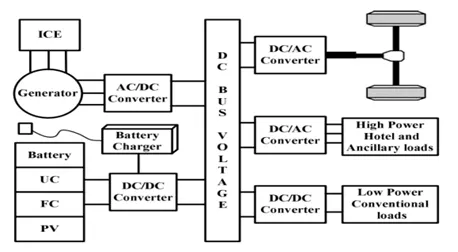
The various power converters used are explained below:
1.AC-DC power converters (Rectifiers): In case of a Hybrid EV the AC power generated during by the generator needs to be converted into DC to be able to store it into the on-board Battery. In BEVs and HEVs both, the battery of the vehicle works on DC power. The utility provides AC supply and thus to charge the battery of the vehicle, a rectifier circuit has to be used to convert this grid supply into the DC supply required by the battery. (This is not mentioned in the figure above)
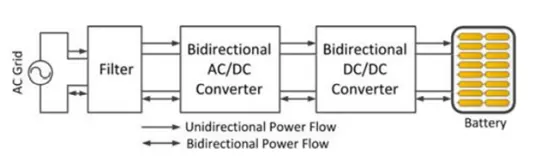
Battery Charger: EV battery chargers can be classified as on-board and off-board with unidirectional or bidirectional power flow. Unidirectional charging limits hardware requirements simplifies interconnection issues and tends to reduce battery degradation. A bidirectional charging system supports charge from the grid, battery energy injection back to the grid, and power stabilization with adequate power conversion.
2. DC-AC converter (Inverter): The most commonly used motors used in electric vehicles are 3 phase Induction Motors. These motors require AC supply to run at the desirable speeds. However, the ESS used in the vehicle stores DC power. Inverter is a power converter that converts this DC power into AC power required by the induction motors. The DC/AC inverter also performs the function of recharging the batteries during regenerative braking in HEVs. Also, Inverters are used for supplying utility loads such as Air conditioning and power outlets. Inverters are generally classified into voltage-fed and current-fed types. Because of the need of a large series inductance to emulate a current source, current-fed inverters are seldom used for EV propulsion. In fact, voltage-fed inverters are almost exclusively used because they are very simple and can have power flow in either direction.
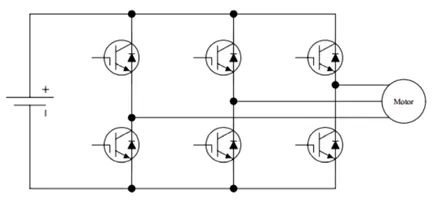
A typical Voltage source inverter is shown in the figure below. The semiconductor switches in each arm switch in regular intervals in order to generate a AC voltage waveform.
3. DC-DC Converter (Chopper): A DC/DC converter in its basic form converts unregulated DC input voltage at a certain level to a regulated DC output voltage at a different level with very high conversion efficiency (>90%). Modern day DC/DC converters are operated at high frequencies (10 kHz - 1 MHz). The size of the components such as inductors, transformers, and capacitors are reduced at high frequency operation. Transistors such as MOSFETs and IGBTs are used as switches. The former is preferred in high frequency, low and medium power applications, whereas the latter is preferred in low frequency high power applications. The switches are turned ON and OFF by pulse width modulation (PWM) technique.
DC-DC converters are used to supply auxiliaries of the vehicle and functions like:
- Providing low voltage (12V or 14V) for low voltage loads. (Step-down Chopper)
- Boosting the voltage level of the battery such that it matches the level of the DC bus voltage for driving the AC motor inverter if the traction motor is AC motor (Step up chopper)
- Motor propulsion if the traction motor is a DC motor.
2. An Electric Vehicle's powertrain with 72V battery pack in shown in the diagram below. The duty ratio for acceleration operation is 'd1' and for the braking operation the duty ratio is 'd2'.
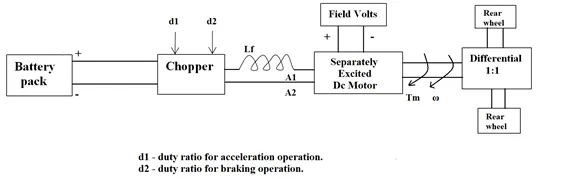
Parameters Given:
Motor and Controller Parameters:
Rated Armature voltage= 72 V
Rated armature current= 400 A
Ra= 0.5Ω, KΦ= 0.7 Volt second
Chopper Switching frequency= 400 Hz
The vehicle speed-torque characteristics equation
To find the steady state speed,
First evaluate the torque speed equation using the equation
T = [V*KΦ /Ra] – [ω*(KΦ) 2/Ra]
Here, V = 72*d1 = 50.4V
T = [50.4*0.7 /0.5] – [ω*(0.7) 2/0.5]
= 70.56 – 0.98 ω
Equating given and calculated equation for torque-speed we get,
24.77 + 0.0051 ω2 = 70.56 – 0.98 ω
0.0051ω2 +0.98ω – 45.86 = 0
Solving the quadratic equation,
ω = 38.914 rad/sec
= 371.601 RPM
Thus steady-state vehicle speed with 0.7 duty cycle is, 371.6 RPM
- To refer to the blog: Induction Versus DC brushless motors by Wally Rippel, Tesla and explain in brief about the author’s perspective.
In this blog, the author compares the features of the Induction Motors and Brushless DC Motors and after detailed discussion, concludes around the point that DC brushless drives will dominate in the hybrid and coming plug-in hybrid markets, and that induction drives will be used in high-performance pure electric vehicles and the possibility of induction and DC brushless motors both working together in a single vehicle.
The constructional difference between the two motors is between their rotors, the stators having almost similar construction. The rotor of the Brushless DC motor has permanent magnets and the interaction between the stator magnetic field and the rotor magnetic fields produce the required torque. The author focuses on the point that, to produce the variable stator magnetic field the current control required is provided by the inverter. Thus the Brushless DC Motors could be useless if it wasn’t for the developments in the power electronics. The rotor of the induction motor has a squirrel cage type of construction and is self-starting. Thus the induction motor requires less ancillary equipment and can directly be connected to the utility supply.
While comparing the speed control limitations of both machines, the author points out that the speed of the output shaft of the IM is dependent on the supply frequency and therefore, the speed cannot be controlled unless a variable frequency supply is available. On the contrary, the speed of DC motor is comparatively easy to control. However, in the EV application, the battery DC power can be supplied to the induction motor via an inverter which can provide the variable frequency supply required. DC brushless drives require an absolute position sensor, while induction drives require only a speed sensor. The control laws are complex, though the cost concerns for the control gear are bearable.
The heat generated in the rotor is less, power factor (higher peak operating point), efficiency is better in BLDCs. On the other hand, since these motors have permanent magnet rotors, the magnetic field strength is constant and there is no scope for minimization of losses. These issues can be very effectively addressed in the induction motor drives, where the magnetic field is proportional to V/f. Thus, optimum efficiency can be maintained minimizing the losses. With an increasing rating, this factor proves advantageous for the average efficiency of the IM because BLDC drives cannot really control the amount of power lost.
Spinning induction machines produce little or no voltage when de-excited thus they are easier to protect whereas Permanent magnet (PM) rotors are also difficult to handle due to very large forces that come into play when anything ferromagnetic gets close to them thus requires high amount of protection. IMs retains cost advantages over BLDC drives.
These comparisons make BLDC drives suitable for commercial vehicles like HEVs and PEVs and 3 phase IM drives will dominate high performance pure electric vehicles.
CONCLUSION:
- The power electronic components play a very important role in the vehicle control and operation of the vehicle.
- BLDC and Induction motor drives will prevail in the EV market in the years to come.