Week-6 Challenge: EV Drivetrain
(1)Types of power converter circuits employed in electric and hybrid electric vehicle:-
>A motor drive consists of a power converter and a controller. A power electronic convereter handles the flow from the bulk from the source to the motor input terminals.The controller process the command input and the feedback information to generate switching signals for power converter and semi conductor switches.
>The power converter can be a DC power supply to a DC motor or a Ac power suppllying to an AC motor.
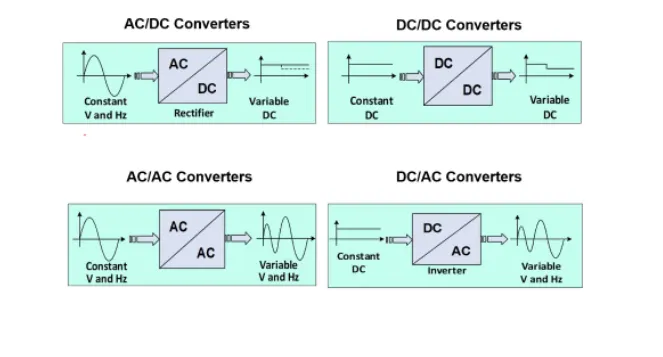
>A DC/DC converter in it's basic form converts unregulated DC inout voltage to a regulated DC output voltage, usually it's to convert hight amout of voltage to low amount of voltage.
>The power converter is made up of high power fast-acting semi-conductors devices, such as bipolar junction transistor. Therer are some other transistor as well like, MOSFET, IGBT, SCR, GTO, MC. These devices are used as an on-off switch to convert the fixed suplly voltage into variable voltage and variable frequency supply.
>All these devices have a control inout gate or base through which the devices are turned on and off as per the command generated by the controller.
>There are two types of step converters. When a low voltage input is converted into high voltage output it's known as step-up converter, whereas when a high voltage input is converted into low voltage output it's known as step-down converter.
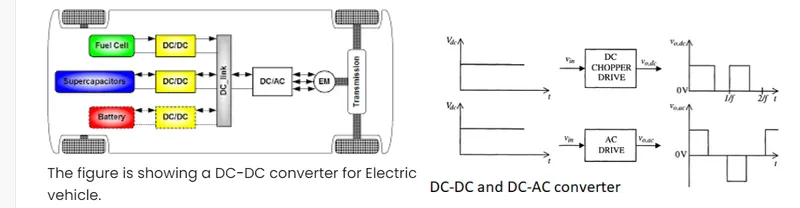
>Power converters.
(2) Given Data:-
Va=72V
I=400A
Ra=0.5
K=0.7
Fs=400Hz
Tv=24.7+(0.0051)w^2....(a)
Duty cycle=70%
>Vehicle output Voltage=72*0.7=50.4
T=(V-w*K).K/Ra
T=(50.4-0.7w)0.7/0.5....(b)
Placing equation a in b we get,
24.7+(0.0051)w^2=(50.4-0.7w)0.7/0.5
>Solving the equation we get two values ofw, one positive one negative, as speed cannot be negative we have to consider postive one as the main answer
w=38.95rad/sec.
(3)Mathematical model of a DC Motor for the below equation using Simulink.
ωω= V/Kϕϕ -Ra/Kϕϕ^2 .T
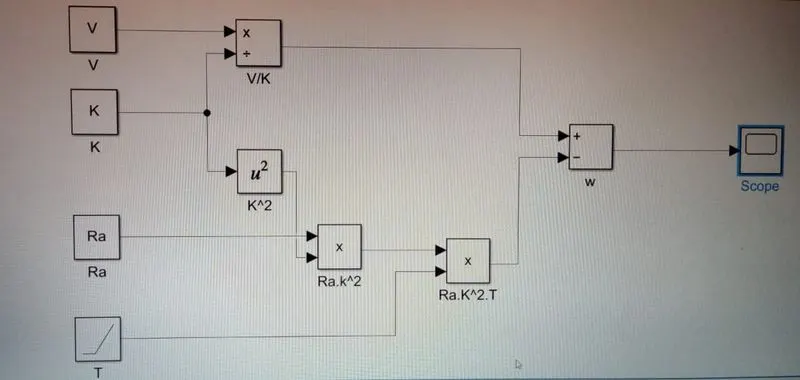
>In this mathematical model we have taken 3 constants blocks and named them V, K and Ra.(Voltage, constant and resistance).
>A ramp block is talem to calculate the value of the Torque over the time.
>Volatge is connected with the product block, which connects with square block.
>Then two product blocks are used for getting the product of given resistance in the equation.
>Than for subtarcting the final main two equations add block is used which is connected with the scope block.
(4) Induction Versus DC brushless motors by Wally Rippel, Tesla
> In the blog of induction and DC brushless motors, the author has mentioned about positive and negative side of both the induction and DC motor. In the blog, the basic construction of both the induction and Dc brushless motor is explained.
> In case of DC brusless notor , permanent magnets are used which produces a rotating magnetic field. This magnetic field when induces a current in the conductor, this current results in forced genration in the rotor an d this results in rotation of the rotor.
>Whereas in the case of induction motor, the current is supplied to the strator, which results in the generation of emf. When this enf comes in contact with the rotor which is generally a squirrel cage type , this results current induced in the rotor. Unlike the DC motor, the rotor consist of conductor plates and placed in a cage like structure.
> One of the main difference is that much less rotor heat is generated with the Dc brushless drive. Rotor cooling is easier and peak point efficiency is genrally higher for this drive. It is mentioned that the DC beushless can drive at unit poer factor, whereas the best power factor tfor the induction drive is about 85%.
>In case of DC brushless motor, the strength of the DC brushless motor, the strength of the magnetic field is adjustable. When at low speed the maximum torque is required magnetic field should be maximun i.e. inverter and motor current mantained athier lowest optimized efficiency. Whereas, there nis no such adjustment in case of induction motor.
>As machine size grows, magnwetic lossed increases proprtionally and part load efficiency drops. In case of Induction motor, as machine size grows, losses do not necssarily grows.
> The construction of DC brushless motor is costly as comapred to induction motor, due to the use of permaent magnets.
>However thogh the speed variation of induction motor depends upon the frequency input is difficult to control.