Week-4 Challenge WOT Condition Part-2
EV-BAtch 16 Student:-
(1)Difference between mapped and dynamic model of engine, motor and generator:
The Mapped Model:
>The simulation of powertrain blockset consists of data that is pre-built in the look up table is dealing with mapped data or mapped model.
>The map model calculaton is much fast.
The Dynamic Model:
>The simulation of powertrain blockset consists of data that is not pre-built but, it takes the real time data b calculating each small parts like moement of automobile, drag, speed, braking, etc, which is dynamic model for engine system, motor system or generator system.
>The time taken for calulation in this model is longer.
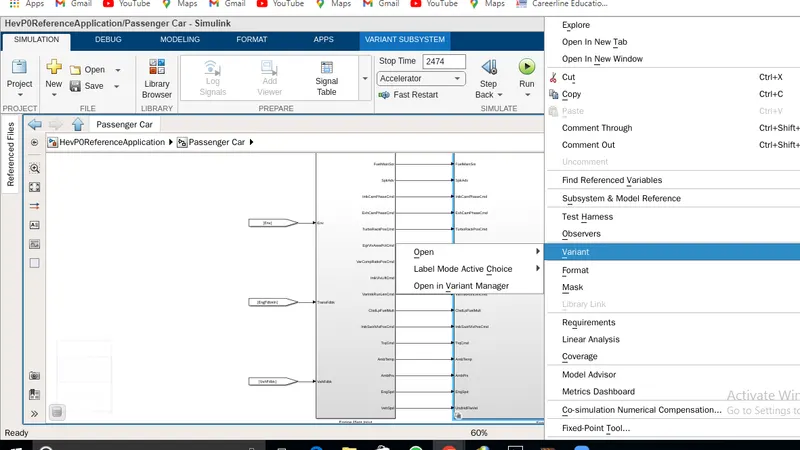
>To change the model:-
> Open he model than go to passenger block.
>In that block a option for variant will be there and than there would be a aoption to change the moel.
asasd
(2)How does the model caluclte miles per gallon?
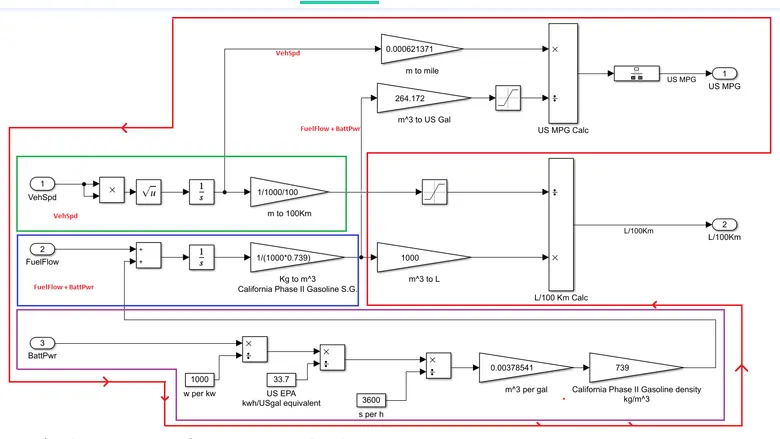
>The model caluclates miles per gallon in a wa that, it use batter power n watts and Fuel-flow in kg and vehicle speed in seconds.
>The vehicle speed is integrated to get the displacement or distrance in meters.
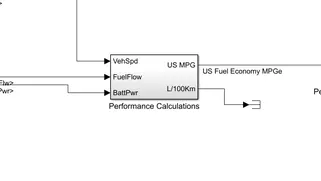
These are the main parameters need for calulating in miles per gallon.
>First, the batter power(x) i watts is divded with thousand to get in kilowatts and than the killowatts is divded with 33.7 kW/US gallon which is under US EPA(Environomental Protectional Agenc) for US gallons same for killo watts hours.
>Than killo watt hours is conerted to killo watt seconds, dividing it with 3600.
>Now the US EPA alue and 3600 killo watt is multiplied with 0.00378 which gies m^3/gallon and multiplied with 739 to convert m^3/gallon into kg/m^3 and addes to the fuel flow.
>Then the fuel flow and power are added to get kg/m^3 and multipied with 264.72 to convert m^3 into US gallon.
>Then the ehicle speed is taken form xdot which is the ehicle speed and undergo the integration to get the distance, we know b integrating the speed we get the distance in meters, b multiplied with 0.0006237, this will convert meters in miles.
>Now miles is divided with gallon we get miles per gallon, speed/(fuel+power) we get miles/gallon.
Factors considered to model Fuel Flow:-
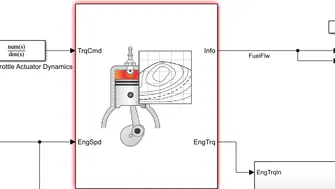
>The factors considered to odel fuel flow are SI or Ci engine, fuel mass flow rate, Engine feedback out, fuel flow.
>The fuel mass flow rate is fuel coming out of engine info.