Week-6 Challenge: EV Drivetrain
1. Which types of power converter circuits are employed in electric and hybrid electric vehicle?
Answer:
Power converters are the combination of electrical and electronic circuits that are used to process & control the flow of electric energy in order to get the desired load by supplying voltages & current in a suitable form. Power converters are the device that changes the input supply form(DC-AC & AC-DC) & level(DC-DC & AC-AC). So based on their input & output power converters are categorized into 4 types.
- DC-AC converters [Inverters]
- AC-DC converters [Rectifiers]
- DC-DC converters [Choppers]
- AC-AC converters [Cycloconverters]
In EV & HEV field Inverters, Rectifiers & Choppers are mainly used.
a. DC-AC converters [Inverters]:
This converter will convert input DC power to AC output power. Three-phase induction motors are commonly used in EVs for propulsion. These vehicles are using batteries as energy storage devices. To run the AC motors at a desirable speed, battery DC power has to be converted to AC power using DC-AC power converters.
b. AC-DC converters [Rectifiers]:
AC-DC converters are used to convert input AC power to DC output power. In the case of HEV & EV to charge the onboard charge battery from the power grid these converters are used. Power from the power grid is AC & this has to store in the battery as DC. During the deceleration & regenerative braking motor act as a generator. This generator output is in AC format. This has to convert from AC to DC using rectifiers. In AC-DC converters full-bridge rectifiers are used to convert AC to DC power.
c. DC-DC converters [Choppers]:
These choppers are used to convert DC power to desirable DC power. These converters are classified into step-down choppers & step-up choppers. In step-down choppers, the output voltage is less than the input voltage. In step-up choppers, the output voltage is more than the input voltage. Step-down choppers are used to power up auxiliary systems like audio, lights, etc. Step-up choppers are used if the motor propulsion is through the DC motor. In DC-DC converters IGBTs, and MOSFETs are used to convert DC to DC power.
2. An Electric Vehicle's powertrain with 72V battery pack in shown in the diagram below. The duty ratio for acceleration operation is 'd1' and for the braking operation the duty ratio is 'd2'.
The other parameters of the electric vehicle is given below,
Motor and Controller Parameters:
Rated Armature voltage= 72 V
Rated armature current= 400 A
Ra= 0.5Ω, KΦ= 0.7 Volt second
Chopper Switching frequency= 400 Hz
The vehicle speed-torque characteristics are given by the below equation

What is EV steady state speed if duty cycle is 70%?
Answer:
The speed-torque characteristics are as below:
T = (V*KΦ/Ra) - ((KΦ2/Ra)* ω)
Where:
T = Torque(Nm)
V = motor terminal voltage(v)
KΦ = motor constant
Ra = armature resistance
ω = Speed(rps)
Duty cycle = 70%
So, V = 72*0.7 = 50.4v
Substituting the given values in the above torque equation:
T = (50.4*0.7/0.5) - ((0.72/0.5)*ω)
T = 70.56 - 0.98ω ------------(1)
By equating the eq(1) & given eq.
70.56 - 0.98ω = 24.7 + 0.0051ω2
0.0051ω2 + 0.98ω - 45.86 = 0
solving the quadratic eq.
ω = 38.915 rad/s & ω = -231.072 rad/s
So, for 70% duty cycle steady-state speed = 38.915 rad/s = 371.61 rpm
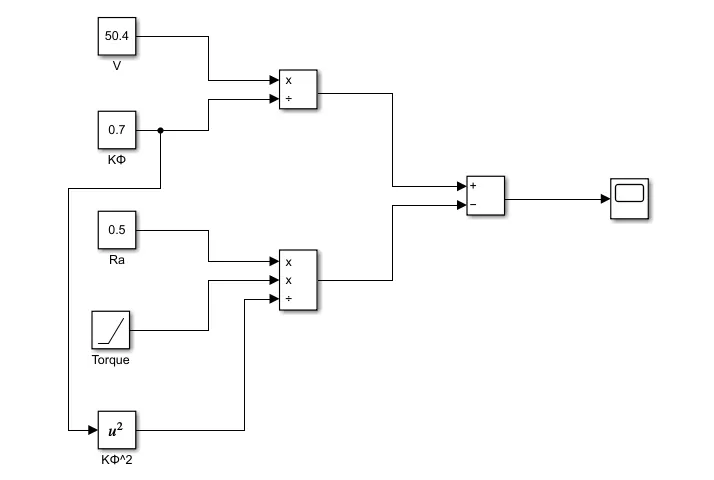
3. Develop a mathematical model of a DC Motor for the below equation using Simulink.
ω">ω= V/Kϕ">ϕ -Ra/Kϕ">ϕ^2 .T
Answer:
The mathematical model is as follows.
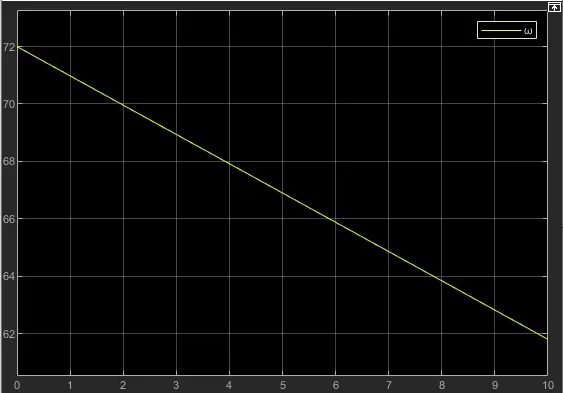
Speed(rad/s) wrt time graph:
4. Refer to the blog on below topic:
Induction Versus DC brushless motors by Wally Rippel, Tesla
Explain in brief about author’s perspective.
Answer:
In this blog, Wally Rippel explained the difference between an Induction motor & DC brushless motor in HEV & EV.
- In earlier days DC brush motors, contact controllers & lead-acid batteries were used. Now it is replaced with either DC brushless or induction & lithium batteries.
- In DC brushless rotor includes 2 or more permanent magnets and the stator includes windings that carry current to produce torque between the rotor & stator. Inverters are used to change the magnitude & polarity of the stator current.
- In 3 phase induction motors includes 3 sets of distributed windings that are inserted in the stator & rotor has laminated stacked steel with shorted structure conductors. Stator winding produces the rotating magnetic field which in turn rotates the rotor.
- He differentiates both motors as follows.
-
DC Brushless motor 3 phase induction motor Good peak torque Limited peak torque Requires absolute position sensors Requires speed sensors Less rotor heat More rotor heat Can operate at unity PF Best PF is 85% Magnetic fields are not adjustable Magnetic fields are adjustable As motor size increases magnetic losses increases. So average efficiency is less than 3 phase induction motor As motor size increases magnetic losses do not increase. So average efficiency is more Permanent magnets are expensive & difficult to handle PM Less expensive compared to PM machines Easier to control Difficult to control - He concluded with, DC brushless will likely continue to dominate in HEV & PHEV & Induction will dominate in high-performance EVs.