Week-6 Challenge: EV Drivetrain
Q.NO 1. Which types of power converter circuits are employed in Electric & Hybrid Electric Vehicle?
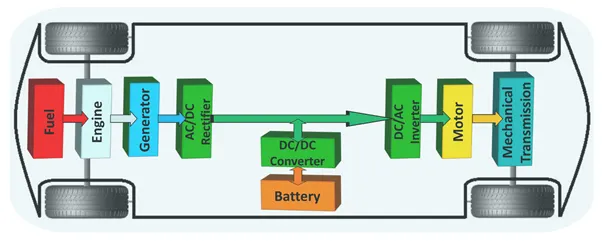
Figure 1. Hybrid Electric Vehicle.
The power converters used in the HEV are
- Rectifier (or) AC-DC Converter.
- Choppers (or) DC-DC Converter.
- Inverter (or) DC-AC Converter.
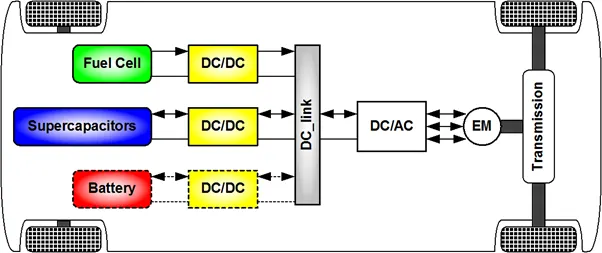
Figure 2. Electric Vehicle.
The power converters used in the EV are
- Choppers (or) DC-DC Converter.
- Inverter (or) DC-AC Converter.
Rectifier: It converters AC/DC.
Uncontrolled Rectifier: It converters fixed AC to Fixed DC.
Controlled Rectifier: It converters fixed AC to Variable DC.
Choppers: It converts Fixed DC-Variable DC.
Inverters: It converters fixed DC to variable AC and Variable Frequency.
Q.NO 2. An Electric Vehicle's powertrain with 72V battery pack in shown in the diagram below. The duty ratio for acceleration operation is 'd1' and for the braking operation the duty ratio is 'd2'.
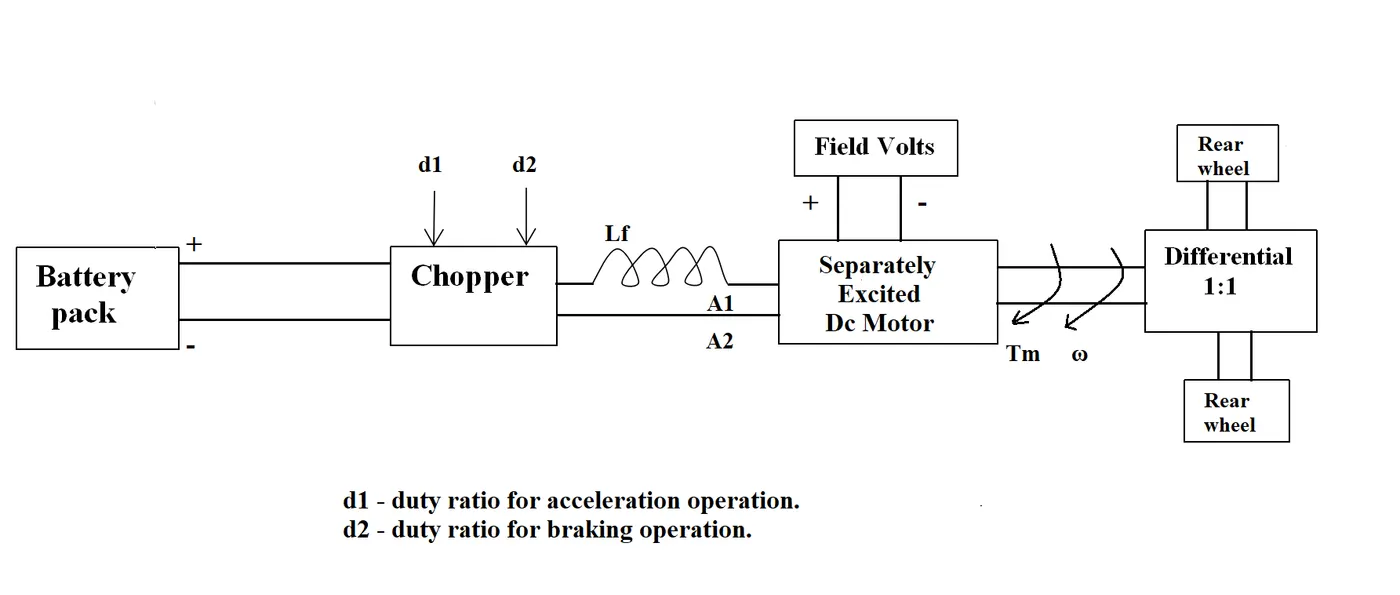
The other parameters of the electric vehicle is given below,
Motor and Controller Parameters:
Rated Armature voltage= 72 V
Rated armature current= 400 A
Ra= 0.5Ω, KΦ= 0.7 Volt second
Chopper Switching frequency= 400 Hz
The vehicle speed-torque characteristics are given by the below equation

What is EV steady state speed if duty cycle is 70%?
Sol: We know that
`T= (Vt Km-Km^2omega m)/(Ra) to 1`
`T= ((0.7*72)*0.7-(0.7*omegam))/0.5 to 2` since Vt= D1*Vs
`T=70.56-0.98omegam to3`
Compare the given equation Tv and equation 3 will gives
`70.56-0.98omegam=24.7+0.0051omega^2`
`0.0051omegam^2+0.98omegam-45.96=0 to 4`
`omega1= 38.91 (rad)/(sec)`
`omega2= -231.07(rad)/sec`
Where Km= Ka*`phi`
Here, we will consider only positive because the equation which we considered is related to forward motoring only.
Q.NO 3 Develop a mathematical model of a DC Motor for the below equation using Simulink.
`omega= (Vt)/(Ka phi)-T/(Ka phi)^2`
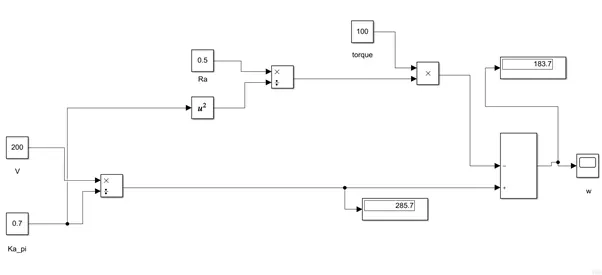
Figure 3. Mathematical model of DC Motor.
Here the values are taken as per the q.no 2. Constant block, Square block, division block, product block, summer, display, and scope are used. In this simulation, torque value is considered randomly because in the q.no 2 constant torque value is not mentioned. It is observed that for the given value 183.7 rad/sec is obtained for the 100Nm torque value.
Q.NO 4 Refer to the blog on below topic:
Induction Versus DC brushless motors by Wally Rippel, Tesla
Explain in brief about author’s perspective.
In this blog, he mentioned various types of batteries and motors used when he was younger age and the year 2007. He said that in the olden days lead-acid and DC Motors with brushes are used and presently lithium-ion batteries and Brushless motors or induction motors are used.
with a closer look, he explained the construction of a brushless dc motor. Wally Rippel used a word that without using inverter brush motors are useless motors. That means power electronics will play a major role to control the DC or AC motors.
coming to the Induction motor it is rugged in construction and has no magnets. Here, stacked steel laminations with buried peripheral conductors form a “shorted structure.”
|
S.no |
Brushless DC Motor |
Induction motor |
|
1 |
Three sets of Distributed winding that are inserted within the stator core. |
Three sets of Distributed winding that are inserted within the stator core. |
|
2 |
Two or more permanent magnets are used. |
No permanent magnets are used. |
|
3 |
No starting Torque. |
Starting Torque is presented. |
|
4 |
Without inverter it is not possible to control the motor. |
Without inverter also induction motor can be controlled. But for smooth and reduce THD definitely Inverter is required. |
|
5 |
Position sensor is required. |
Speed sensor is required |
|
6 |
Less rotor heat is generated. |
More rotor heat is generated. |
|
7. |
Unity power factor is achieved |
0.85 is the maximum power factor. |
|
8. |
High efficiency |
Low efficiency compare to DC Brushless |
|
9. |
Can’t change the flux due to permanent magnets |
Can change the flux based V/F ratio. |
|
10. |
More cost due to permanent magnets |
Less cost due to absence of permanent magnets. |
|
11. |
Achieving stability is easier. |
Achieving stability is difficult. |
wally rippel given conclusion thatDC brushless drives will likely continue to dominate in the hybrid and coming plug-in hybrid markets, and that induction drives will likely maintain dominance for the high-performance pure electrics.