Week-6 Challenge: EV Drivetrain
1.ANS
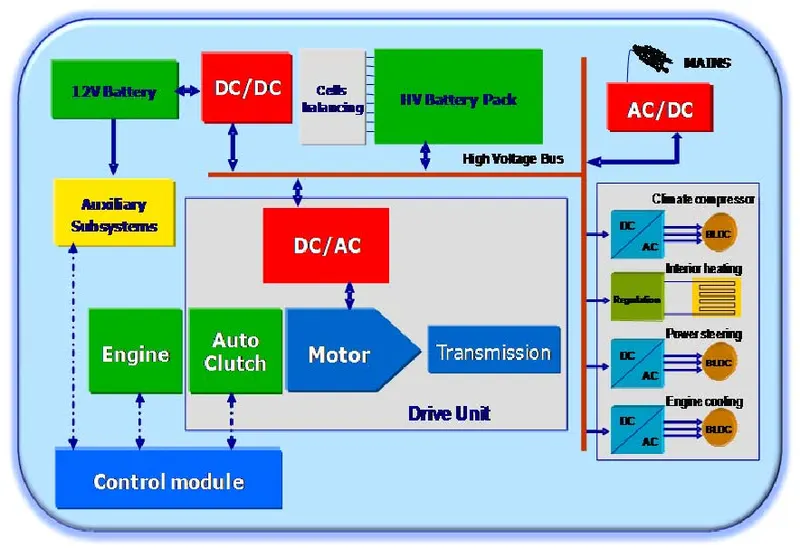
Types of power converter circuits are employed in electric and hybrid electric vehicle:
| S.No. | Types of Power Converter | Devices can be used as Power Converter |
Applications in EV & HEV |
| 1. |
AC-DC Converters AC-DC converters are electrical circuits that transform alternating current (AC) input into direct current (DC) output. They are used in power electronic applications where the power input a 50 Hz or 60 Hz sine-wave AC voltage that requires power conversion for a DC output. |
|
|
| 2. |
DC-AC Converters The converter is a power electronic device, used to convert DC to AC. The DC to AC conversion can be done among 12V, 24V, 48V to 110V, 120V, 220V, 230V, 240V with supply frequency 50Hz/60Hz. |
|
|
| 3. |
DC-DC Converters A DC-to-DC converter is an electonic circuit or electromechanical device that converts a source of direct current (DC) from one voltage level to another. Power levels range from very low (small batteries) to very high (high-voltage power transmission). |
|
Electronic devices takes DC voltages and convert it into other for low level voltage components FETs, IC, Transistors Etc. |
| 4. |
AC-AC Converters AC to AC converters is used for converting the AC waveforms with one particular frequency and magnitude to AC waveform with another frequency at another magnitude. |
|
Speed control of Induction motor |
2.ANS:
AIM: To calculate EV steady state speed if duty cycle is 70%
GIVEN DATA:
Given block diagram of EV:
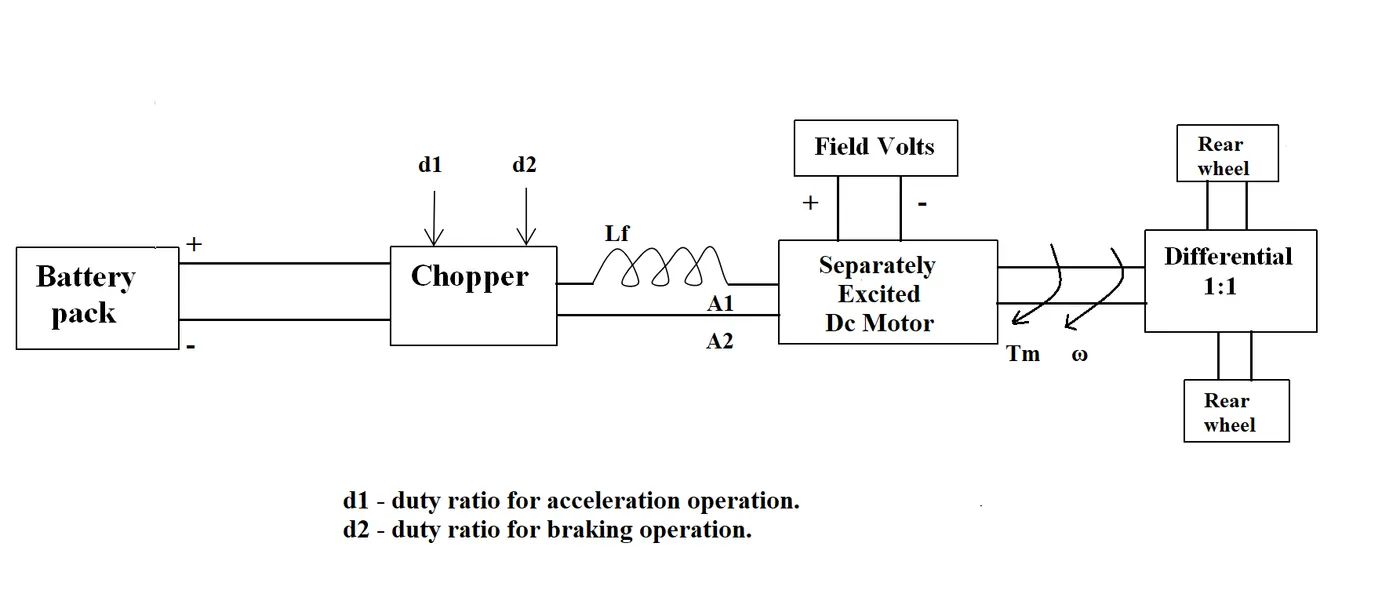
and also given its parameters are given below
Rated Armature voltage Va= 72 V
Rated armature current Ia= 400 A
Ra= 0.5Ω, KΦ= 0.7 Volt second
Chopper Switching frequency= 400 Hz
The average voltage of armature voltage with duty cycle, V = Va x Duty cycle = 50.4V
Already we know the Torque equation Tm = V*K/Ra - K^2*w/Ra
Subtitute the given values in above equ
Tm = 50.4(0.7)/0.5 - w(0.7)^2/0.5
==> Tm = 70.56 - 0.98w -------> equ(1)
and also given the speed-torque characteristics equation is
Tv = 24.7 + (0.0051)w^2 -----> equ(2)
At steady state speed, Tm = Tv
Therefore equating the equ(1) and equ(2) we get
70.56 - 0.98w = 70.56 - 0.98w
==>(0.0051)w^2 + 0.98w - 45.86 = 0 ------> equ(3)
It looks like quadratic equation

After subtituting values of equ(3) in quadratic equation we get
w = 38.91 rad/sec , -231.0686 rad/sec
As the speed value can not be negative so w = 38.91 rad/sec
Hence obtained the EV steady state speed of 38.91 rad/sec if duty cycle is 70%.
3.ANS:
The mathematical model of a DC Motor for the equation  using Simulink
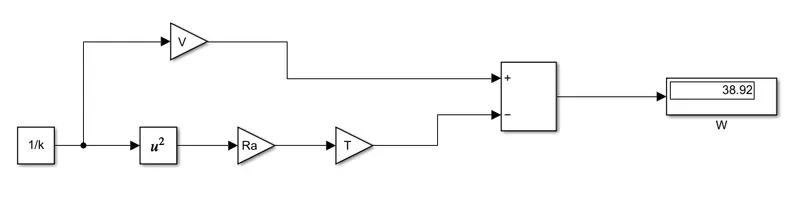
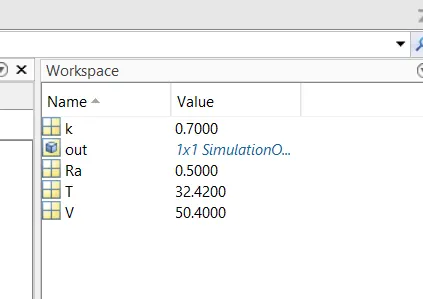
Given values to the model as below and output i got in display block 38.92
4.ANS: Refering to the blog Induction Versus DC brushless motors by Wally Rippel, Tesla
Brief about author’s perspective:
Gas powered vehicle engine are not all alike is similar in case of electric vehicle drives engine. Designed based on personal requirements, such as price and performance.
Today Lead has been replaced by lithium, DC brush motors by either DC Brushless or induction and contactors are replaced by modulating inverters. It is hard to predict future. Here the author obey's that induction and brushless machines for many years to come due to its performance and efficiency.
Let’s start with DC brushless drives:
With brushless machines, the rotor includes two or more permanent magnets that generate a DC magnetic field. In turn, this magnetic field enters the stator core and interacts with currents flowing within the windings to produce a torque interaction between the rotor and stator. The device that provides this current control is called an inverter. Without it, brushless motors are useless motors.
In case of Induction motors:
The induction rotor has no magnets. In response to this voltage, currents are produced within the rotor conductors that are approximately proportionate to the voltage, hence the speed difference produces torque.
The stators for the 3-phase induction motor and the DC brushless motor are virtually identical. Early times tesla invented a Induction motor is useless, now 3-phase induction motor is designed and supplied with 3-phase power. They cannot operate from DC; AC is a must.
Add an inverter and it becomes possible to power an induction machine from a battery or other DC source; variable speed also becomes possible simply by adjusting the inverter frequency.
When comparing Both DC brushless drives and Induction drive:
- The only differences are the rotors and the inverter controls and with digital controllers.
- The efficiency is little bit high on Induction drive compared.
- One of the main differences is that much less rotor heat is generated with the DC brushless drive. Rotor cooling is easier in this drive.
- Permanent magnets are expensive which is used DC brushless drives.
- Induction drives are difficult to control.
Conclusion:
Today, all the hybrids are powered by DC brushless drives. DC brushless drives mostly we will see in Hybrid or PlugIn Hybrid Vehicle and Induction drives see in pure EV. May we can see both motors in EV coming days.