Week-6 Challenge: EV Drivetrain
1. Which types of power converter circuits are employed in electric and hybrid electric vehicle?
Solution:
- Power Electronic Converters:
A power converter is an electrical or electro-mechanical device for
converting electrical energy. A power converter can convert alternating current (AC) into direct current
(DC) and vice versa.
There are 3 types of power converters which are mainly used in EVs and HEVs:-
- AC to DC Converter (Controlled Rectifier)
- DC to DC Converter (DC Chopper)
- DC to AC Converter (Inverter)
>AC to DC converter or Rectifier (On board charger):
-EVs and HEVs get their propulsion power from an external electricity source which is AC.
-Mainly used as an On-Board Charger
-It converts AC power from an external charging source into a DC voltage that is used to charge the battery pack in the vehicle.
-It also perform charge rate monitoring and protection.
>DC to DC Converter (DC Chopper):
-Mainly used as a Chopper either to Step Up or Step Down the DC voltage as per requirement.
-DC-DC converters can be used to interface the elements in the electric power train by boosting or chopping the voltage levels.
>DC to AC Converter (Inverter):
-It is mainly used to convert direct current DC to alternating CUrrent Ac as the name suggests.
-The power output from battery pack is converted using inverter to be used in electric motor to operate on AC.
2. An Electric Vehicle's powertrain with 72V battery pack in shown in the diagram below. The duty ratio for acceleration operation is 'd1' and for the braking operation the duty ratio is 'd2'.
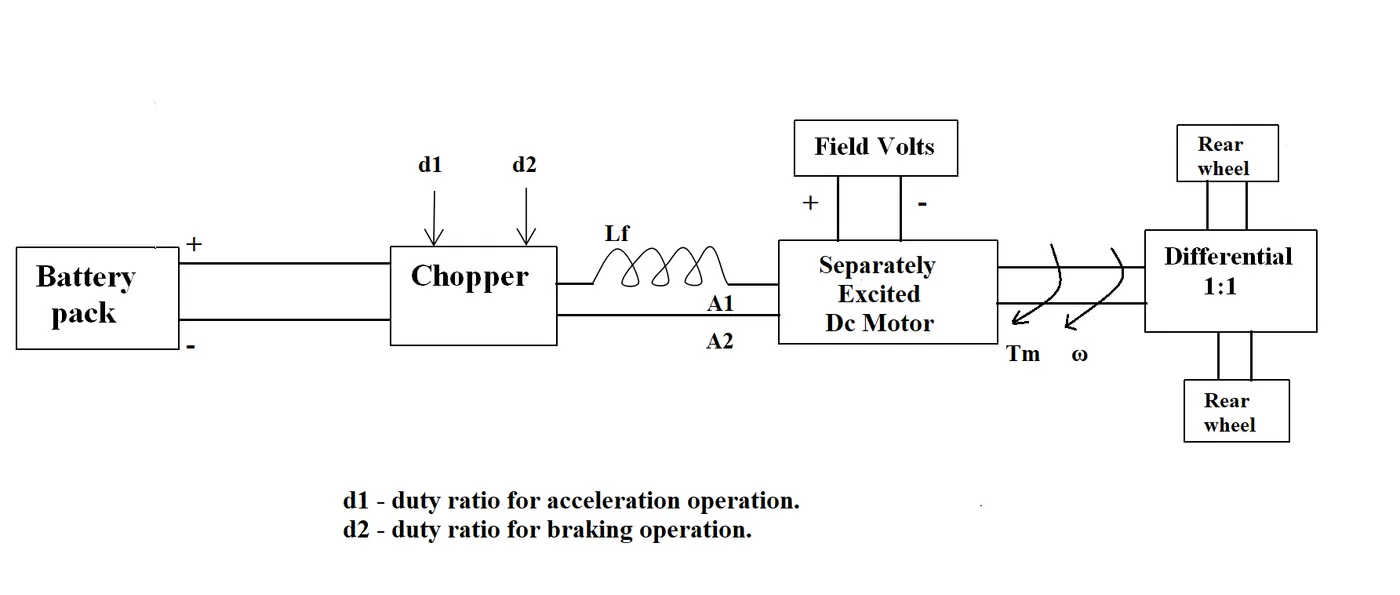
The other parameters of the electric vehicle is given below,
Motor and Controller Parameters:
- Rated Armature voltage= 72 V
- Rated armature current= 400 A
- Ra= 0.5Ω, KΦ= 0.7 Volt second
- Chopper Switching frequency= 400 Hz
- The vehicle speed-torque characteristics are given by the below equation

What is EV steady state speed if duty cycle is 70%?
Solution:
Given That:-
Rated Armature voltage= 72 V;
Rated armature current= 400 A;
Ra= 0.5Ω, KΦ= 0.7 Volt second;
Chopper Switching frequency= 400 Hz;
Duty Cycle=70%=0.7;
Va = 72*0.7=50.4 V;
ω= Va/Kϕ -{Ra/(Kϕ)^2}.T;
Torque,
T = Kϕ/Ra *[ Va - Kϕ ω]
By Substituting the given values,
Torque,
T = 1.4 × (50.4 – 0.7 ω)
= 70.56 – 0.98 ω
T = 70.56 – 0.98 ω and
T v = 24.7 + 0.0051 ω 2 (Given)
At T = Tv;
70.56 – 0.98 ω = 24.7 + 0.0051 ω 2
Or, 0.0051 ω 2 + 0.98 ω +24.7 -70.56 = 0
Or, 0.0051 ω 2 + 0.98 ω – 45.86 = 0
i.e., ω = 38.915 or −231.072 rad/sec
Since Speed cannot be negative, we will consider that the EV steady state speed if the duty cycle is at
70% is
ω = 38.915 rad. S -1 or 371 rpm
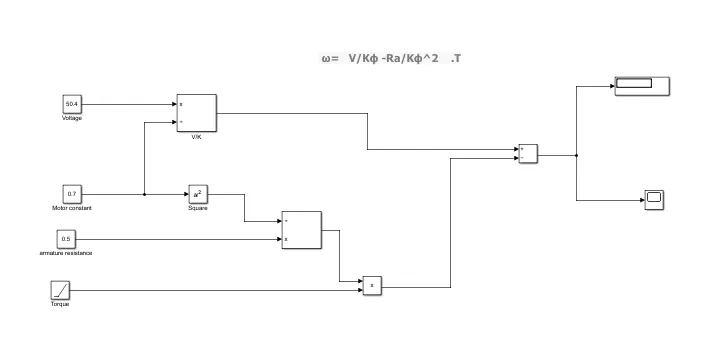
Output:
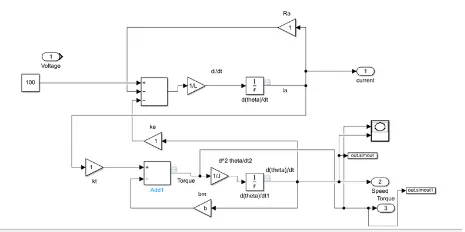
3. Develop a mathematical model of a DC Motor for the below equation using Simulink.
ω">ωω= V/Kϕ">ϕϕ -Ra/Kϕ">ϕϕ^2 .T
Solution:
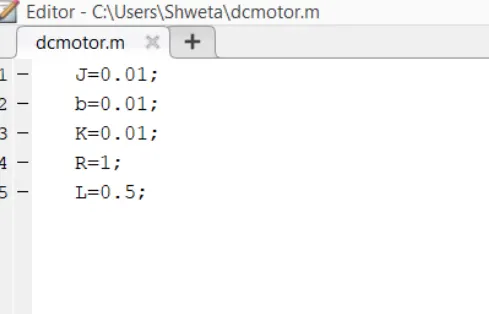
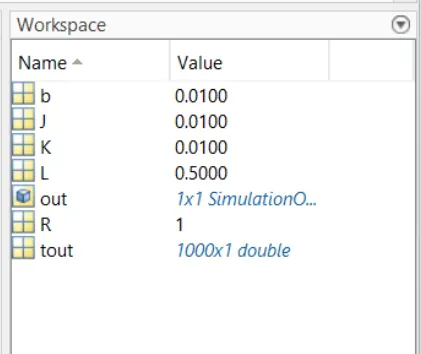
Workspace:
Simulation:
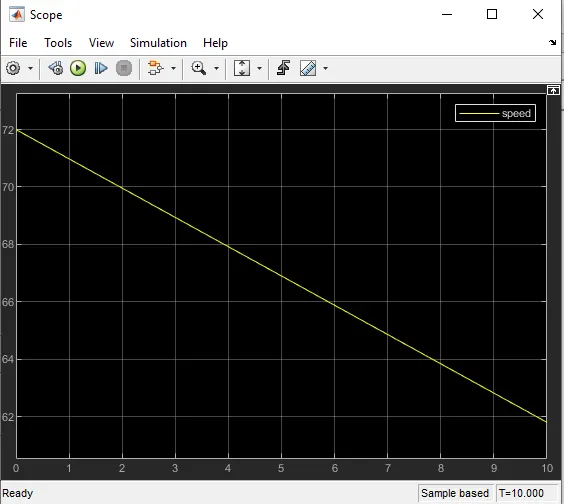
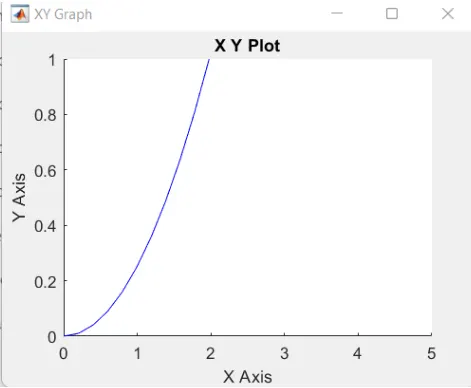
Graph:
4. Refer to the blog on below topic:
Induction Versus DC brushless motors by Wally Rippel, Tesla
Explain in brief about author’s perspective?
Solution:
- Wally Rippel believes that there is not a one best engine type, but different types of engines to suit personal requirements based on price and performance and that is also the case with electric vehicle drives.
- He points out the evolution of components in EV technology from Lead acid batteries, DC brushed motors and contactor controllers to Lithium-ion batteries, BLDC and Induction motors to even inverters.
- He strongly believes that both induction and BLDC motors will have tough competition in coming years, because each will have its loyal proponents and religious detractors.
- He compares the design of both BLDC and Induction and observes that its only differences are in Rotors, He also adds the importance of an Inverter in variable speed application of Induction motor to operate flawlessly.
- He even comments on the efficiency and performance characteristics of both BLDC and Induction motors. He explains that BLDC generates much less Rotor copper loss and its ability to operate at unity power factor helping to achieve peak point efficiency whereas the best power factor available for Induction motor is around 85% making it few percentages point lower efficient.
- He also criticizes the drawback of BLDC motors which is the difficulty in lowering its magnetic field strength during low torque values to achieve best efficiency because to minimizes the magnetic field strength, it is also required to minimize the eddy and hysteresis loss.
- Furthermore, he compares the cost, performance, and reliability of both motors as Induction motor is Cheaper due to absence of PM’s, Performance oriented but requires complex algorithms for controlling and achieving stability is difficult causing increased development cost, Whereas BLDC is expensive but very easy to control, also very efficient and high stability
- The author concludes that there isn’t any winner because he believes that BLDC continues to run the HEV and PHEV segments while Induction motors dominate high performance EV segments. But he anticipates that both Induction and BLDC motors live and work side by side during the coming golden era of hybrid and EVs.