Week-6 Challenge: EV Drivetrain
Question 1.
Types of power converters:
- AC-AC (Regulators)
- AC-DC (Rectifiers)
- DC-DC (Chopper)
- DC-AC(Inverter)
AC-DC (Rectifiers) converters are used to charge phones in Electric and hybrid electric vehicle, it is used for both 1 phase slow and 3 phase fast charging.
DC-DC (Chopper) converters convert one voltage value to another either by increasing or decreasing.
Types:
- Unidirectional – used in safety equipment, powering the sensor
- Bidirectional – used in regenerative breaking, charging, power backup.
DC-AC(Inverter) converters are mainly used in induction motor-based cars. PWM and multilevel inverters are used in EV.
Types of PWM’s:
- Single PWM- single pulse width modulator
- MPWM- multiple pulse width modulator
- SPWM- sinusoidal pulse width modulator
- MSPWM- modified sinusoidal pulse width modulator
The speed of the vehicle is controlled by a multilevel inverter this inverter has the highest efficiency.
Types of multilevel inverters:
- Diode clamp inverter
- Hybrid inverter
- Cascade H-type inverter
- Flying capacitor inverter
Question 2.
`T=K.I_a`
`T=0.7 * 400=280`
Duty cycle = 0.7
`V = 0.7*72 = 50.4`
`T=V*K_∅/R_a -(K_∅)^2/R_a .ω`
`T=24.7+(0.0051) ω^2`
`→T=50.4*0.7/0.5-(0.7)^2/0.5 .ω`
`→T=24.7+(0.0051) ω^2`
From above two equations we must find `"ω"`
`70.56 - 0.98 ω = 24.7+(0.0051) ω^2`
`(0.0051) ω^2+ 0.98 ω - 45.86 = 0`
We can use either manual calculation or an online solver to find the roots.
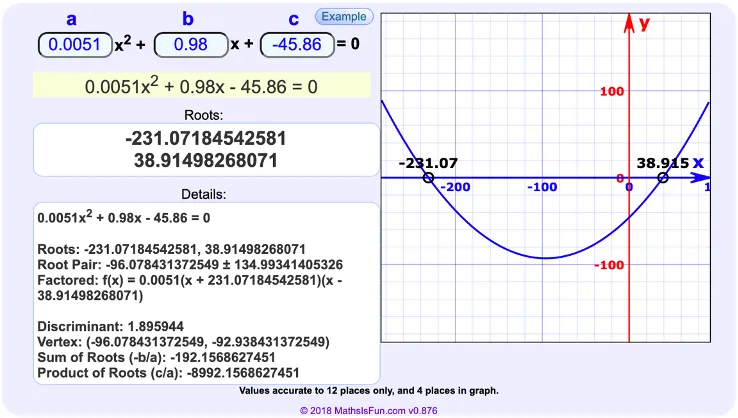
`ω=38.91498268071 (rad)/sec`
Question 3.
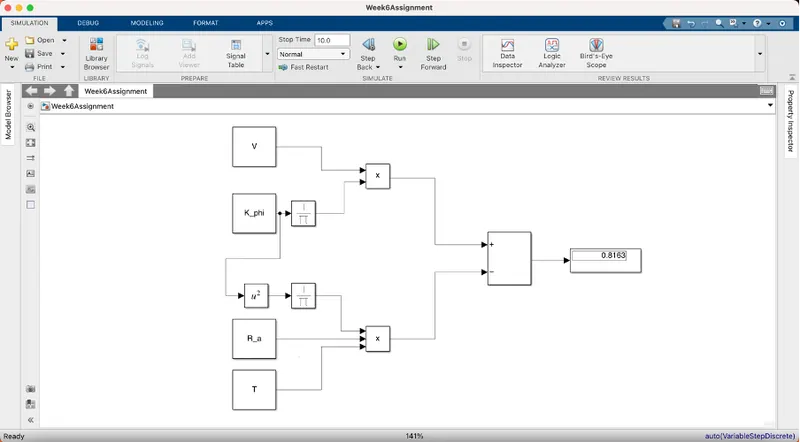
First, we must take 4 constant blocks for four variables in the equation, and using mathematical operators available we must connect them according to the equation to complete our required Simulink model.
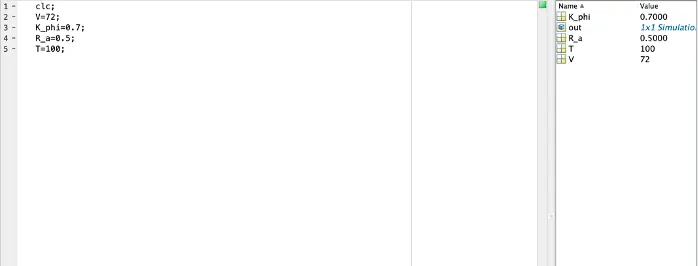
In the script file, we must assign values to the variables and save the script file in the same location so that our Simulink model directly takes the values for the variables directly from the workspace after running the script file.
Script File:
Question 4.
Author Walley Rippel is comparing the Induction motor and DC brushless motor and presenting his views in this blog
He starts by saying the statement “based on the personal requirements like price, performance and so on, best engine tag changes from the engine to engine”. He compares the Induction motor and DC brushless motor.
Differences:
In a brushless motor when the rotor rotates the magnitude and polarity of stator currents must vary continuously in order to keep torque constant and electrical to mechanical energy conversion will be efficient. The inverter provides this current control and without it brushless motors are useless.
In induction motor currents flowing in the stator winding produces a magnetic field that enters the rotor. The magnetic field in the rotor is equal to the difference between the applied rotational frequency and the electrical frequency of the rotor itself. Thus, an induced voltage exists across the shorted structure that is proportional to this speed difference between the rotor and electrical frequency. Thus, voltage, currents are produced within the rotor conductors that are approximately proportionate to the voltage, hence the speed difference. Finally, these currents interact with the original magnetic field to produce forces – a component of which is the desired rotor torque.
Similarities:
In both, the stator core of the Induction motor and DC brushless motor has 3 sets of distributed winding core in the stator. The difference is with the rotor.
Limitations:
Brushless DC motor cannot start under load it needs an inverter
The induction motor cannot operate with DC
Conclusion:
Brushless DC motors are winners of hybrid electric vehicles.
Induction Motors are winners of pure electric vehicles.