Week-6 Challenge: EV Drivetrain
1) Different power converters used in Electric and Hybrid Electric vehicles are:
- DC to AC converter(Inverter).
- DC to DC converter(Chopper).-> Buck,Buck boost
- AC to AC converter(cyclo converters)
DC to AC converter: In this type of conversion, the battery voltage which is DC will be converted to AC voltage. This inverter will have a role in those electric cars that employ Induction Motor for propulsion.
AC to AC converter: This type of converter is used in electric vehicles where Induction Motor are employed for propulsion. The cyclo converters help in controlling the Induction Motor i.e Speed control, Torque control.
DC to DC converter(Chopper): The chopper circuit is used to step up or step down the DC voltage and DC current so as to control the DC motor characteristics. Some times, the battery voltage may not be sufficient to drive the motor therfore it is required to Step up the DC voltage and then feed the DC motor. During the regeneration action, the cicuit has to maintain the DC voltage level for successful regeneration action therefore these circuits are employed in the electric vehicles.
2) Given: Armature voltage = 72V, I = 400A, Ra= 0.5ohm Kϕ=0.7, Duty cycle=70%.
The Torque equation is T=(Kϕ/Ra)-((Kϕ)^2/Ra)*ω;
Substituting all the values in the above equation, we get T=70.56 - 0.98ω
The given vehicle speed characteristics is T = 24.7+0.0051ω^2
Comparing both the equations as below:
0.0051ω^2+0.98ω-45.86=0;
The above equation is of the form ω=-b+-□√b^2-4ac/2a
The steady state speed for 70% duty cycle is 111.47 rad/s.
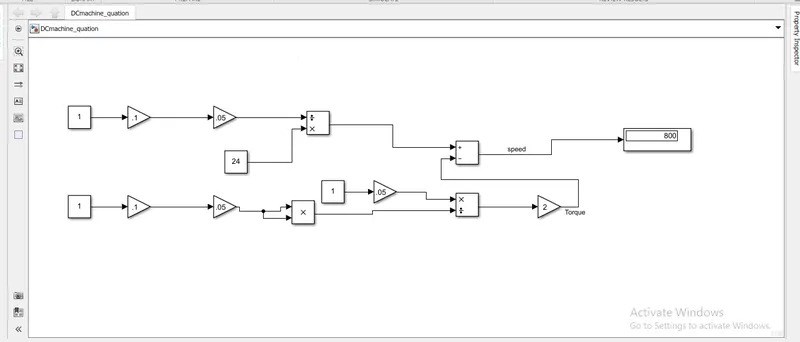
3) The simulink model of the equation is as shown below.
4) The Perspective of the author to write this blog is to point out the differnces between the two popular motors in electric vehicles and to make better choice for them to be employed in the electric vehicles. Following are the points mentioned in the blog
| Brushless Dc motor | Induction Motor |
| 1) These employ permanent magnets and are more costlier | 1) No permanent magnets, instead the the rotor bars are shorted |
| 2)High performance cannot be achieved as varying the magnetic field density is very difficult (due to permanent magnets) | 2) High performance can be achieved as the V/f control can be done. |
| 3) Initial torque requirement can be easily met with less current and voltages from the inverter circuit. | 3)They have limited starting torque. |
| 4) A sensor is reqiured to sense the position of the rotating part | 4) Speed difference is sufficient to maintain the torque. |
| 5) It is necessary to maintain the polarity and the magnitude of the current in order to keep the torque constant | 5)Can be readily used from 3phase mains(No inverter required) |
Unlike brushless dc motors, the induction motors have severe limitations. The are difficult to control and the control laws are more difficult to understand.
The permanent magnet motors are difficult to handle.
The conclusion is that in this era of emerging EVs and HEV's, both brushless and 3phase induction motors utilization will go on side by side.