Week-4 Challenge WOT Condition Part-2
1) Mapped Model:
- In mapped model, the data points are predefined in a lookup table.
- If we run the mapped EV model, the result obtained is based on the predefined data points and not on the actual real time data.
- The simulation with mapped model is fast as it does not use real time data.
- The accuracy compared to dynamic model is less.
Open the electric vehicle reference application available in power train blockset.(i.e search 'Powertrain' in help section).
Now, Double click on passenger car --->Electric Plant--->Motor. you will find the MotGenEvMapped block as shown below.
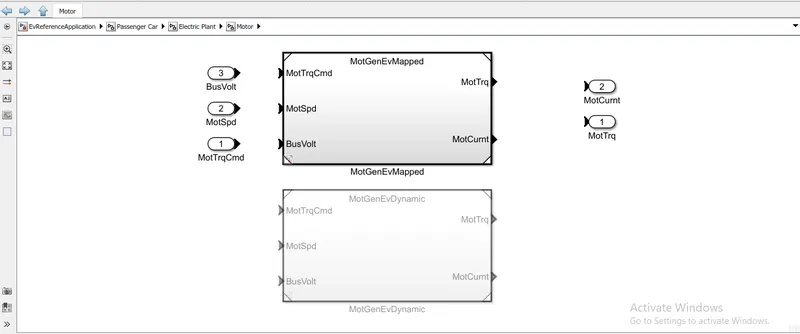
From the above image, you can see that the model is mapped EV.
Dynamic Model:
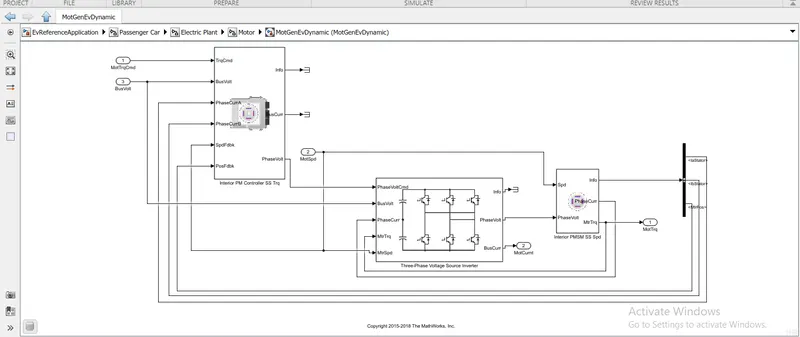
- The dynamic model generates the output based on the real time data.
- It takes the feedback of various subsytems of the vehicle application and generates the result.
- The dynamic model simulation is slow compared to mapped model as it generates the output based on the real time data.
- The results generated are more accurate than the mapped model.
Steps to change the model type:
- Follow the above steps for opening the Electric vehicle reference application model and open the Motor block.
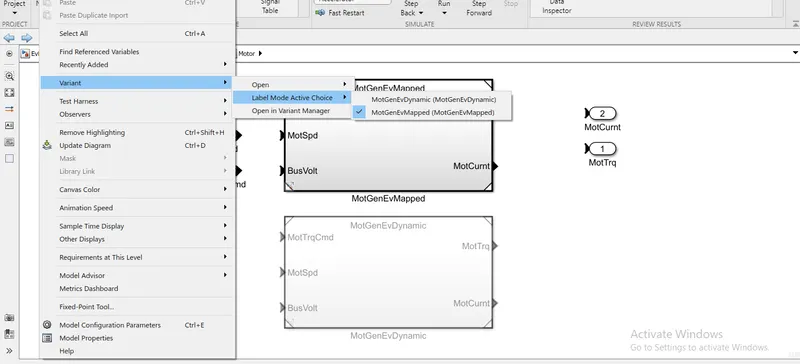
- Just Right click anywhere on the screen and select Variant--->Label Mode Active Choice--->MotGenEvDynamic.(See the below image).
2) Miles per gallon:
- The fuel energy required to cover the distance by the engine powered car is calculated and the equivalent amount of electrical energy required to cover the same distance is expressed as miles per gallon.
- The powertrain blockset has the model that calculates miles per gallon for all vehicles(The model is as shown below).
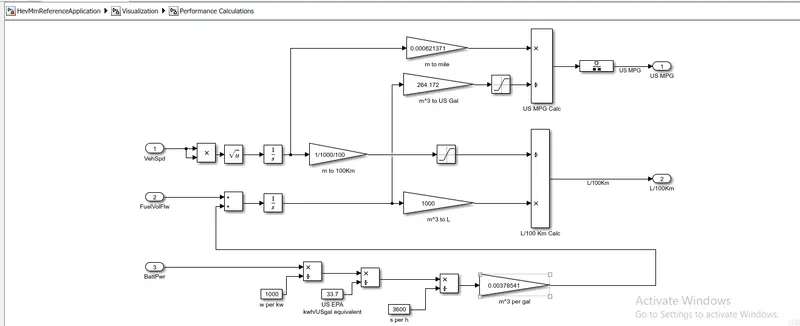
The above model takes the input of vehicle speed, fuel flow, battery power to calculate the fuel consumption and battery consumption and calculates the miles per gallon.
3) WOT:
The test is first performed without grade and wind effect.
Run the HEV application with WOT test.
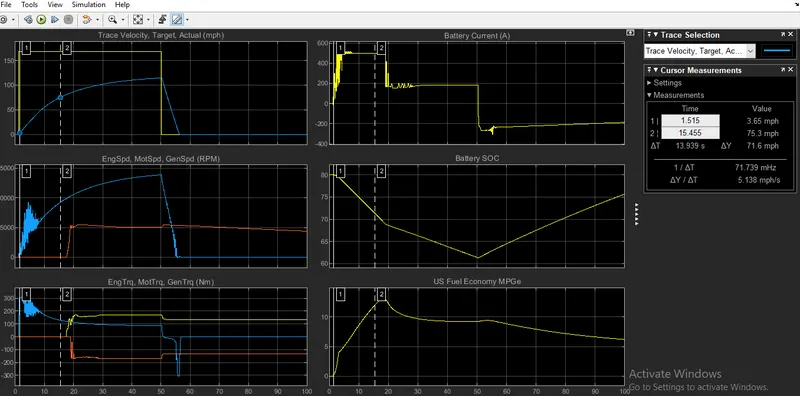
- From the above result it can be observed that the time taken to reach maximum speed(75miles/hour)is 15seconds.
- The battery state of charge after reaching the maximum speed(75miles/hour) is 71%.
- The Miles per gallon for the said speed is 11.
- The discharge current is about 497Amps
- The motor speed is 9092 rpm.
- Motor torque 130.5 N-m.
- Generator torque 118.9N-m.
Below is the graph after changing grade and wind velocity.
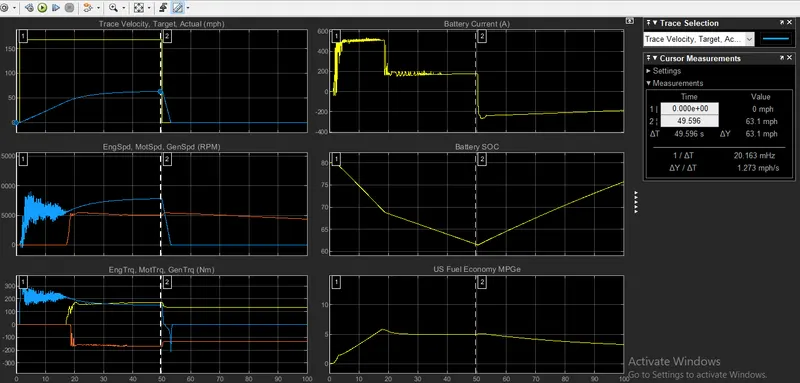
- The max speed that the vehicle can achieve is only 63miles/hour i.e due to the effect of wind velocity and grade.
- The battery discharge current is 512Amps.
- The miles per gallon has also reduced to 5 due to effect of the load.
- Engine torque is 172N-m.
- Motor torque is 189N-m
- Generator torque is 166N-m.
4) Open the EV reference application from the powertrain blockset
Run the application for WOT and give the speed and time same as that of HEV application
Below is the result obtained by performing the simulation of pure EV vehicle for WOT test:
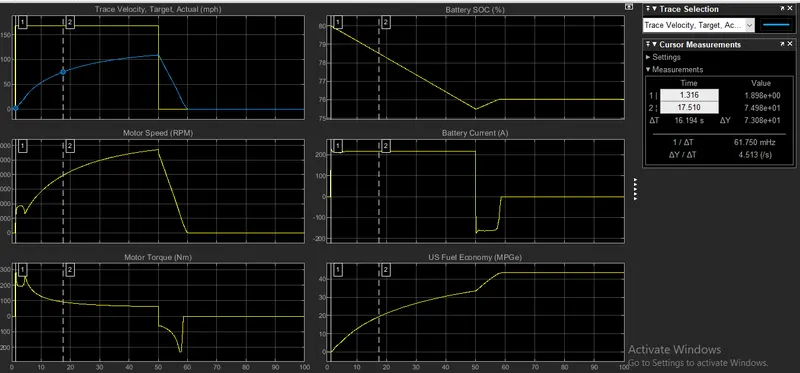
- From the graph it can be observed that the maximum speed of 75miles/hour is reached at 17sec.
- Battery discharge current is 215 Amps.
- Miles per gallon at that speed is 19.4.
- Motor speed is 7897rpm.
- Motor torque is 92.
- Battery state of charge is 78.5%
Below is the result for 10degree grade and 5m/s wind velocity:
- Battery discharge current is 217 Amps.
- Miles per gallon at that speed is 17.3
- Motor speed is 5656 rpm.
- Motor torque is 128.3 N-m.
- Battery state of charge is 75%.