Week-6 Challenge: EV Drivetrain
Week 6 Challenge
Part 1 Types of power converter in electric and hybrid electric vehicle-
Powerconverters- Converters are devices used for changing signal specification such as voltage nature, voltage magnitude, frequency and phase etc. Powerconverters are useful for changing power signal. In powerconverters powerelectronic devices are used for conversion. Using powerconverters we can change nature of voltage or current i.e. from AC to DC or vice versa and magnitude of voltage or current can be also changed. Let discuss some powerconverters used in electric and hybrid electric vehicle-
1. AC to DC power converters(Rectifiers) - Rectifier is used to convert AC signal in DC signal using powerelectronic devices. There are many kinds of rectifier such as half-rectifier, full rectifier and bridge rectifier etc. In vehicles rectifiers are used for charging battery, it converts AC electrical energy from charging station or grid to DC power to charge battery.
2. DC to AC power converters (Inverters)- Inverter converts DC to AC, most of us have seen inverter at home, it takes chemical energy from battery and convert it into electrical energy. There are many kinds of inverters such as square wave inverter, sine wave inverter, single phase inverter, and three phase inverter etc. In vehicle it plays same role when we use AC motor for running the vehicle. Many companies use permanant synchronous magnet motor so they use inverters for driving motor.
3. DC to DC power converters(Chopper)- Chopper is a device which does not change nature of DC voltage but changes average output by using powerelectronic switches. The output voltage of chopper depends on chopping frequency and its output average voltage depends on dutycycle. In DC, there are mainly two types of chopper - step up chopper and step down chopper. In step up chopper output voltage is greater than input voltage and in step down chopper output voltage is less than input voltage. In electric vehicles, chopper is used for controlling speed of DC motor. Chopper is connected between battery and motor and it control rated voltage of battery and supply a regulated voltage to motor as per demand.
4. Variable frequency powercontroller- This is used for controlling speed of induction motor by changing the frequency of output of powercontroller.
Part 2 Steady state speed calculation-
Motor parameters- Rated armature voltage = 72 v Rated armature current = 400 A Armature resistance Ra = 0.5 K*phi = 0.7
For separately excited DC motor speed-torque characterstic w= V/(K*phi) - Ra*T/(K*phi)^2
w = speed in radians per second, V = applied voltage to armature, T = motor torque, and remaining are motor parameters.
In given question there is a chopper connected betweeen battery and motor so applied voltage to motor is not equal to rated voltage of battery. It will depend on duty cycle of chopper because -
Vo = D*Vin so V = 0.7 * 72 = 50.4 v
Now put all values in speed torque characterstic of motor- w = 50.4/0.7 - 0.5*T/(0.7)^2
w = 72- 1.02*T
T = 70.588 - 0.98*w ................eq(1)
In question vehicle speed-torque characterstic is given - Tv = 24.7 + (0.0051)*w^2 .......eq(2) Tv = vehicle torque
At steady state motor torque and vehicle torque must be equal so equate equation 1 and 2-
70.588 - 0.98*w = 24.7 + (0.0051)*w^2
0.0051*w^2 + 0.98*w -45.888 = 0 , this is a quadratic equation on solving the values of angular speed are 38.92 and -231.07.
As speed can not be negative so steady state speed = 38.92 rad/sec
Part 3 Mathematical model for DC motor for given equation-
w = V/(K*phi) - Ra*T/(K*phi)^2.....
Here is model for above equation-
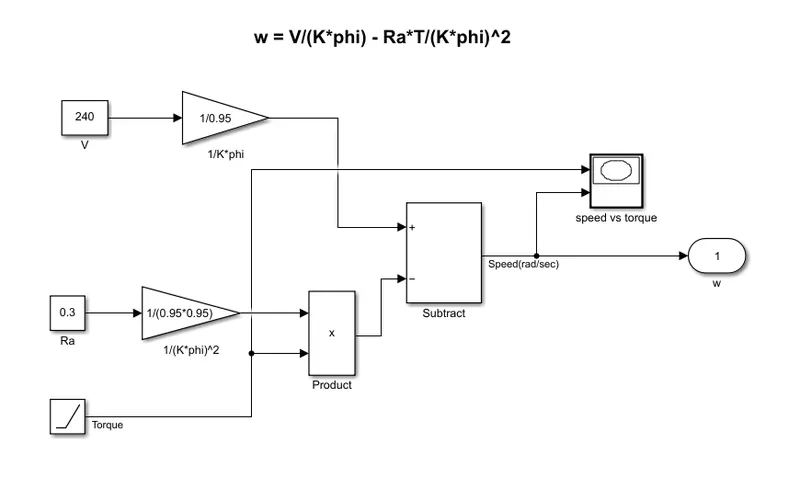
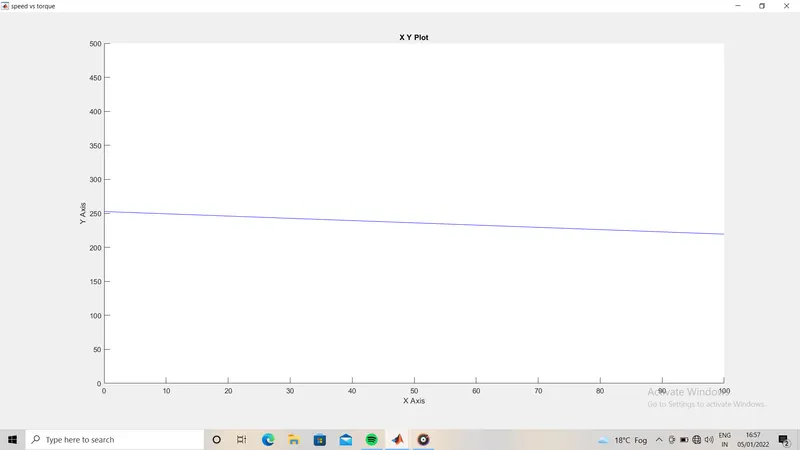
In above model the value of armature resistance Ra = 0.3, Applied voltage = 240v, K*phi = 0.95, and ramp is given torque. After running the model, the obtained speed vs torque graph is following-
Part 4 Author's perspective
In blog author wally rippel, have discussed about brushless DC motor and induction motor. Also compare them on basis of construction and performance. Let explain in brief about author's view under following headings-
One Size Does Not Fit All- Here writer wants to say that there is no absolute engine which fits for all kind of vehicles. Different kind of demand and performance needs different kind of engine. Similarly one kind of motor can not be useful for achieving all needs and demands.Each will have its loyal proponents and religious detractors.
A Closer Look - Under this topic author discuss about construction of both brushless DC motor and induction motor and compare them. He found that both motor are similar in some extent. As construction of stator of both are same but thier rotor's design is not same. There is lot of differences and similarities in both motor regarding construction. He also discuss about the starting of both motor, he concluded that induction motor is self starting but it need AC supply . 3-phase induction motors have great utility, they also have some severe limitations. They cannot operate from DC; AC is a must. Shaft speed is proportionate to line frequency. So inverter is connected between battery an motor for conversion. Brushless motor is not self starting but its speed can be controlled by variable voltage supply. In induction motor variable frequency drive is used for controlling speed.
Brushless or Induction?- Here wally rippel is trying to compare both motor regarding control and its operation.He says that both DC brushless and induction drives use motors having similar stators. Both drives use 3-phase modulating inverters. The only differences are the rotors and the inverter controls. And with digital controllers, the only control differences are with control code. Cooling of DC brushless motor is easier compared to induction motor so its peak point performance is better. In DC brushless motor permanant magnets are used so we can not control strength of magnetic field and its strength decreases with time. In induction machines have no magnets and B fields are “adjustable,” since B is proportionate to V/f (voltage to frequency).This advantage becomes increasingly important as performance is increased. With DC brushless, as machine size grows, the magnetic losses increase proportionately and part load efficiency drops. With induction, as machine size grows, losses do not necessarily grow.Also, due to the field weakening capabilities of induction machines, inverter ratings and costs appear to be lower, especially for high performance drives. Induction machines are more difficult to control. The control laws are more complex and difficult to understand.
Still No Winner- The conclusion of author is that DC brushless drives will likely continue to dominate in the hybrid and coming plug-in hybrid markets, and that induction drives will maintain dominance for the high-performance pure electrics vehicles. There is a lot of common hardware and parts in both motor drives. Both are economically useful according to demand and performance of vehicles.