Week-6 Challenge: EV Drivetrain
1) Which types of power converter circuits are employed in electric and hybrid electric vehicle?
Solution:
- Electric vehicles and hybrid electric vehicles configurations utilizes two energy storage devices, one with high energy storage capability, called the “Main Energy System” and the other with high power capability and reversibility, called the “Rechargeable Energy Storage System”.
ELCTRIC VEHICLES:
- Energy storage devices and supply devices changes its output voltage with load or state of charge.
- This results in the highvoltage of the DC-link makes a challenge to the designers while integrating energy storage devices.
- This is where power converters are used. DC-DC converters are used to interface the elements in the power train by boosting the voltage levels.
- In EV vehicles there is combination od different energy sources, fuel cells, batteries, supercapacitore to drive anelctric driven system.
- DC-DC convertor is neccessary to interface with FC, super capacitors module to DC-link.
- DC-DC convertor can be designed to transfer power in only one direction from input to output.
- DC to DC converter is a category of power converters and it is an electric circuit which converts a source of DC from one voltage level to another, by storing the input energy temporarily and then releasing that energy to the output at a different voltage.
- While interfacing the Fuel Cell, the DC/DC converter is used to boost the Fuel Cell voltage and to regulate the DC-link voltage.
HYBRID ELECTRIC VEHICLES:
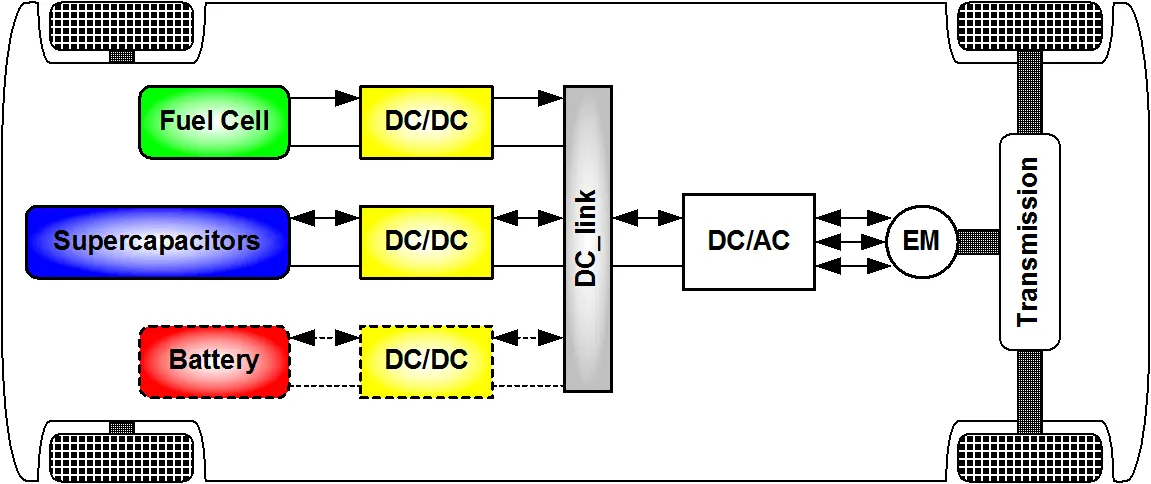
- There are five main types of convertor in non-isolated group usually called as buck,boost,buck-boost,cuk and charge-pump convertors.
- Buck converter is used for voltage step-down, while the boost converter is used for voltage step-up.
- The buck-boost and Cuk converters can be used for either step-down or step-up.
- The charge-pump converter is used for either voltage step-up or voltage inversion, but only in relatively low power applications.
2) An Electric Vehicle's powertrain with 72V battery pack in shown in the diagram below. The duty ratio for acceleration operation is 'd1' and for the braking operation the duty ratio is 'd2'.
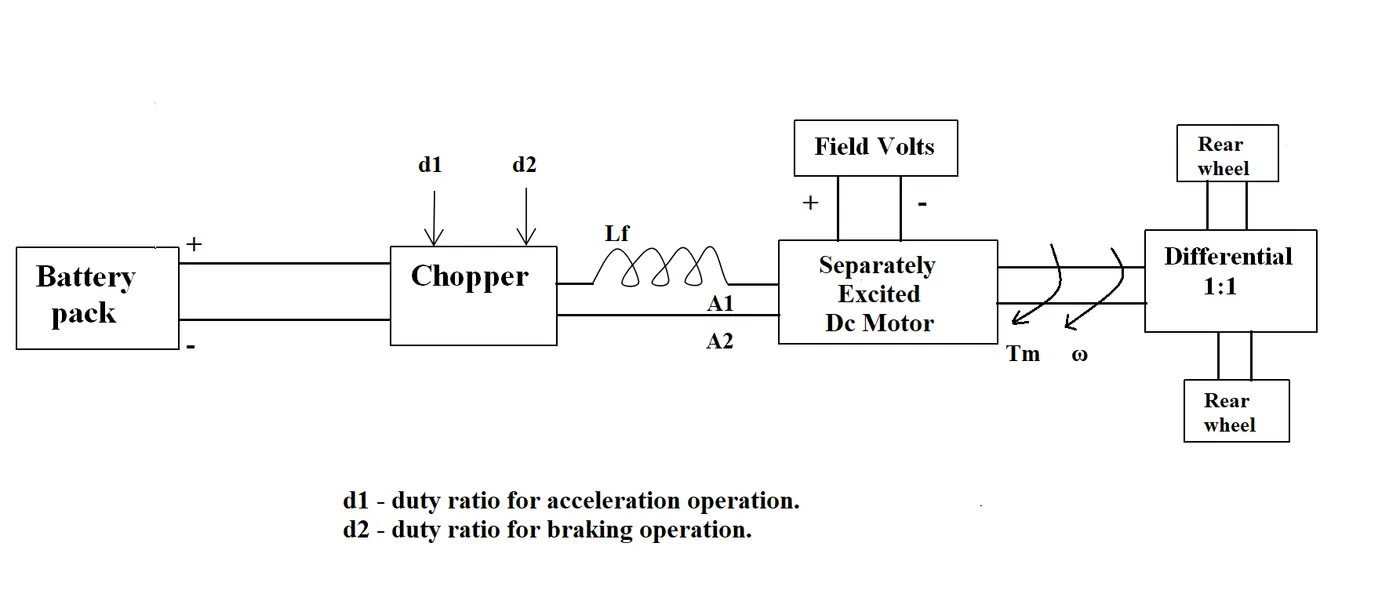
The other parameters of the electric vehicle is given below,
Motor and Controller Parameters:
Rated Armature voltage= 72 V
Rated armature current= 400 A
Ra= 0.5Ω, KΦ= 0.7 Volt second
Chopper Switching frequency= 400 Hz
The vehicle speed-torque characteristics are given by the below equation

What is EV steady state speed if duty cycle is 70%?
Solution:
Given parameters :
Rated Armature voltage = 72V
Rated armature current = 400 A
armature resistance (Ra) = 0.5Ω
Motor constant (KΦ) = 0.7
Chopper Switching frequency= 400 Hz
Duty cycle = 70% = 0.7
Actual voltage = 0.7*72 = 50.4V
vehicle torque equation of a motor is given as
T = ((V*KΦ)/Ra)-((KΦ)^2/Ra)*ω
T = ((50.4*0.7)/0.5)-((0.7)^2/0.5)*ω
T = 70.56 - 0.98ω ...........(2)
.........(1)
By solving 1 & 2
comparing both Torque of vehicle & Torque of motor
24.7 + (0.0051)*ω^2 = 70.56-0.98ω
0.0051ω^2 + 0.98ω - 45.86 = 0
by solving this quadratic equation we get two ω values as
ω = 38.91 rad/sec ω = -231.07 rad/sec
So the EV steady state speed is 38.91 rad/sec if duty cycle is 70%.
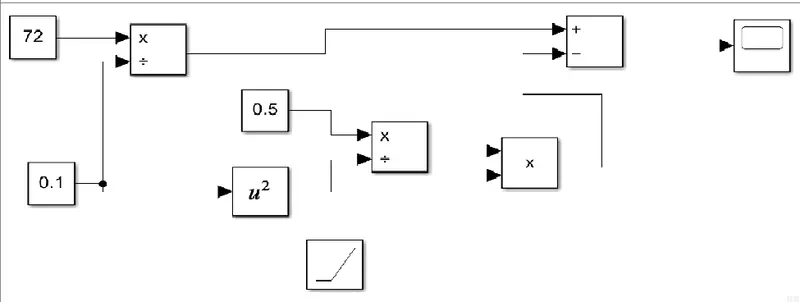
Develop a mathematical model of a DC Motor for the below equation using Simulink.
ω= V/Kϕ - Ra/Kϕ^2 .T
Solution:
We have drawn the model equation in simulink with assumed values and simulated result is shown below.
Result:
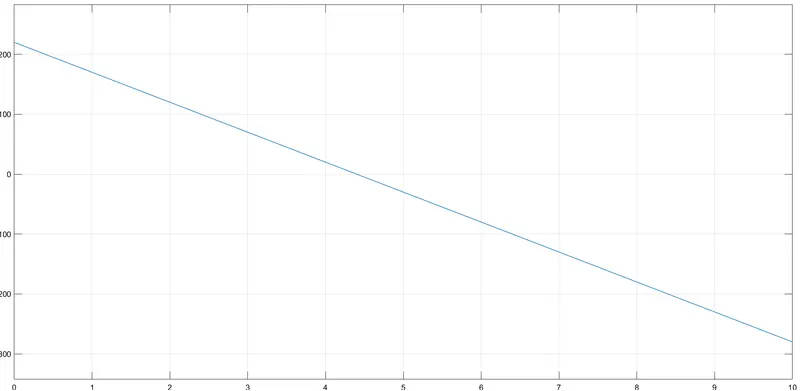
It is seen that speed is inversely propotional to torque.
4) Refer to the blog on below topic:
Induction Versus DC brushless motors by Wally Rippel, Tesla
Explain in brief about author’s perspective.
Solution:
According to author Lead has been replaced by lithium and DC by either DC brushless or induction. He predicts that we will see both induction and brushless machines in near future.
DC Brushless motor:
- In DC Brushless motor rotor includes two or more permanent magnets that generate a DC magnetic field.
- As the rotor rotates, it is necessary that the magnitude and polarity of the stator currents be continuously varied – and in just the right way - such that the torque remains constant and the conversion of electrical to mechanical energy is optimally efficient.
- where less rotor heat is generated for DC brushless motor.
- So Rotor cooling is easier also peak point efficiency is high for this drive.
- It is same as synchornous motor, where input is DC supply and is converted to AC supply using invertor.
- The advantage of DC motor when compared to all is its controlling speed.
Induction motor:
- It is must that it should have an AC.
- These do not have brushes and it makes it less in maintainence.
- like the DC brushless rotor, the induction rotor has no magnets.
- The stators for the 3-phase induction motor and the DC brushless motor are virtually identical.
- Both have three sets of distributed windings that are inserted within the stator core.
- The essential difference between the two machines is with the rotor.
- The DC brushless drive can also operate at unity power factor, whereas the best power factor for the induction drive is about 85 percent.