Week-4 Challenge WOT Condition Part-2
1)What is the difference between mapped and dynamic model of engine, motor and generator? How can you change model type?
Solution:
Mapped and dynamic model of motor and generator:
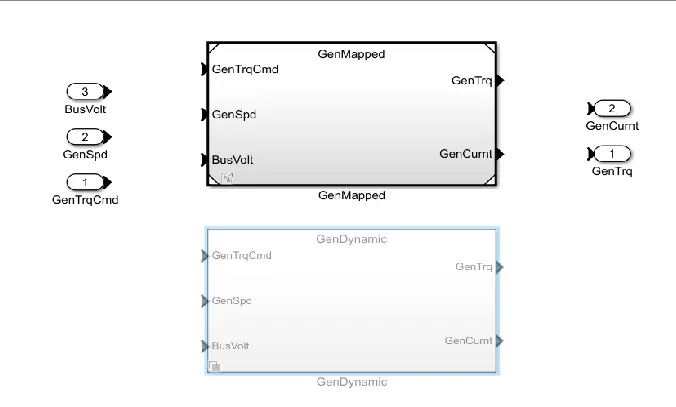
The above figure denotes the mapped and dynamic model of generator and motor.
Mapped Model:
- In genral mapped model the datapoints are pre-assigned in lookup tables.
- we can also run the simulation with predefined commands.
- Mapped model takes less time in simulation process.
- It does not involves the real-time outputs from subsystems.
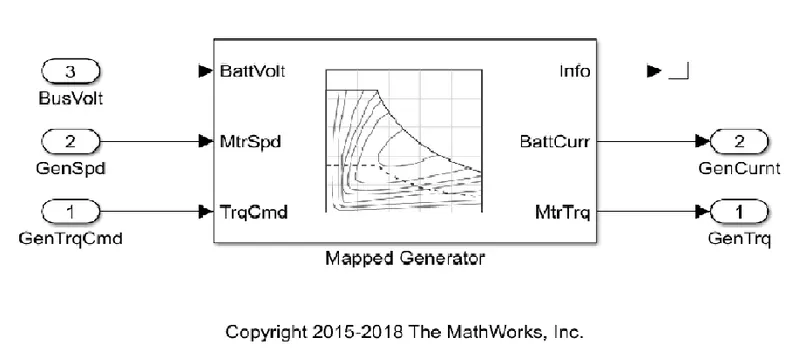
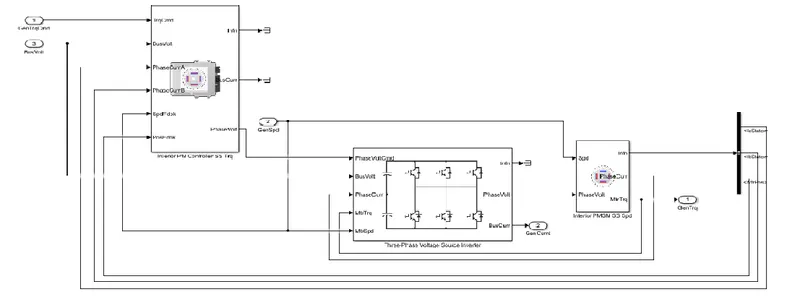
Dynamic Model:
- Dynamic model is simulated with actual model with out any predefined dataset.
- The real-time outputs from all subsystems involves dynamic model.
- It takes more time to simulate when compared to mapped simulation.
Changing model type:
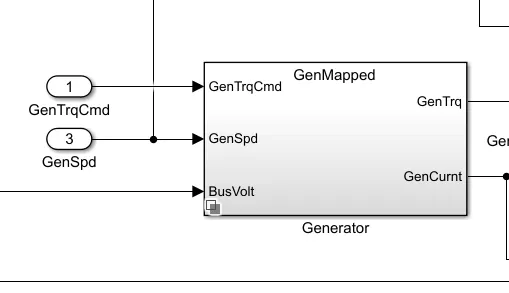
- To change in model type of generator rightclick on generator then select variant and select label mode active choice and select model type.
- To change in model type of motor rightclick on generator then select variant and select label mode active choice and select model type.
2.)How does the model calculate miles per gallon? Which factors are considered to model fuel flow?
Solution:
Here the model is taken as HEV reference application.
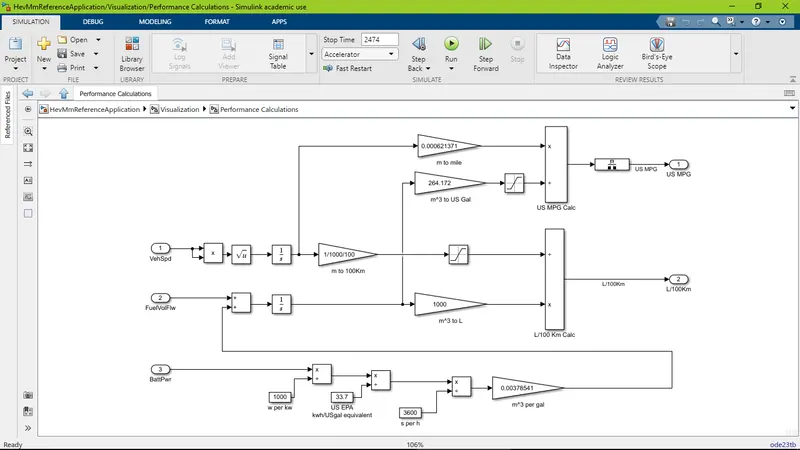
- vehicle speed
- Fuel flow
- Battery power are the things that to be considered to model fuel flow.
- Miles per gallon gasoline equivalent is a measure of the average distance traveled per unit of energy consumed.
- The miles per gallon is calculated by considering the battery output, Fuel output and speed of vehicle in kilometers driven.
- Battery power is divived by 1000 to convert W per KW, after that we convert the energy from KWh to USgallon equivalent energy by dividing it by 33.7 of automotive gasolone.
- Then by dividing with 3600 to convert hour to seconds, we get energy of equivalent LISgallons per seconds.
- Then this is taken as feed back to fuel flow and now integrating this will give the mass of fuel and then we can multiply by 1000 to get in litres.
- Now to calculate miles per gallon all inputs(distance, vehicle speed) are taken into consideration then converts into miles by multiplying with 0.00621371.
- Now the inputs(battery power, fuel flow) are taken and then converts into equivalent US gallons by multiplying with 264.172.
- Then further by dividing US gallons and multiplying miles we get the results as miles per gallons.
3) Run the HEV ReferenceApplication with WOT drive cycle. Change the grade and wind velocity in the environment block. Comment on the results.
Solution:
- Here i have taken HEV multimode reference application. so we will see this application with and without changing the grade and wind velocity in environment block.
Hybrid Electric Vehicle Multimode Reference Application:
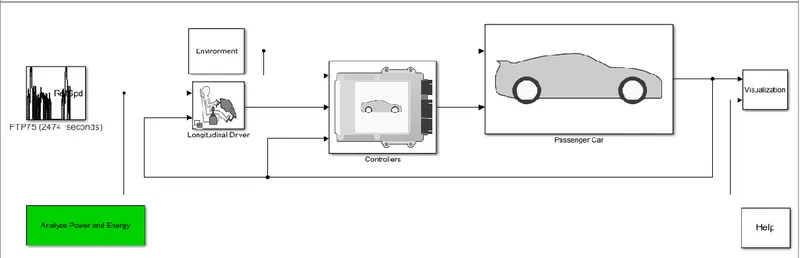
HEV ReferenceApplication with WOT drive cycle and without changing the environment block:
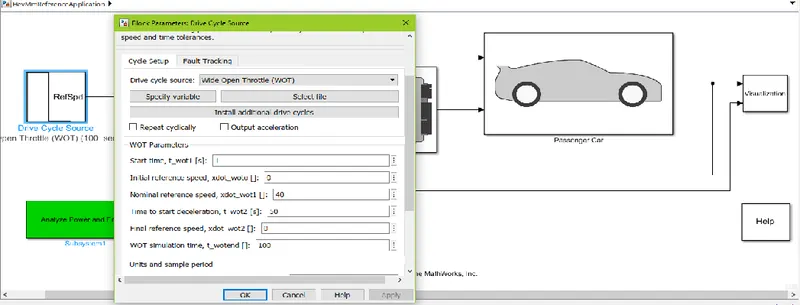
we should change the drive cycle to wide open throttle as shown below
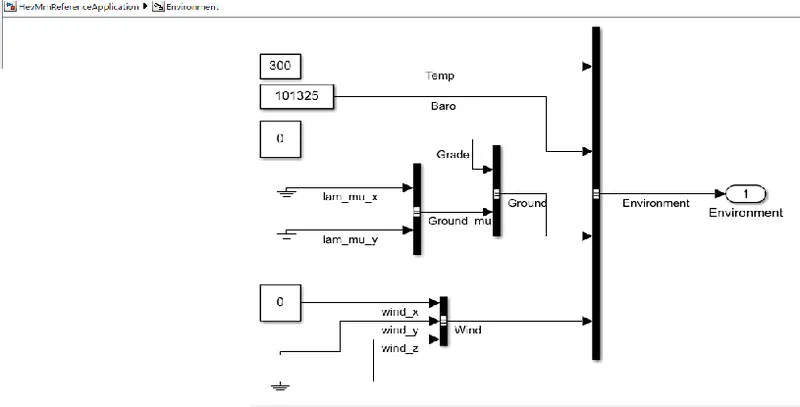
Then we should open the environment block and see that no change is to be done for grade and wind velocity .
Now run the simulation to see the results.
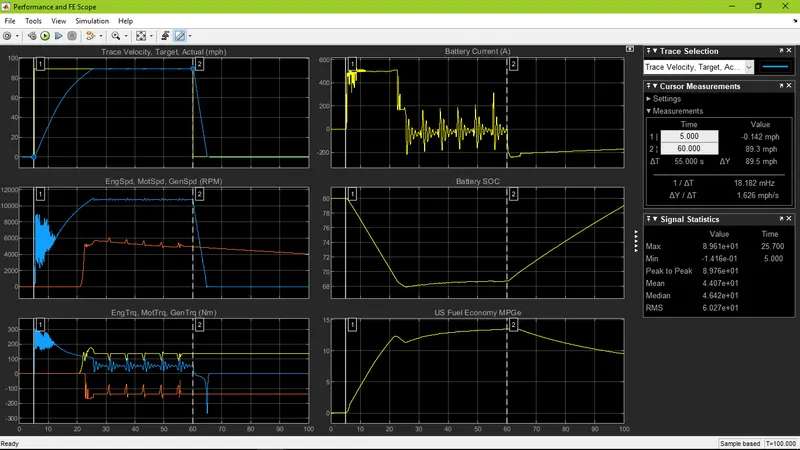
- The vehicle attains a speed of 89.5 mph with the acceleration time of 55 sec.
- The state of charge at start of simulaton is 80 and reduces to 68.7 by the end of accelaration period.
- The motor speed of the vehicle during the acceleration period is noted as 4932 rpm.
- The maximum fuel used during the vehicle simulation is 13.5.
HEV ReferenceApplication with WOT drive cycle and changing the environment block:
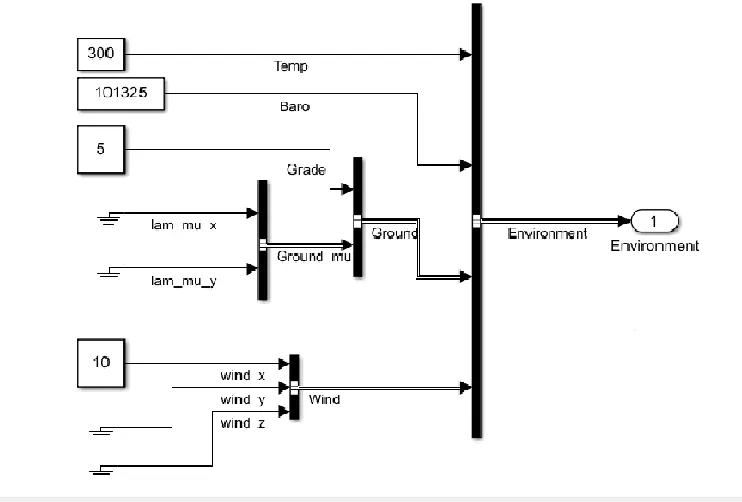
After changing the grade and wind velocity in environment block we should simulate the results and analyze it.
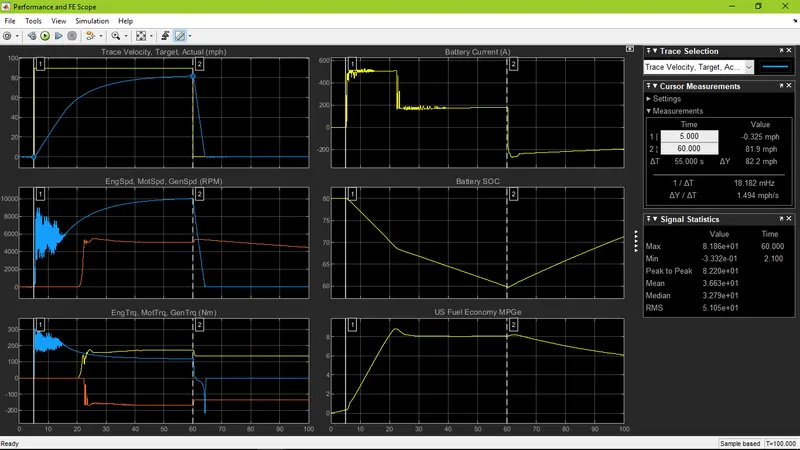
- After changing the vehicle attains a speed of 82.2 mph with an acceleration time of 55 sec.
- The state of charge at the start is similar as previous but by the end of acceleraton time the state of charge is 59.8.
- The maximum fuel used by the vehicle in this process is 8.8.
- The motor speed during the acceleraton reches maximum to 100000 RPM.
Analysing Both in Tabular Form :
| Parameters | with out change in environment block | with change in environment block |
| Grade | 0 | 5 |
| Wind velocity | 0 | 10 |
| Top speed | 89.5 mph | 82.2 mph |
| Acceleration time | 55sec | 55 sec |
| Deceleration time | 5.05 sec | 4.34 sec |
| Intial soc | 80 | 80 |
| Soc at the end of acceleration | 68.7 | 59.8 |
| Soc at the end of simulation | 79 | 71.3 |
| Maximum Fuel economy | 13.5 | 8.8 |
| Max battery current | 523.7 amp | 527.8 amp |
4) Keeping all other parameters same, compare the simulated results of hybrid and pure electric powertrains.
Solution:
Pure EV ReferenceApplication with WOT drive cycle and without changing the environment block:
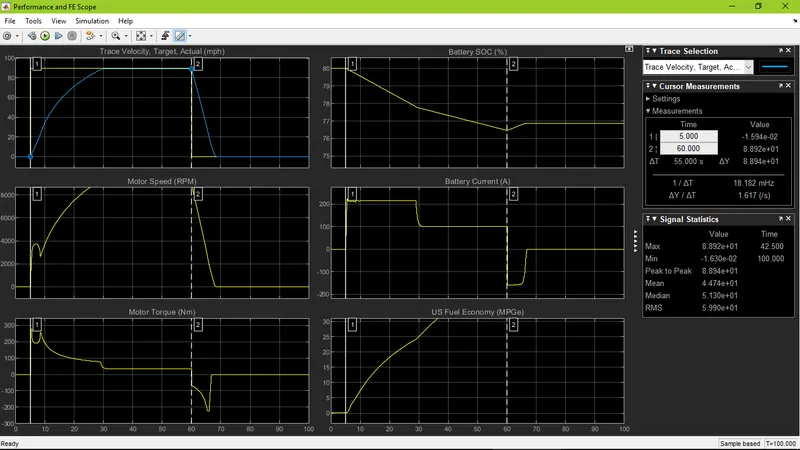
- The vehicle attains a speed of 88.9 mph with the acceleration time of 55 sec.
- The state of charge at start of simulaton is 80 and reduces to 76.4 by the end of accelaration period.
- The motor speed of the vehicle during the acceleration period is noted as 9269 rpm.
- The maximum fuel used during the vehicle simulation is 55.4.
Pure EV ReferenceApplication with WOT drive cycle and changing the environment block:
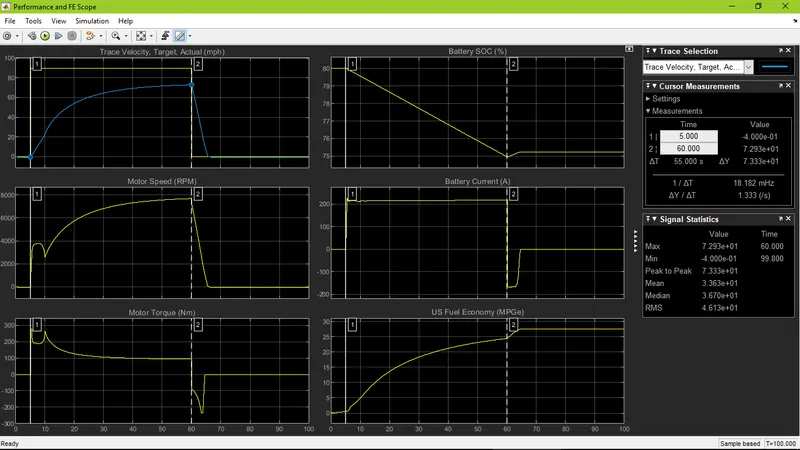
- After changing the vehicle attains a speed of 73.3 mph with an acceleration time of 55 sec.
- The state of charge at start of simulaton is 80 and reduces to 74.9 by the end of accelaration period.
- The maximum fuel used by the vehicle in this process is 27.6.
- The motor speed during the acceleraton reches maximum to 7494 RPM.
Analysing in Tabular Form :
| Parameters | with out change in environment block(HEV) | with out change in environment block(EV) | with change in environment block(HEV) | with change in environment block(EV) |
| Grade | 0 | 0 | 5 | 5 |
| Wind velocity | 0 | 0 | 10 | 10 |
| Top speed | 89.5 mph | 88.9 mph | 82.2 mph | 73.3 mph |
| Acceleration time | 55sec | 55 sec | 55 sec | 55 sec |
| Deceleration time | 5.05 sec | 8.38 sec | 4.34 sec | 5.76 sec |
| Intial soc | 80 | 80 | 80 | 80 |
| Soc at the end of acceleration | 68.7 | 76.4 | 59.8 | 74.9 |
| Soc at the end of simulation | 79 | 76.8 | 71.3 | 75.2 |
| Maximum Fuel economy | 13.5 | 55.4 | 8.8 | 27.6 |
| Max battery current | 523.7 amp | 223.5 amp | 527.8 amp | 224.8 amp |