Week-6 Challenge: EV Drivetrain
1. Which types of power converter circuits are employed in electric and hybrid electric vehicle?
2. An Electric Vehicle's powertrain with 72V battery pack in shown in the diagram below. The duty ratio for acceleration operation is 'd1' and for the braking operation the duty ratio is 'd2'.
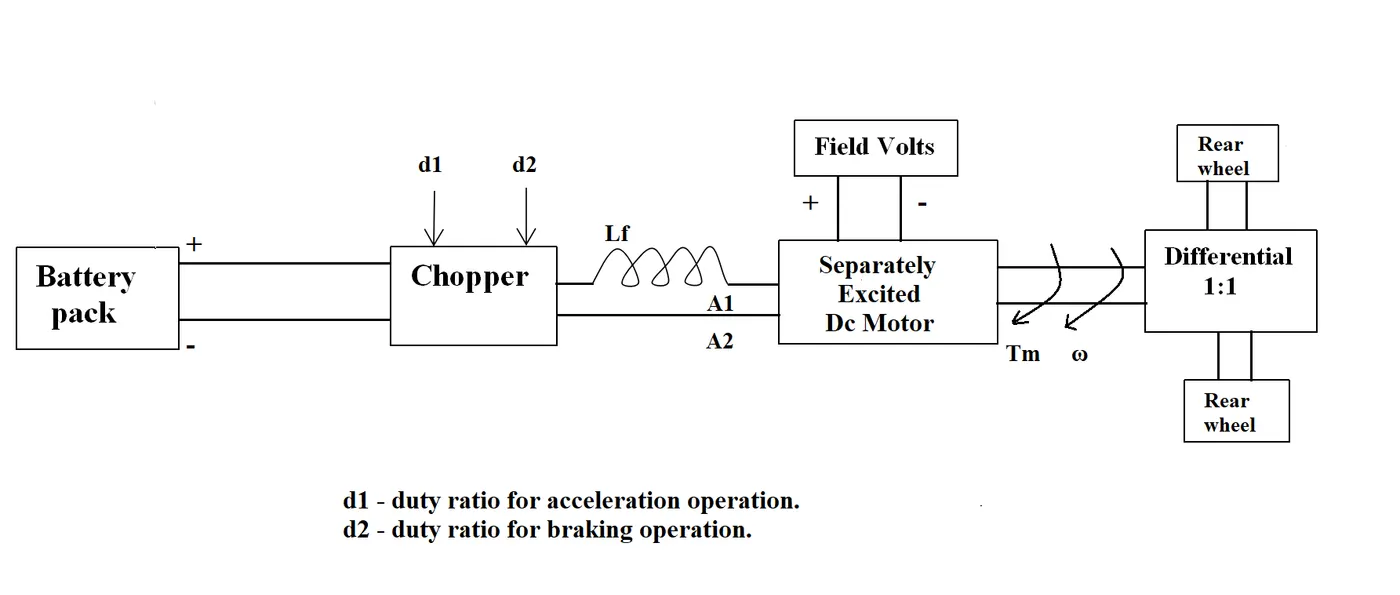
The other parameters of the electric vehicle is given below,
Motor and Controller Parameters:
Rated Armature voltage= 72 V
Rated armature current= 400 A
Ra= 0.5Ω, KΦ= 0.7 Volt second
Chopper Switching frequency= 400 Hz
The vehicle speed-torque characteristics are given by the below equation

What is EV steady state speed if duty cycle is 70%?
3. Develop a mathematical model of a DC Motor for the below equation using Simulink.
ω">ωω= V/Kϕ">ϕϕ -Ra/Kϕ">ϕϕ^2 .T
4. Refer to the blog on below topic:
Induction Versus DC brushless motors by Wally Rippel, Tesla
Explain in brief about author’s perspect
Sol
1. Which types of power converter circuits are employed in electric and hybrid electric vehicle?
Depending on the functions following are the four different classifications
a) AC to DC converter- It is called as rectifier,it converts ac in dc current
b) DC to AC converter - It is called as inverter and converts AC into Dc of desired voltage and frequency
c)AC to AC converter- It is known as cycloconverter- It converts Ac of desired frequency and voltage magnitude from the AC supply
d) DC to DC converter- It converts high voltage DC to Low voltage DC or vice versa.
Except from AC-AC converter rest 3 are highly used.
AC to DC converter this is used for charging the traction battery.because the source current is AC and the voltage stored in the traction battery is DC.
the DC current from the batery and the DC induction motor,the motor is directly connected to the wheels and is reponsible for the traction.Incase of regenerating braking this motor works as generator.
DC -DC converter takes the DC source from the traction battery,the output from this dc to dc converter is used to power all the other components of EV like Headlamps ,AC ets.
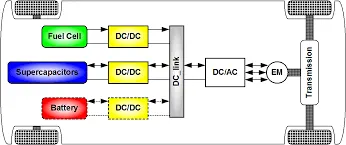
2. An Electric Vehicle's powertrain with 72V battery pack is shown in the diagram below. The duty ratio for acceleration operation is 'd1' and for the braking operation the duty ratio is 'd2'.
The other parameters of the electric vehicle is given below,
Motor and Controller Parameters:
Rated Armature voltage= 72 V
Rated armature current= 400 A
Ra= 0.5Ω, KΦ= 0.7 Volt second
Chopper Switching frequency= 400 Hz
The vehicle speed-torque characteristics are given by the below equation
What is EV steady state speed if duty cycle is 70%?
Sol
Battery voltage =72 V
Va=72V
Ia=400A
Ra=0.5 ohm
KΦ=0.7 V
Switching Frequency=400Hz
Vehicle speed torque char eqn T= 24.7+0.0051 omega ^2 eq(1)
Sol
Supply terminal @70% duty cycle is 0.7*72=50.4V
Putting the value in torque speed eq
(V.kΦ)/(Ra)-(kΦ)^2/(Ra)*w
we get
=70.56=0.98 omega eq2
From eq1 &2
We get eq3
0.0051omega^2+0.98 omega-45.86=0
eq3 represents quadratic eq ax^2+bx+c
by using quadratic eq solver method
omega =(-bpmsqrt(b^2-4ac))/(2a)
Putting the values we get omega =39.9 rad/s
Therefore steady state speed of EV @ 70% duty cycle is 38.91 rad/s.
3. Develop a mathematical model of a DC Motor for the below equation using Simulink.
ω= V/Kϕ -Ra/Kϕ^2 .T
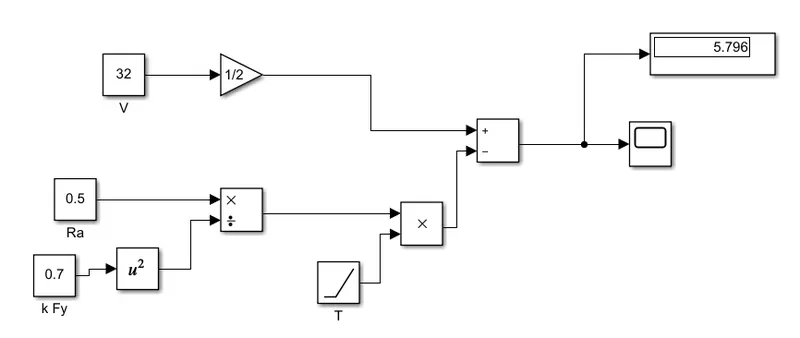
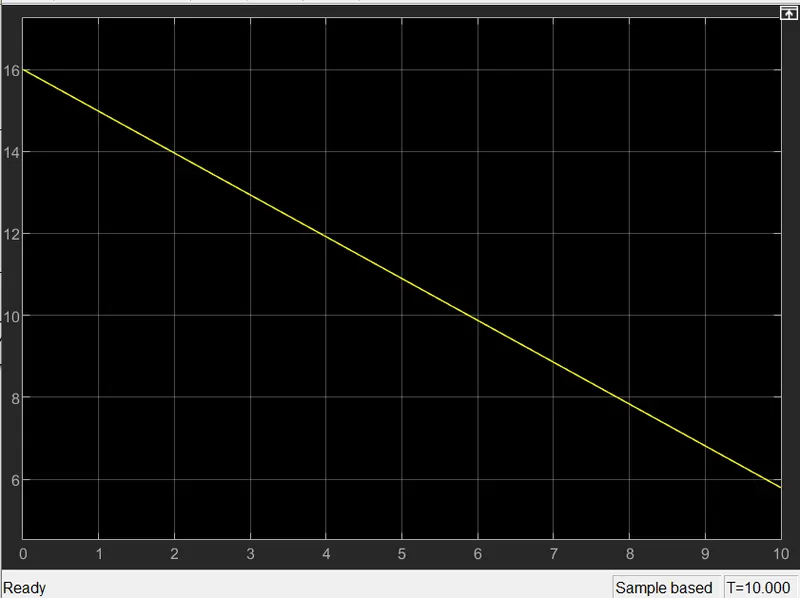
Display block shows the total output
T is the torque which is used as ramp function
4. Refer to the blog on below topic:
Induction Versus DC brushless motors by Wally Rippel, Tesla
Explain in brief about author’s perspect
Sol
Authors perspective is to highlight advancement happening in the production of EVs but at the same time he wanted us to realise that there is no major advancement happening.
Lead acid batteries are now replaced with Lithium ion battery,Brushed DC by BLDC or Induction motor,contactors by modulating inverters.
He then explains about construction and working of BLDC and IM.Stators of both the motors were simila in construction but stator of BLDC needed phase inverter and rotor positioning sensor to work.Rotor of BLDC made up of magnets whereas IM is made of stacked steel lamination with conductors inside them which are shorted at the ends using rings.
IM do not have much torque range,and they have constant speed drive not much variation in speed.but by using the inverter frequency of the signal can be varied to get wide range of speed control.
He then explains how we can get High torque low speed characteristics from moto.one way was strenthening magnetic field.In BLDC we cant do that due to permanent magnet.But IM can do as it runs on principal of induction but still peak performance of BLDC is higher than IM.
IM seems to be winner but he then says that IM is very difficult to control.It involves very difficult techniques.
Walley concludes that BLDC will rule all HEV and IM will be useful in high application EV.
As per Walley no motor can serve all the purpose.