Week-6 Challenge: EV Drivetrain
Question-1:
Question-2:
Given :-
Duty Cycle = 70% à converting to absolute value = 0.7
Rated Armature voltage = Vr = 72V
Rated current of Armature = Ir = 400A
Armature Resistance = Ra = 0.5 Ω
K∮ = 0.7 volt second
Frequency of Chopper = f = 400 Hz
w = speed
Vt = Rated armature voltage * Duty Cycle = (72V * 0.7) = 50.4 volts
Vehicle characteristics = Tv = 24.7 + 0.0051 w^2 …………..............................................eq. (1)
Motor speed characteristic equation : w = ( Vt / K∮ ) – (Ra / (K∮)^2)*T ………….................. eq. (2)
Rearranging eq. (2) we arrive at T = Vt * (K∮ / Ra) – ((K∮)^2 / Ra) * w ………………………………. eq. (3)
Using the given values in eq. (3)
T = ( (50.4) * (0.7) / 0.5) – ((0.7^2) * w / 0.5)
T = 70.56 – 0.98w ….................................................................................................... eq. (4)
Comparing eq.(1) & eq.(4)
24.7 + (0.0051)w^2 = 70.56 – (0.98)w
(0.0051)w^2 + (0.98)w – 45.89 = 0
w = -231.07 rad /sec
w = 38.92 rad/sec (Torque transfer by motor and is the steady state speed for the given battery voltage and duty cycle of 70%)
Question-3
To Develop a mathematical model of a DC Motor for the below equation using Simulink.
ω= (V/Kϕ) - (Ra/Kϕ^2) .T
following values are assumed
V = 380V
Kϕ = 0.5 volt second
Ra = 5 ohms
T = 20 m/s
Simulink Model is attahced with the submission for ref.
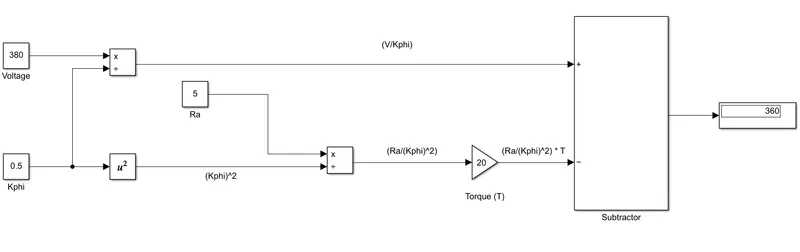
w achieved by using the model (with assumed values ) = 360 rad/sec
Question-4
The prime focus of the author (Mr. Walley Ripple) is to elaborate the characteristics difference (w.r.t construction, working principle and cost) between the,
1.Brushless DC motor drive &
2.Induction motor drive
and to provide the optimum choice for a right motor depending on the requirements
The comparison made by the author w.r.t Key characteristics of Brushless DC & Induction motor drive is given below.
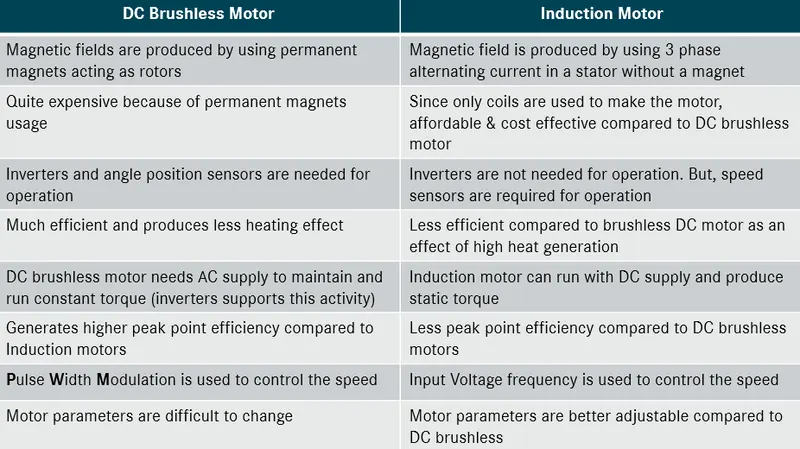
Inference on Author's conclusion:
- Both DC brushless motor drive and Induction motor drive will continue to serve the automotive industry as most of the hardware structures of both are very comon.
- DC brushless motors dominates the HEVs and PHEVs. But, Induction motor will dominate pure electric vehicles
- The choice of the right motor drive clearly depends on it’s utility and each of them have their own significance and capabilities for their choice. Hence, a clear analysis and requirement study is necessary to understand the Pros and Cons of Brushless DC motor drive over Induction motor drive and vice versa before they are selected for a specific need.