Week-6 Challenge: EV Drivetrain
- Which types of power converter circuits are employed in electric and hybrid electric vehicle?
Ans.
The figure below shows how Power Electronic Converter is used in different configurations of vehicles.
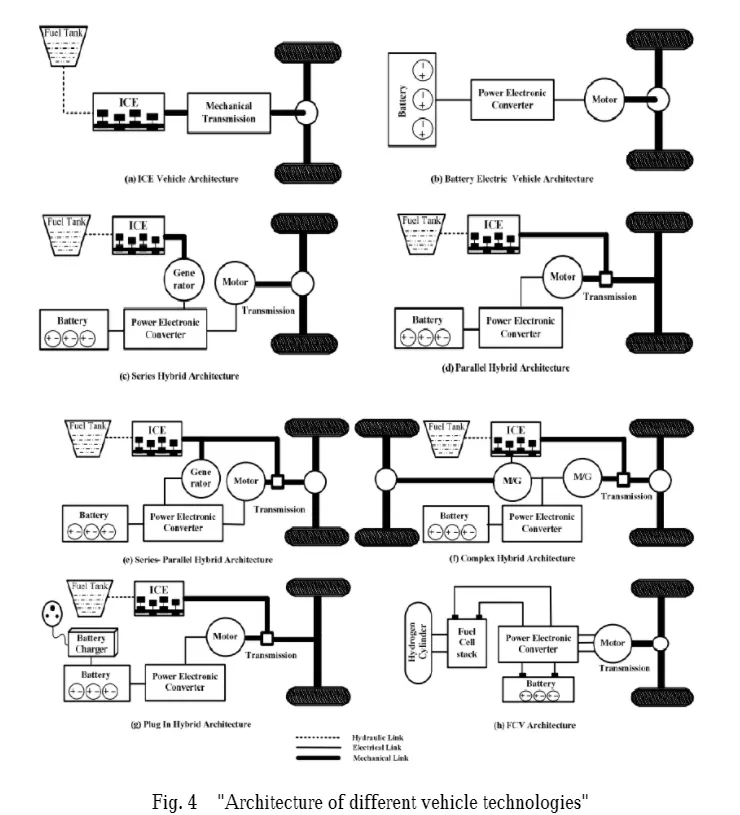
Few of the power electronic converters used in EV/HEV vehicles include:
1.DC/DC Converters used for supplying Low Voltage Loads (12-14V):
Nominal voltages of the battery packs of EV and HEV typically range from 200 volts
to 340 volts. The use of high-voltage battery packs requires some kind of power
conditioning to provide 12 volts to 12-volt electrical loads. There would always be a
need for high-voltage-to-low-voltage power conversion because some loads, such as
headlights and microprocessors, require low voltages.
2.DC/DC Converters used for boosting the battery voltage:
AC motors in EVs and HEVs are fed by inverters which in-turn is fed by a high voltage DC/DC converter. Unidirectional DC/DC converters cater to various onboard loads such as sensors, controls, entertainment, utility, and safety equipment. They are also used in
DC motor drives electric traction. Bidirectional DC/DC converters find applications
in places where battery charging, regenerative braking, and backup power are required.
3.DC/DC Converters used for DC Motor Drives:
Some soft-switching DC/DC converters have been specially
developed for EV propulsion, which offers the capability of bidirectional power flow
for motoring and regenerative braking.
4.DC/AC Converters:
A suitable DC/AC inverter draws DC power from the batteries to drive the electric
traction motor, which in turn provides power to the wheels. The DC/AC inverter also
performs the function of recharging the batteries during regenerative braking in HEVs. Also, Inverters are used for supplying utility loads such as Air conditioning
and power outlets. Voltage source inverters are extensively used.
5.Battery Chargers:
EV battery chargers can use on-board and off board with unidirectional or
bidirectional power flow. Battery charger consists of powerfactor correction circuitary which in turn uses power electronic devices for rectification purposes.
2. An Electric Vehicle's powertrain with 72V battery pack in shown in the diagram below. The duty ratio for acceleration operation is 'd1' and for the braking operation the duty ratio is 'd2'.
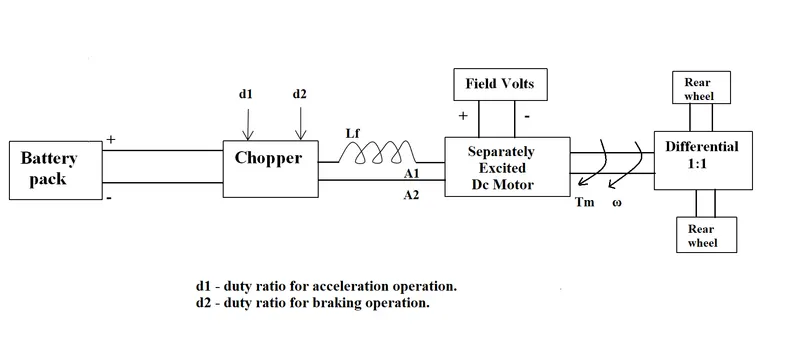
The other parameters of the electric vehicle is given below,
Motor and Controller Parameters:
Rated Armature voltage= 72 V
Rated armature current= 400 A
Ra= 0.5Ω, KΦ= 0.7 Volt second
Chopper Switching frequency= 400 Hz
The vehicle speed-torque characteristics are given by the below equation

What is EV steady state speed if duty cycle is 70%?
Ans.
The torque of the motor is given by the equation,
Tm=(V/Ra)K-(K2/Ra)*ω2
Substitute the values given in the question,
Tm=(50.480.7)/0.5-((0.7*0.7)/0.5) ω2
Tm=70.56-0.98 ω2
At steady state Tv=Tm
24.7-0.0051 ω2=70.56-0.98 ω2
0.0051 ω2 +0.98 ω -45.85=0
On solving the quadratic equation above we get,
ω =38.92rad/s
- Develop a mathematical model of a DC Motor for the below equation using Simulink.
ωω= V/Kϕ -Ra/Kϕ^2 .T
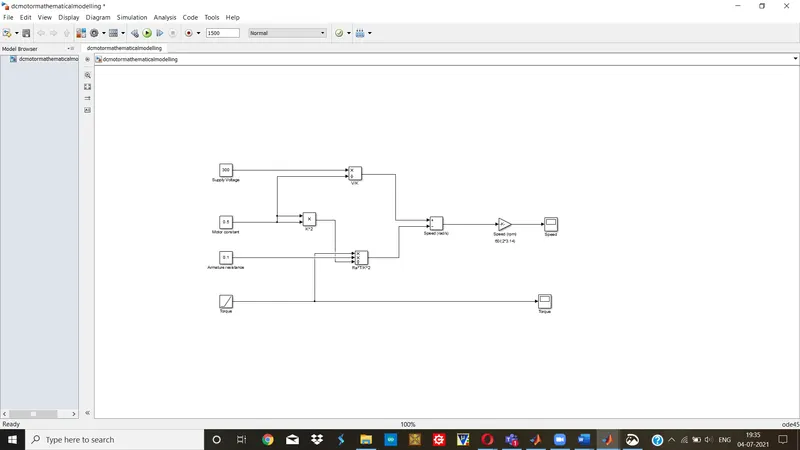
Ans. Following is the Simulink mathematical model for the equation of DC motor given in the question.
https://drive.google.com/file/d/1oh2zHFlRx3kdNuwqTTmAiqyKD7rTWjo_/view?usp=sharing
In order to obtain the given equation, constant block, ramp signal, adder block multiplication-division blocks are obtained from Simulink library.
Supply voltage is taken as 300V, Motor constant as 0.25 and Armature resistance as 0.1ohm for calculating speed. From equation we get speed in rps. To convert rps to rpm a factor of 9.5493(60/(2*pi)) is multiplied.
As in graph, we need to plot speed with respect to change in torque, torque is not considered as constant and took as a ramp signal.
On simulation, both Speed and Torque graphs are obtained in the scope block.
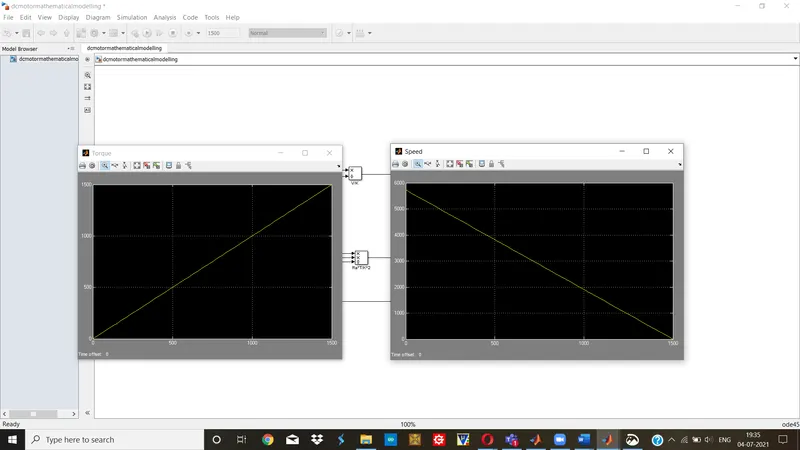
We observe that as torque is increased, speed of the motor decreases. We can conclude that speed is inversely proportional to the torque. We can also observe that obtained plot for speed is linear.
- Refer to the blog on below topic:
Induction Versus DC brushless motors by Wally Rippel, Tesla
Explain in brief about author’s perspective.
Ans. According to the author, there is not best engine. Engine characteristics depends on price and performance. Author says it is impossible to select one best engine between induction motor and DC brushless motor. They both are equally good at their performance. Rather than choosing best among them, we need to look at the requirements needed to be fulfilled by the motor.
CHARACTERISTICS OF DC BRUSHLESS MOTOR:
- Rotor heating will be less.
- There is no starting torque with fixed frequency supply. So, inverter is surely needed.
- This can be operated for UPF loads, whereas, induction motor can operate till 0.85pf loads only.
- Peak energy efficiency is little higher in Brushless motor than induction motor.
- To reduce eddy current losses and hysteresis losses, B should be modified. Strength of magnetic field produced is adjustable but, we don’t have easy ways to vary the magnetic strength of the magnet.
- Rotor cooling is easier.
- Easier to control than induction motor as induction motor equations are difficult to understand.
- DC motor needs position sensor whereas Induction motor requires speed sensor.
CHARACTERISTICS OF INDUCTION MOTOR:
1. Induction motor can directly be connected to conventional utility .
- AC supply is must. Can’t be operated with DC.
- They have limited starting speed, limited maximum torque
- Torque performance is little lower than DC machine
- Induction motors have no magnets so magnetic field can directly be controllable
- Induction motor with smart inverter can have advantages over DC machines.
- For lighter loads, inverter reduces the voltage thereby decreasing the losses. Hence, efficiency is improved.
- Magnetic and conduction losses can be traded with efficiency. This is very important performance characteristics.
- DC brushless motor size is big, So, magnetic losses will be more and efficiency decreases. Whereas, even if size of induction motor is increased losses will not increase. So, for high performance, induction motor is preferred.
- Average efficiency is better
- Permanent magnets are costlier. Magnets are used in DC brushless motor and not in Induction motor . So, induction motor is cost efficient.
High performance Electric vehicles requires Induction motor whereas Hybrid Electric vehicle uses Brushless DC motor.If high torque is the requirement we can go for BLDC and for constant speed requirements Induction motors are preferable. Author also says that Brushless DC motor and Induction motor continue to persist for many upcoming years because of the best characteristics they are providing.