Week-4 Challenge WOT Condition Part-2
WEEK 4:
1.What is the difference between mapped and dynamic model of engine, motor and generator? How can you change model type?
Ans.
Mapped Model:
- Mapped model uses pre-defined value sets.It is generally used for quasi-steady state analysis.
- Mapped model is used when there is no need of detailed component level monitoring.
- Mapped models are faster in simulation.
Dynamic model:
- This model has lower level components which combinedly calculate the dynamic effects. They help in real time analysis as this uses run time data.
- These models are used when component level monitoring is required.
- Dynamic models take more time to simulate.
Steps to change the model type:
1.Navigate to the block which model is to be changed.
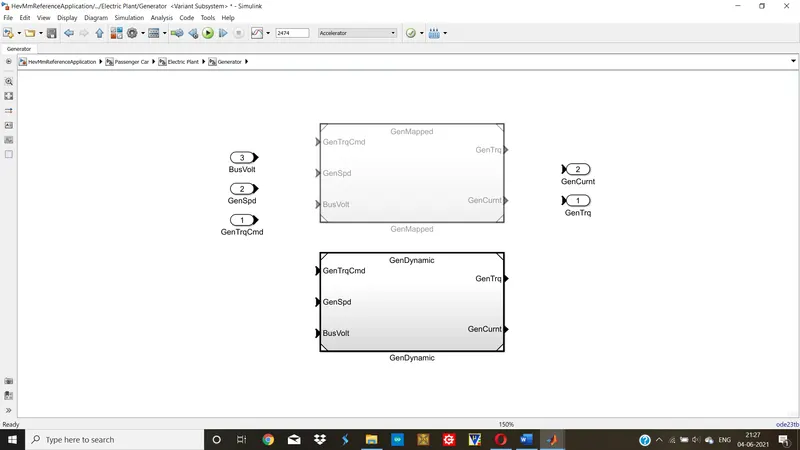
I have changed the generator variant. For that first, double click on Passenger block.
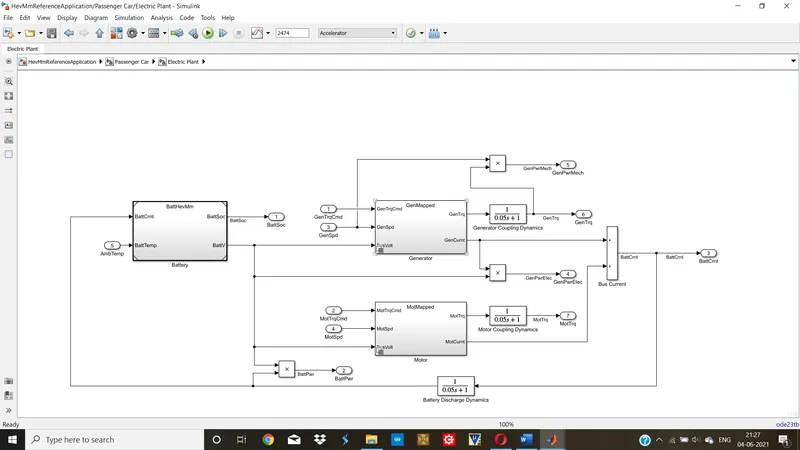
2.Double click on Electric plant.
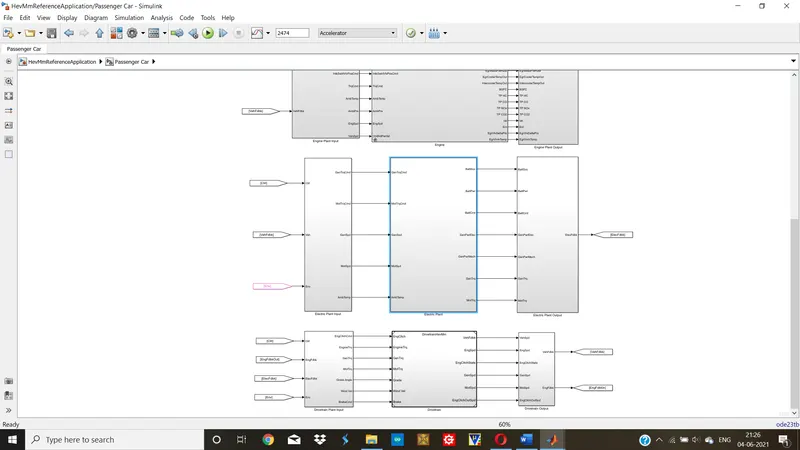
3.Then open Generator block.
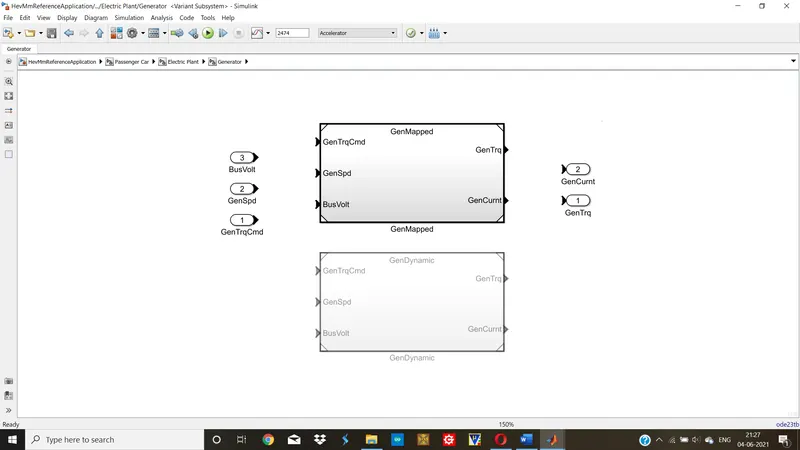
4.Right click the mouse, where we find variant option. Hover on that option and we find Label Mode Active Choice. In that select GenDynamic (GenDynamic).
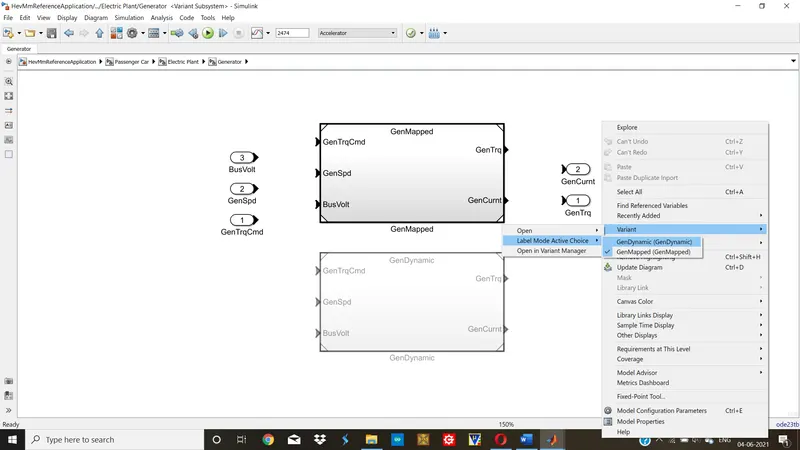
We observe that the model of the Generator is changed from Mapped to Dynamic.
2. How does the model calculate miles per gallon? Which factors are considered to model fuel flow?
Ans. To see the miles per gallon calculation open, Visualization> Performance characteristics
The block diagram to evaluate different parameters is visible as seen in the following picture.
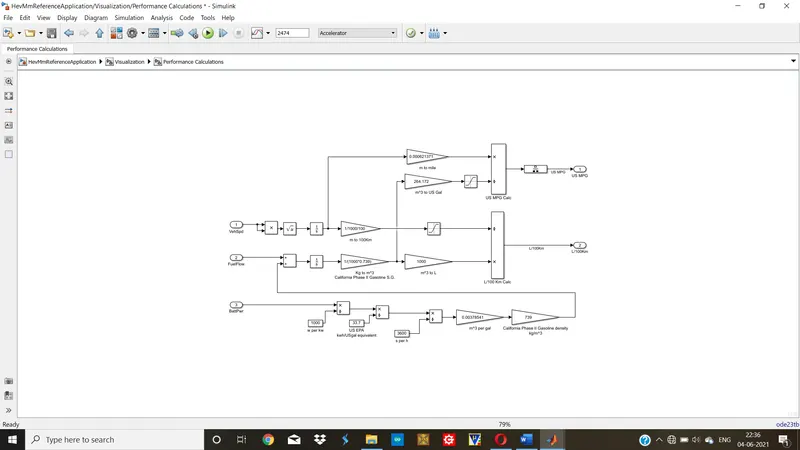
Calculate of MPG can be understood from the following:
- Battery power is converted from W to kW by dividing by 1000 and then converted to US gallons per hour by dividing by the factor 33.7 and then converted to gallons per seconds by dividing it with 3600 and then the result is multiplied with 0.00378541 in order to convert it to m3/s and then multiplied with gasoline density to get the result in kg/sec.
- Fuel flow is added to the battery power output obtained before. This is then integrated to obtain result in Kg. Then Kg is converted to m3 and m3 to liters by multiplying with 1000.
- Vehicle speed is multiplied with itself to avoid negative sign and took square root to get velocity which is integrated to obtain distance.This distance is muliplied with a factor to convert distance to miles.
- The volume of fuel obtained in step 2 in m3 is converted to US Gallons by multiplying with 264.172.
- The result in step 3 is divided by that in step 4 to obtain the output MPG.
3. Run the HEV ReferenceApplication with WOT drive cycle. Change the grade and wind velocity in the environment block. Comment on the results.
Ans.
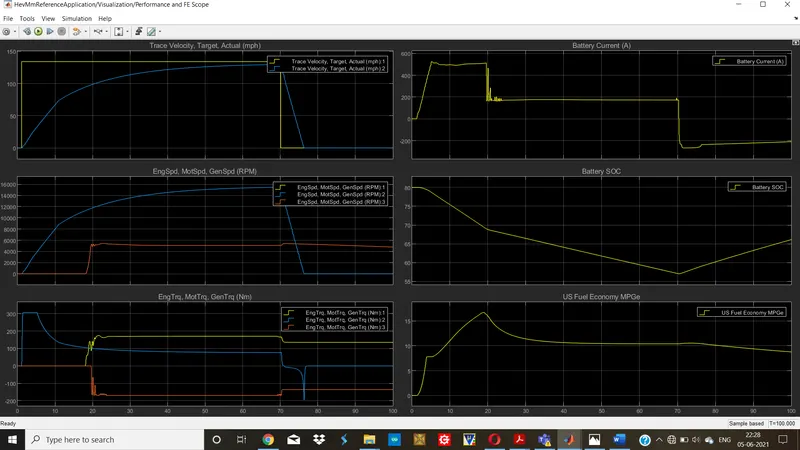
First change the drive cycle from FTP to WOT.

And run the simulation. The obtained waveforms are as below:
Change the grade and velocity in environment block. I have changed grade to 2 and velocity to 10m/s.
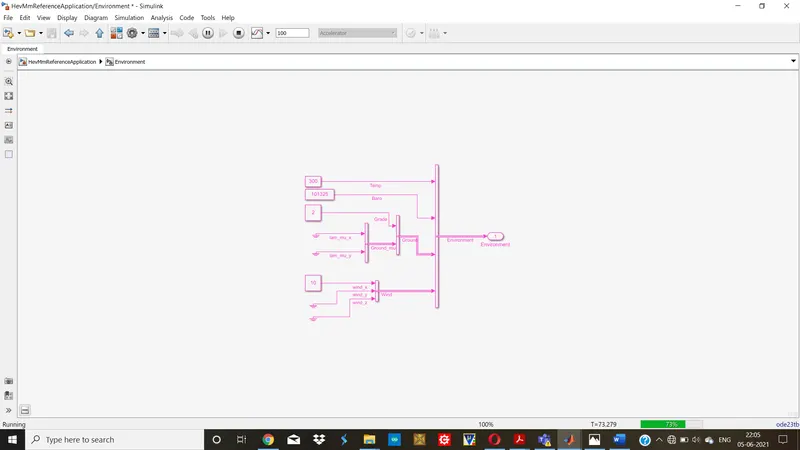
The output waveforms are as follows:-
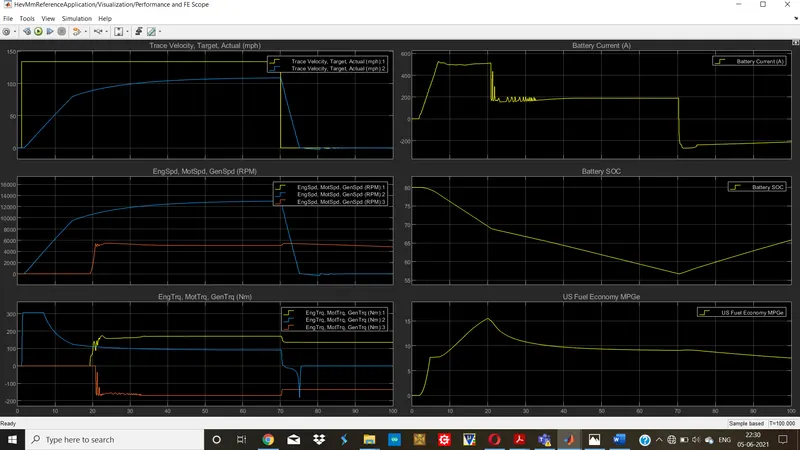
From above two cases we can observe that:
1.Peak voltages obtained at nearly 50ms in both the cases, but the value of peak voltage got reduced in 2nd case due to grade and velocity of air in the surroundings.
2.Maximum fuel efficiency got reduced from about 17 MPG to 15 MPG.
3.In both the cases we observe that battery SoC decreases from 80% to 57% at 70ms then battery current becomes negative. That is, battery now goes to charging mode. Battery now draws current from the motor. Hence, we observe that the there is slight reduction in motor torque at 70ms.
Battery gets charged from motor and then again SoC tend to increase.
4.Fuel economy starts decreasing after SoC has reached to its minimum. When SoC is 57%, motor starts to runs and fuel is consumed. Hence, fuel reserves decreases.
5.Motor torque is negative in both the cases when the vehicle decelarates at 70ms. This is to indicate that energy flows from motor to battery at this stage.
4. Keeping all other parameters same,compare the simulated results of hybrid and true electric powertrains.
Ans.For grade=2 and wind velocity=10m/s,
Hybrid Electrical vehicle gives the below results:
Pure Electrical vehicle results are as follows:
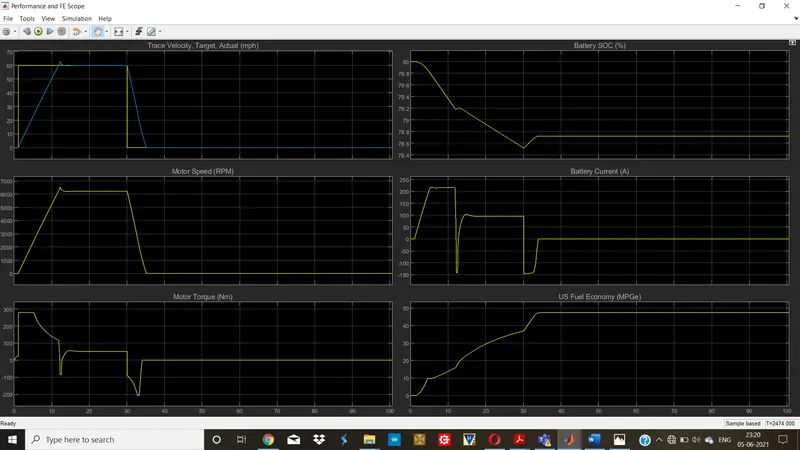
From above two outputs we can conclude that:
- Electrical vehicle doesn’t require fuel. Hence Fuel economy isn’t decreasing in the graph. Whereas, Hybrid electrical vehicle uses fuel when battery SoC level is 57% in this case. Hence, fuel economy decreases.
- In Electrical vehicle, battery charges only when the vehicle is decelerating. Whereas, Hybrid vehicle charges when vehicle is decelerating as well as when SoC reaches 57%.
- In both the cases, chrging takes place whenever the vehicle undergoes decelaration. But, charging in Hybrid vehicles uses fuel whereas in EV, fuel is not required.
- Acceleration time in Pure electrical vehicle is less. That is, electrical vehicle is faster in attainind the desired speed.
- HEV gives better SoC as IC engine is turned on. Due to lack of such facility in EV, SoC at the end is quite low.
- Electrical vehicle doesn’t consume any fuel whereas, HEV requires fuel to run IC engine.