Week-6 Challenge: EV Drivetrain
1. Which types of power converter circuits are employed in electric and hybrid electric vehicle?
There are majorly 4 types of converters:
- AC to DC- Rectifier
- DC to AC- Inverter
- DC to DC- Chopper
- AC to AC- Cycloconverter
Converter basically perform two functions, they change the following 2 qualities of electrical energy:
- Form
- Level
DC/DC converters for electric vehicles
DC/DC converters can be designed to transfer power in only one direction, from the input to the output. However, almost all DC/DC converter topologies can be made bi-directional. A bi-directional converter can move power in either direction, which is useful in applications requiring regenerative braking.
The amount of power flow between the input and the output can be controlled by adjusting the duty cycle (ratio of on/off time of the switch). Usually, this is done to control the output voltage, the input current, the output current, or to maintain a constant power. Transformer-based converters may provide isolation between the input and the output. The main drawbacks of switching converters include complexity, electronic noise and high cost for some topologies. Many different types of DC/DC power converters are proposed in literature (Chiu & Lin, 2006), (Fengyan et al., 2006). The most common DC/DC converters can be grouped as follows
Non-isolated converters
Isolated converters
Below is a Electric vehicle drive system.
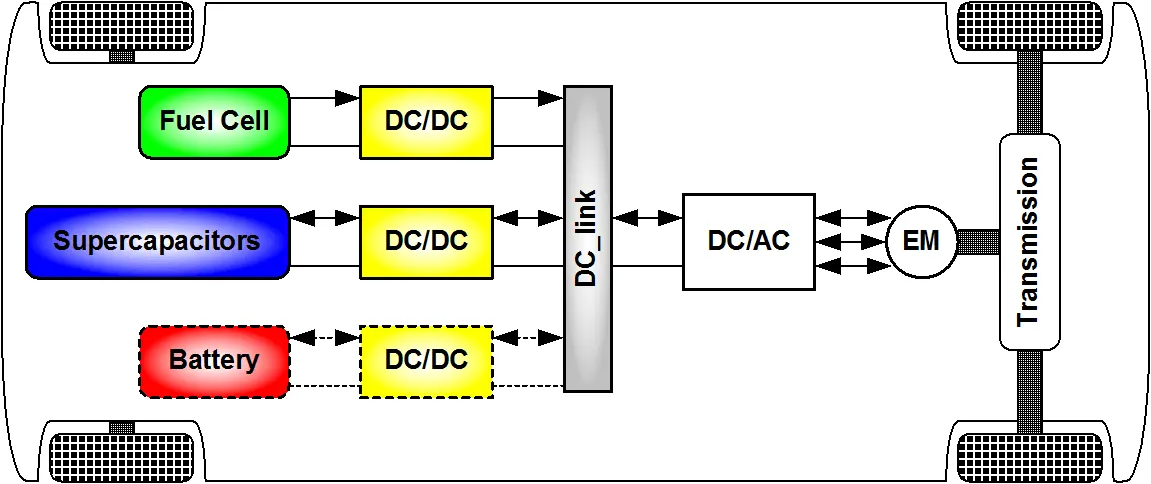
source: intechopen.com
2. An Electric Vehicle's powertrain with 72V battery pack in shown in the diagram below. The duty ratio for acceleration operation is 'd1' and for the braking operation the duty ratio is 'd2'.
What is EV steady state speed if duty cycle is 70%?
we know the speed torque characterstic relation is given as:
ω= V/(Kϕ) -[Ra/(Kϕ)^2].T ................(1)
Also since the duty cycle is 70% , hence the out voltage at the terminals of the motor is,
V = 0.7*72 = 50.4
Now putting the values given in the question in equation (1) and solving we get,
Motor torque, Tm = -0.98ω + 7.056 ..............(2)
Also, from the equation in question,
 ....................(3)
Upon putting values in (2) and (3) and solving with each other we find,
ω = 38.91 rad/s
Hence the speed of the EV is 38.91rad/s
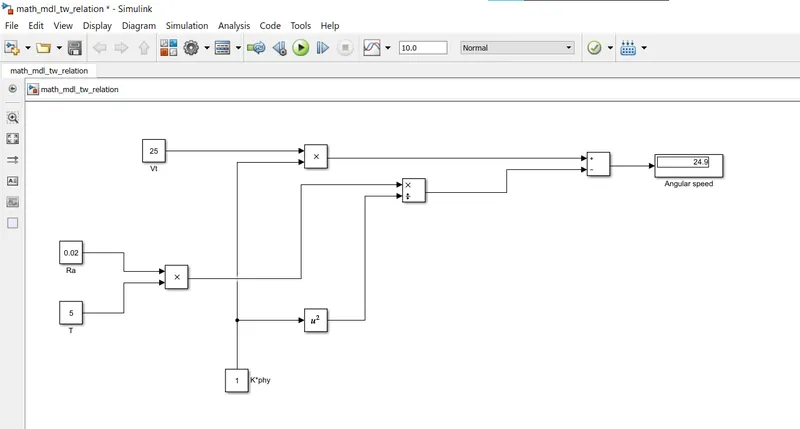
3. Develop a mathematical model of a DC Motor for the below equation using Simulink. ω= V/Kϕϕ -Ra/Kϕ^2.T:
We made a simple mathematical model the above equation in which the constants can be changed and coresponding results can be found.
.slx file of the same is attached.
4. Refer to the blog on below topic: Induction Versus DC brushless motors by Wally Rippel, Tesla Explain in brief about author’s perspective.
In this article Wally Rippel discuses about the various types of electric drives used in the Electric Vehicles. He explains how there is no general suitable for all the applications, whereas there are different types and sizes for different applcations depending upon the factors like cost and performance.
He explains how in earlier times DC motors, lead acid batteries and contractor controllers were used in electric vehicle applications, which are now replaced by BLDC/ Induction motors, Lithium batteries and modulating inverters respectively.
Wally also compares BLDC against Induction motors and also tries to guess what will be the scenario in the coming future, which type of motors will be dominating. Here is a tabulated form of the differences betweeen BLDC and Induction motors:
| BLDC motors | Induction motors |
| Needs inverter to have a starting torque | Has a starting torque without inverter and can function using utility supply, and speed in also fixed for fixed supply. |
| They operate on DC directly | They can not directly operate on DC supply |
| Torque performance is good | Needs feedback loops in inverter for exact frequency as motor desires to compete with DC and BLDC motors. |
| They need position sensor for control |
The need a speed sensor |
|
BLDC generate much leser heat and cooling is easier. They can also operate at Unity Power Factor |
Best power factor for IM is around 85% But when operated with a smart inverter they are better than BLDC motors |
| As the size increase magnetic losses increase and efficiency drops, | As the size increase losses don't increase necessarily. |
| Do NOT have the cost advantage and are less easier to protect |
Have the cost advantage and are easier to protect. |
| Easir to control over torque speed range hence lesser development costs. | Difficult to control and higher development costs, but likely little or no recurring costs. |
and hence due to the above difference at present time BLDC motors are prefered for Hybrid EVs and IMs are prefered for performance based pure electriv vehicles.
In conclusion the authors points out that "much of the hardware is common for both drives and that could mean that we will see induction and DC brushless live and work side by side during the coming golden era of hybrid and electric vehicles".