Week-6 Challenge: EV Drivetrain
AIM:
- To study different types of power converter circuits used in electric and hybrid electric vehicles.
- For the given parameters of the electric vehicle powertrain calculate the steady-state speed of EV if the duty cycle is 70%.
- Create a Simulink model of the mathematical model of a DC Motor.
- Refer to the blog and explain the author’s perspective about the blog.
STUDY 1:
Study different types of power converter circuits used in electric and hybrid electric vehicles.
In Electric and hybrid electric vehicles both controller and power electronics are used in order to control the performance and outcome of the vehicles. The Controller electronics process input and feedback information to generate the switching signals from the power converter semiconductor switches. Whereas a power electronics converter deals with the flow of power from the battery source to the motor input terminal. In EV design to have highly efficient converters we have to go for advanced DC/DC and DC/AC converters are required to maintain the output voltage and current.
The three types of converters that are widely used in Electric vehicles are:
AC-DC converters:
AC-DC converters take AC power from wall outlets and convert it into unregulated DC power. This power supply includes transformers that change the voltage of AC that comes through the outlet's wall to DC voltage. AC-DC converters are most commonly used in Plug-in Hybrid electric vehicles and plug-in electric vehicles.
DC-AC converters
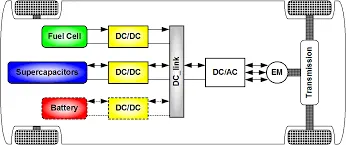
DC-DC converters are a category of power converters(In electric circuit) that converts a source of direct current from one voltage level to another by storing the input energy temporarily and then releasing that energy to output at a different voltage. DC-DC converters can be designed to transfer the power in one direction from input to output.
DC-AC converters:
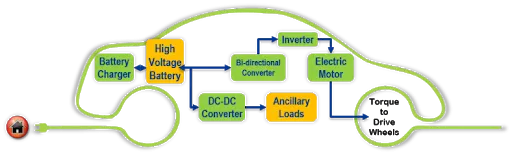
DC-AC converters are also known as inverter which converts the DC power to suitable AC power for electric vehicle application.
STUDY 2:
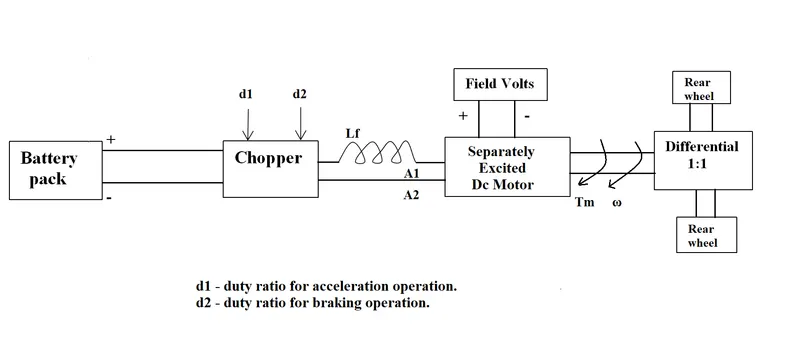
An Electric Vehicle's powertrain with a 72V battery pack is shown in the diagram below. The duty ratio for acceleration operation is 'd1' and for the braking operation the duty ratio is 'd2'.
The other parameters of the electric vehicle are given below,
Motor and Controller Parameters:
Rated Armature voltage= 72 V
Rated armature current= 400 A
Ra= 0.5Ω
KΦ= 0.7 Volt second
Chopper Switching frequency= 400 Hz
The vehicle speed-torque characteristics are given by the below equation
`T=24.7+(0.0051)*omega^2`
Calculate the steady-state speed of EV if the duty cycle is 70%.
Battery voltage(V)= 72V
Ra= 0.5Ω
KΦ= 0.7 Volt second
Duty cycle=70%
The vehicle output voltage is given by
Vo=Battery voltage * duty cycle.
Vo= 72*0.70
Vo=50.4V
Hence required voltage of the vehicle is 50.4V.
The equation for the angular velocity of DC motor
`omega=((Vo)/(Km))-((Ra)/(Km)^2)*Tv`
By substituting all the above parameters
`omega=(50.4/0.7)-((0.5/(0.7)^2)*Tv)`
`omega=72-(1.0204*Tv)`
we know that `Tv=24.7+(0.0051)*omega^2`
Hence
`omega=72-(1.0204*[24.7+(0.0051)*omega^2])`
`omega=72-25.2038-5.204*10^-3*omega^2`
`omega=46.7962-5.204*10^-3*omega^2`
By rearranging the terms we get a quadratic equation.
`5.204*10^-3*omega^2+omega-46.7962=0`
By solving the above quadratic equation we get two solutions
`omega`=-231.25 rad/s and `omega`=38.94 rad/s.
We take a positive value
Hence Steady state speed of the vehicle is 38.94 rad/s.
STUDY 3:
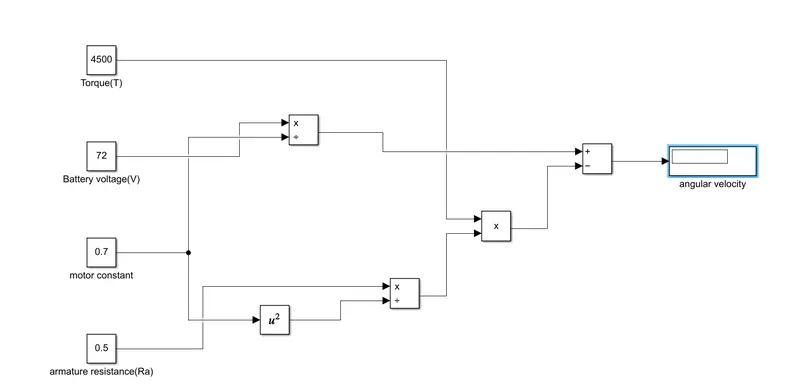
Create a Simulink model of the mathematical model for the equation of a DC Motor
Equation of a DC Motor
`omega=((Vo)/(Km))-((Ra)/(Km)^2)*T`
STUDY 4:
Induction Versus DC brushless motors by Wally Rippel, Tesla
Refer to the blog and explain the author’s perspective about the blog
The following points were concluded from the above blog:
- In convention vehicles, there is no best engine type, rather than there are different types of an engine which is selected based on the price and performance. For an EV application before there were lead-acid batteries, DC brush motors, and contractors controllers but in today's market lead-acid is replaced by a lithium battery, DC brush by DC brushless or induction, and contractors meanwhile by modulating inverters.
- Further author DC brushless drives have more advantage(Heat generated is less). Energy efficiency for DC brushless drive will have few points higher than the induction drive.
- The induction motor is more useful since it has no magnets and the shaft speed is proportional to the line frequency. Hence this motor used with proper utility power they run at a constant speed. In case the, when it is operated from utility power the motor has limited torque and it's limited to run at peak torque conditions.
- Also, the author explains about 3 Phase induction motors and also the limitations of 3 phase induction motors such as AC is must be used rather than DC.
- Finally, the author concludes DC brushless drives will continue to dominate in electric and hybrid electric vehicles and induction drives will maintain the dominance for high performance of pure electric vehicles.