Week-6 Challenge: EV Drivetrain
Types of converters in electric vehicles:
The types of converters employed in the configuration are Electric and Hybrid electric vehicles are
- DC - AC converter (or) Inverter
- AC -DC converter (or) Rectifier
- DC - DC converter (or) Chopper
- DC - AC converter (or) Inverter:
- A DC - AC converter or an invertor is a power electronic device that changes direct current (DC) to alternating current (AC).
- The purpose or application of this DC - AC converter in an electric vehicle is that to feed alternating current to the motor in vehicle.
- The most commonly used motors in the electric vehicle are 3- Phase induction motors. For these motors it requires to ac supply but energy system used in EV is DC power.
- So to convert that DC power to AC supply the inverter is used as a power converter.
- The DC -AC converters also perform the recharging of batteries during the regenerative braking of the vehicle.
- AC - DC converter (or) Rectifier:
- The rectifier is a power converter used to convert the AC supply to DC supply.
- The application of this rectifier in electric vehicle is that to convert the AC to DC because both HEV and BEV the energy system is of DC supply.
- In HEV the AC power generated from the generator must be converted to DC to be able to store in the battery.
- In BEV or plug-in the batteries get charged by Grid which is a AC supply, so it is required to convert it into DC to charge or store in battery pack.
- DC - DC converter (or) Chopper:
- A DC - DC converter or a chopper is used to convert unregulated DC input of a certain level to regulated DC output of other level with high conversion efficiency. A chopper is used to either step up or step down the voltage to required level.
- The most commonly used dc - dc converters are Unidirectional and Bidirectional converters.
- Unidirectional converter:
As the name suggest it is only one directioned and are used in onborad sourced like sensors, controls, safety equipment etc.
- Bidirectional converter:
The power flow in this converter is bi directional. These are required at battery charging and regenrative braking.
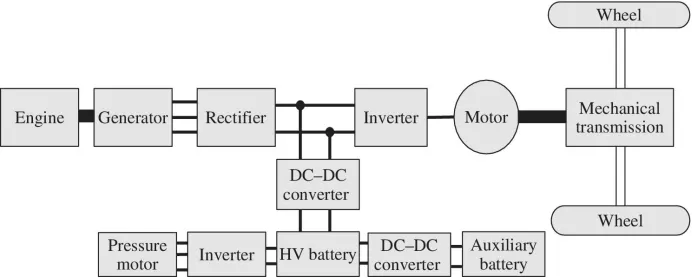
Hybrid EV configuration
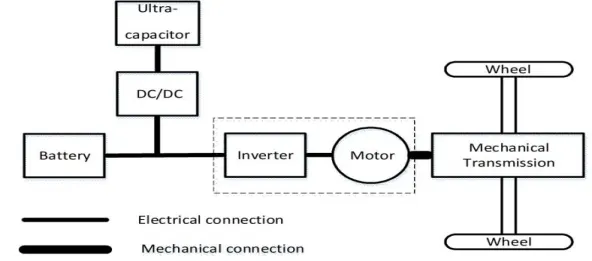
BEV configuration
The general configuration of HEV and EV are shown in which we can observe the basic arrangement (or) circuit with all the converters that are employed in those vehicles.
2.
Given Motor and Controller Parameters:
Rated Armature voltage= 72 V
Rated armature current= 400 A
Ra= 0.5Ω, KΦ= 0.7 Volt second
Chopper Switching frequency= 400 Hz
Given the duty cycle is 70% so the voltage supplied to the motor is
V= 72 * 0.7 = 50.4 V.
The vehicle speed-torque characteristics are given as
 ---------(1)
We know that torque - speed characteristics of a motor is
By substituting the values in eqaution
Tv = 70.56 - 0.98`omega` --------(2)
By equating eq (1) & (2)
24.7 + (0.0051) `omega`^2 = 70.56 - 0.98w
We get
`omega`^2 + 192.15`omega` - 8992.15 = 0
By solving the above equation we get
`omega`= 38.915 or -231.0718 rad/s.
Hence the speed of vehicle = 38.915 rad/sec.
3.
Mathematical model of DC motor using Simulink:
Given the torque speed equation of DC motor
ω^2= V/Kϕ -Ra/Kϕ^2 .T
Procedure:
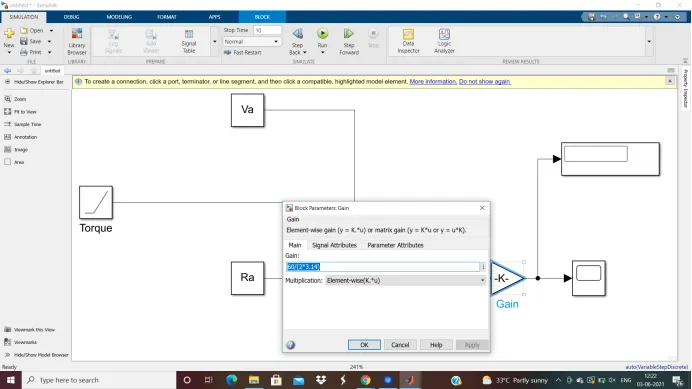
Step1: Take the inputs for this model is armature voltage Va, Resistance Ra, constant Kϕ and Torque is varied for a particular time to get the characteristics.
For torque input ramp signal is taken to vary the values of torque for every second.
Initialize the values of Va,Ra,K in the command window such that they get stored in the workspace.
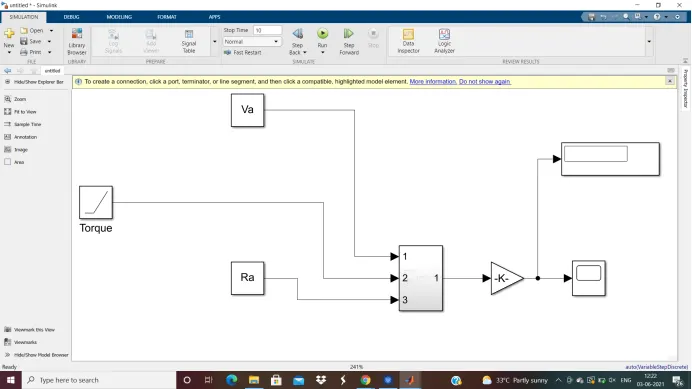

Step 2: Develop a simulink with required blocks to get the given equation. The below fig shows.
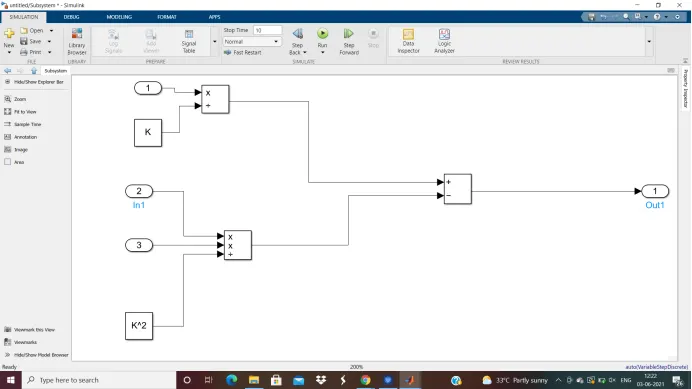
Step 3: Convert the obtained speed which is in rad/s to rpm
Result:
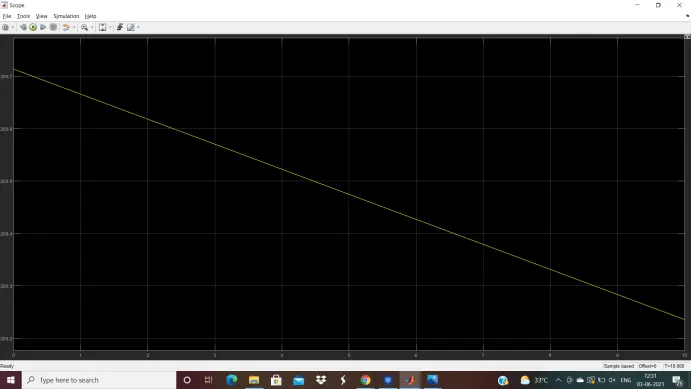
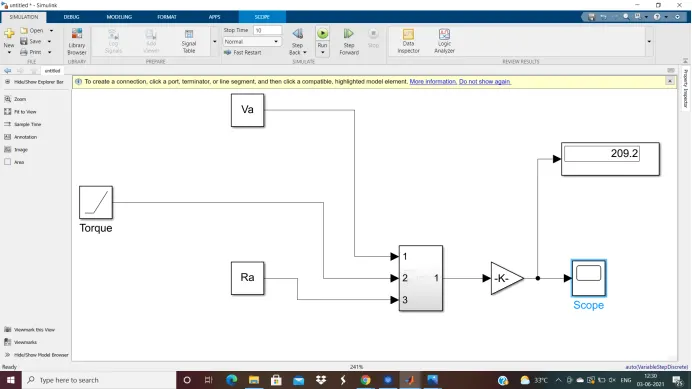
We can observe that characteristics of Speed - torque characteristics of DC motor and from the display we can observe the Max speed which is no load speed i.e., equal to 210 rpm.
4.
DC brushless Verses Induction motors:
In this blog the author has stated how the Electric vehicles are evolved and changes made i.e., the evolution of battery system from lead acid to lithium and the motors from Dc motors to DC brushless and Induction motors.
He mainly stated the differences between the DC brushless and Induction motor.The stators for the both are identical as both have three sets of distributed windings within the stator core. The essential difference between the two machines is with the rotor.
BLDC motor:
- Initially he discussed about the construction of both the motor. In brushless motor, the rotor includes two or more permanent magnets replacing the winding to generate DC magnetic field interacts with currents flowing within the windings to produce a torque.
- To produce the variable stator magnetic field and thedevice that provides this current control is called an inverter. Without it, brushless motors are useless motors.
- He stated that most of the vehicles contain BLDC motors except for GM EV1 and Tesla Roadster
- Much less rotor heat is generated in BLDC motor and the Rotor cooling is easier.
- It was stated that with DC brushless, as machine size grows, the magnetic losses increase proportionately and part load efficiency drops.
- It is stated that the Brushless DC can drive at unit power factor.
- Peak point efficiency is high for this BLDC drive.
- The cost is high when compared because of presence of permanent magnet which cost high.
Induction motor:
- Unlike the DC brushless rotor, the induction rotor has no magnets – just stacked steel laminations with buried peripheral conductors . Currents flowing interacts with magnetic field generated by the stator windings produce aforce i.e., a rotating magnetic field that enters the rotor.
- These motors doesnt require any magnets
- This motors does not require inverter because of its ability to start under load.
- With induction, as machine size grows, losses do not necessarily growand has high-performance as desired.
- Heat generated is more and cooling strips are used.
- It is stated that the best power factor is 85% and so the peak efficiency is few percentage lower than the BLDC motor.
- As there are magnets present the cost is ess when compared.