Week-6 Challenge: EV Drivetrain
1. Which types of power converter circuits are employed in electric and hybrid electric vehicle?
Ans:
Power electronics in Electric vehicles:
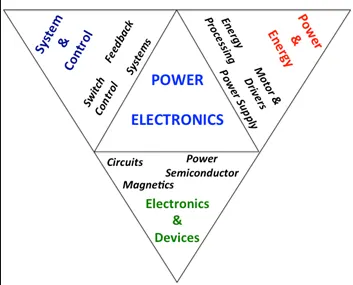
In electric cars, power electronic is responsible for converting and controlling electric power in system. Power electronic is a key technology used in various applications to optimize energy management, providing the conversion to operate motors, battery storage, and generator.
Advantages:
High efficiency due to low loss in power semiconductor devices. High reliability of power electronic converter system. Long life and less maintenance due to absence of any moving parts. Fast dynamic response compared to electromechanical converter system.
In Electric and Hybrid Electric Vehicles mainly 3 types of Power converters are used:
- AC to DC Converter (Rectifier):
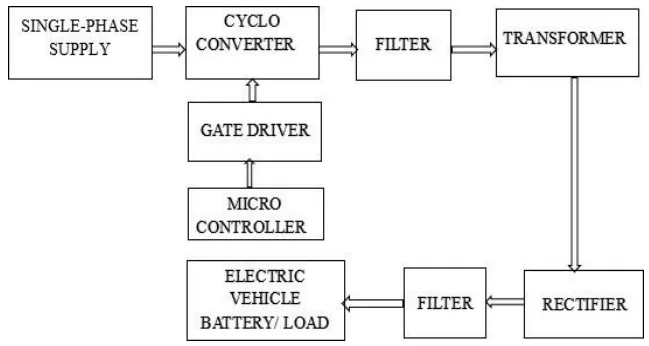
AC/DC converter which feeds power from a billboard power system to an on- board high- voltage battery. To improvise the power factor and to boost up the output voltage, this paper proposes a innovative design of an AC/DC converter with high frequency isolation with different loads like RL, RLE, battery and motor loads, which is suitable for on board EV/PHEV charges. This converter plays a double role as ac/dc converter for power factor correction and as well as dc/dc converter for output regulation. AC to DC converter uses rectifier to turn on AC input into DC output regulators to adjust the voltage level and reservoir capacitor to smooth the pulsating DC.
- DC to AC Converter (Inverter):
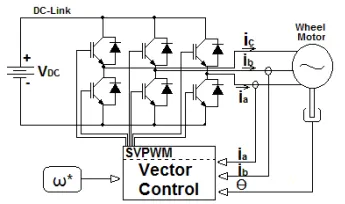
It will find electric motors in everything from juicers and toothbrushes, washing machines and dryers, to robots. They are familiar, reliable and very durable. Electric vehicle motors use AC power. An inverter is a device that converts DC power to the AC power used in an electric vehicle motor. The inverter can change the speed at which the motor rotates by adjusting the frequency of the alternating current. It can also increase or decrease the power or torque of the motor by adjusting the amplitude of the signal.
- DC to DC Converter (Chopper):
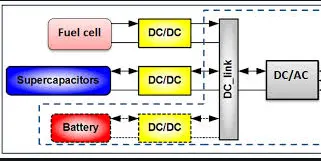
- DC/DC converters can be designed to transfer power in only one direction, from the input to the output. However, almost all DC/DC converter topologies can be made bi-directional. A bi-directional converter can move power in either direction, which is useful in applications requiring regenerative braking. The amount of power flow between the input and the output can be controlled by adjusting the duty cycle (ratio of on/off time of the switch). Usually, this is done to control the output voltage, the input current, the output current, or to maintain a constant power. The main dc-dc converter changes dc power from an on-board 200-800V high voltage battery into lower dc voltages (48V or 12V) to power headlights, interior lights, wiper and window motors, fans, pumps and many other systems within electric vehicles (EV) and hybrid electric vehicles (HEV). This high voltage to low voltage (HV-LV) dc-dc converter is often referred to as an auxiliary dc-dc, or Auxiliary Power Module (APM). Isolation is critical for separating the control systems from high-voltage domains.
--------------------------------x------------------------------------x------------------------------
2. An Electric Vehicle's powertrain with 72V battery pack in shown in the diagram below. The duty ratio for acceleration operation is 'd1' and for the braking operation the duty ratio is 'd2'.
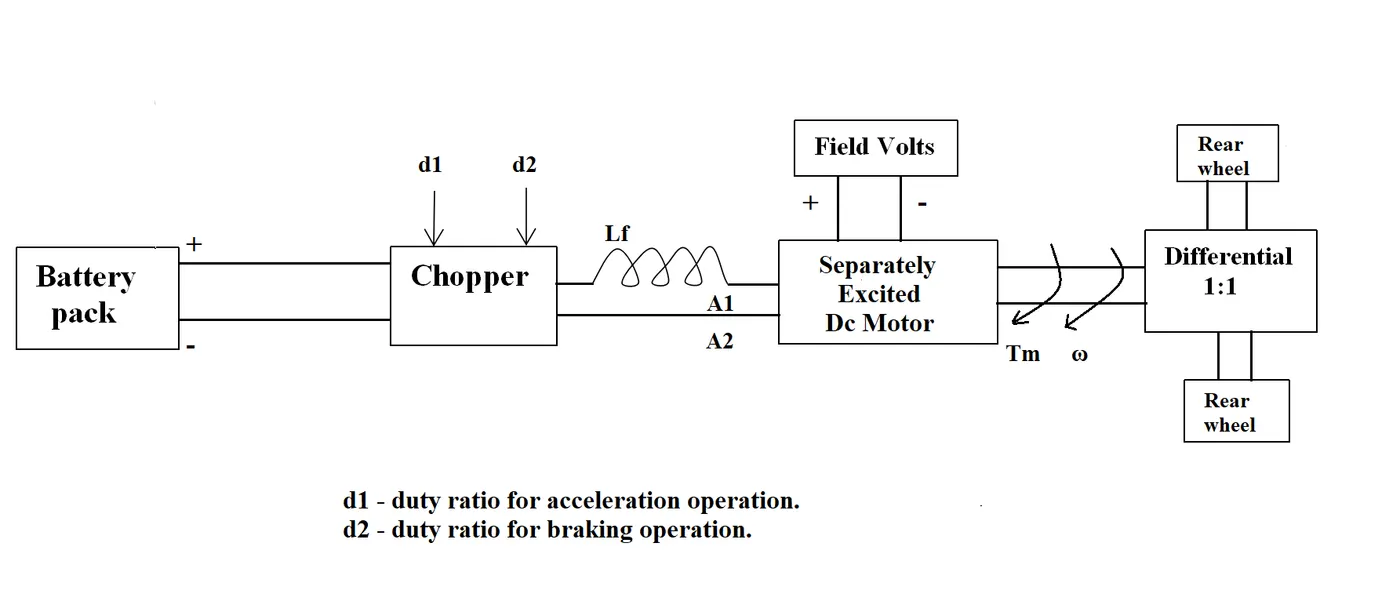
The other parameters of the electric vehicle is given below,
Motor and Controller Parameters:
Rated Armature voltage= 72 V
Rated armature current= 400 A
Ra= 0.5Ω, KΦ= 0.7 Volt second
Chopper Switching frequency= 400 Hz
The vehicle speed-torque characteristics are given by the below equation

What is EV steady state speed if duty cycle is 70%?
Ans:
Given data:
Rated Armature voltage = 72 V
Rated armature current = 400 A
Ra = 0.5Ω,
KΦ = 0.7 Volt second
Chopper Switching frequency = 400 Hz
Battery pack voltage = 72 V
vehicle speed-torque characteristic Tv = 24.7+(0.0051)w2
Solution:
To find vehicle voltage we need to multiply % of duty cycle to the battery pack voltage
Vehicle voltage Vv = (Battery pack voltage) * (% duty cycle)
Vv = 72*0.7
Vv = 50.4 Volts
Tv = 24.7 + 0.0051w2 ---------------(i)
we already know the speed torque equation of vehicle
w = (v/k.pi) - Tv * (Ra/(k.pi)2)
rewriting the above equation
Tv = k.pi (v - (w*k.pi)) / Ra
Substitute the above given data in above equation
Tv = 0.7 (50.4 - 0.7w) / 0.5
Tv = 70.56 - 0.98w --------------(ii)
By solving the equations (i) & (ii) we getting quadratic equation as shown in below
0.0051w2 + 0.98w - 45.86 = 0
We solved the above equation using ax2+bx+c method
a = 0.0051 b = 0.98 c = -45.86
finally we got w = -231.07 rad/s and 38.91 rad/s
We taking the positive value hence
EV steady state speed = 38.91 rad/s
----------------------------x----------------------------------x---------------------------------
3. Develop a mathematical model of a DC Motor for the below equation using Simulink.
ω = V/Kϕ - Ra/Kϕ^2 .T
Ans:
Mathematical model for the given equation:
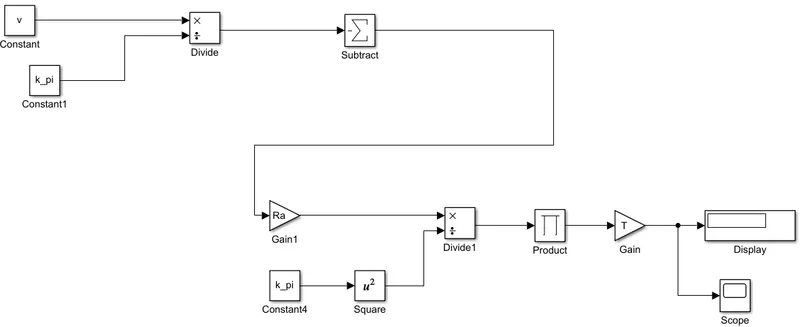
Explaination:
- Constant: Output the constant specified by the 'Constant value' parameter. If 'Constant value' is a vector and 'Interpret vector parameters as 1-D' is on, treat the constant value as a 1-D array. Otherwise, output a matrix with the same dimensions as the constant value.
- Gain: The Gain block multiplies the input by a constant value (gain). The input and the gain can each be a scalar, vector, or matrix. The Multiplication parameter lets you specify element-wise or matrix multiplication. For matrix multiplication, this parameter also lets you indicate the order of the multiplicands.
- Subtract: The Sum block performs addition or subtraction on its inputs. The Add, Subtract, Sum of Elements, and Sum blocks are identical blocks. This block can add or subtract scalar, vector, or matrix inputs. It can also collapse the elements of a signal and perform a summation.
- Product: Multiply or divide inputs. Choose element-wise or matrix product and specify one of the following:
a) * or / for each input port. For example, **/* performs the operation 'u1*u2/u3*u4'. b) A scalar value specifies the number of input ports to be multiplied. For example, 2 performs the operation 'u1*u2'.
- Divide: If there is only one input port and the Multiplication parameter is set to Element-wise(.*), a single * or / collapses the input signal using the specified operation. However, if the Multiplication parameter is set to Matrix(*), a single * causes the block to output the matrix unchanged, and a single / causes the block to output the matrix inverse.
- Square: Mathematical functions including logarithmic, exponential, power, and modulus functions. When the function has more than one argument, the first argument corresponds to the top (or left) input port.
- Display: Display input values. If the incoming signal is of type string, the 'Numeric display format' parameter selection does not affect the display of the string.
- Scope: Display signals generated during simulation.
-------------------------------------x------------------------------------x--------------------------
4. Refer to the blog on below topic:
Induction Versus DC brushless motors by Wally Rippel, Tesla
Explain in brief about author’s perspective.
Ans:
- Before joining into Tesla motors Wally Rippel was an engineer at AeroVironment, where he helped develop the EV1 for general motors and also worked in the jet propulsion lab on electric vehicle battery research, among other projects.
- And he also told that there is no one best engine type, rather there are different types of engines to suit personal requirements such as price and performance. This is also true for electric vehicles.
- He also said that in earlier days there are lead acid batteries, DC brush motors and contactor controllers, but now a days none of those products are there including his hairs. And also told that lead acid battery is replaced by lithium ion, DC brush motor by DC brushless motors or induction motors and Contactors are replaced by Inverters.
- About DC brushless motor: It rotor includes two or more magnets to produce DC magnetic field, this field enters stator core and interact with current and generates torque between stator and rotor. Inverter is needed. In this less rotor heat is generated.
- About Induction motor: It is not having any permanent magnets but it produce magnetic field when current passes the stator winding. the frequency of this magnetic field is equal to the difference between the supply frequency and rotor frequency. When the supply is given to the stator and torque is produced then a motor is ability to start under load. No inverter is needed. It have some disadvanteges like they cannot operate from DC, shaft speed is proportional to line frequency.
- By adding inverter to induction motor we have some advantages like possible to run a machine from a battery, variable speed also becomes possible simply by adjusting the inverter frequency. but torque performance is low compared to DC.
- By seeing the DC brushless and induction motor both have some advantages and disadvantages so we can use these motors as per our requirements. If considering with power factor DC motor has unity pf, and Induction motor has 85% pf. This means that peak point energy efficiency of a DC brushless drive will typically higher than induction motor.
- Hence Author concluded that DC brushless drive will continue to dominate in hybrid and plug in hybrid vehicles and induction motor will continue in high performance of electric vehicles.
-----------------------------x------------------------------------x----------------------------------