Study about power converters, and types of electrical motors, and design the Simulink model of DC motor for the given equation.
Aim: Study the different parameters used in EV powertrain design and do the calculation of steady-state velocity.
Objectives:
- Study about different power convertors used in EV and HEV.
- Study about the steady-state speed of EV in the speed-torque graph.
- Do modeling of the given equation in Simulink.
Theory:
Power Converters: The power converter is used to supply the electric motor with proper voltage and current. The electronic controller commands the power converter by providing control signals to it, and then controls the operation of the electric motor to produce proper torque and speed, according to the command from the drive.
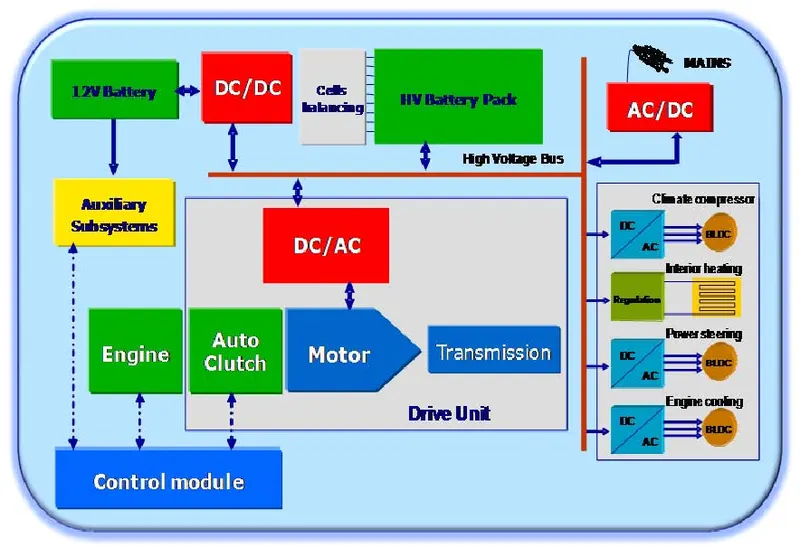
Types of Power converters:
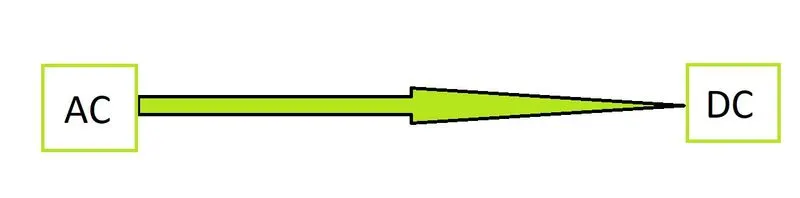
1.Rectifier or converter: This device is used to convert the AC supply voltage to the DC voltage. There are two types of rectifier step-up and step-down. Step-up used to increases the voltage whereas step-down is used to decrease the voltage.
Advantages:
- The AC to DC converters can be used to charge a large number of devices including laptops, cellular phones, and all types of portable devices quite easily and quickly.
- These power converters aid in providing adequate power to any device, at any point in time, from anywhere in the world.
- The AC to DC converters can convert different voltages based on the rectifier.
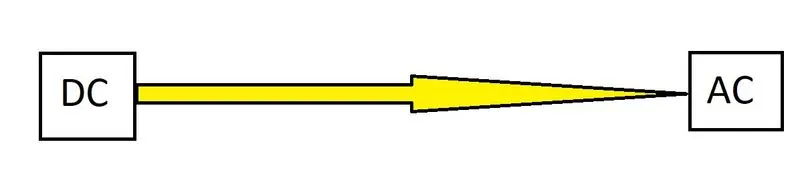
2.Inverter: This type of power converter is used to convert DC voltage to AC voltage. In this also we have two types of the inverter which are step-up and step-down inverter.
Advantages:
- Can be an energy-efficient way of changing voltage.
- Can provide electrical isolation between input and output.
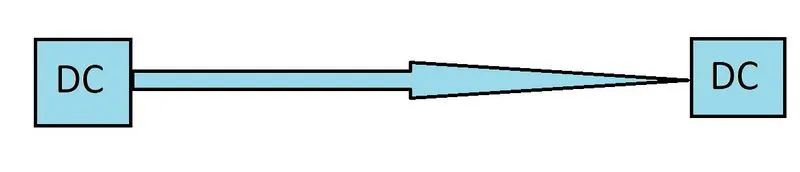
3.Chopper: This device is used to convert the DC voltage to the DC voltage. In this also we have two types of the inverter which are step-up and step-down inverter. In step down chopper output voltage is less than the input voltage. In step-up chopper output voltage is more than the input voltage.
Advantages:
- Battery space can be reduced by reducing or increasing the available input voltage.
- A device can be driven by bucking or boosting the available voltage. Thus preventing the damage of the device or breakdown.
2. An Electric Vehicle's powertrain with a 72V battery pack is shown in the diagram below. The duty ratio for acceleration operation is 'd1' and for the braking operation the duty ratio is 'd2'.
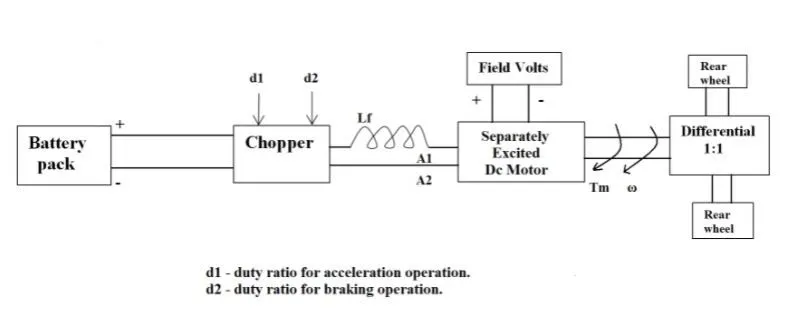
Given input parameters:
Battery Supply voltage(`V_(bat)`): 72v
Rated Armature voltage= 72 V
Rated armature current(`I_a`)= 400 A
Ra= 0.5Ω, KΦ= 0.7 Volt second
Chopper Switching frequency(f)= 400 Hz
speed-torque characteristics of the vehicle
`T_v = 24.7+0.0051*omega^2`
duty cycle(d) = 70% = 0.7
To find:
steady-state speed=w
Solution:
As we know the motor speed-torque characteristic equation is
`T = (k*phi*V_o)/R_a-((k*phi)^2*omega)/R_a`.......................................................(1)
where as,
T = Torque of the motor
Vo = Supply voltage of from battery
Ra = Armature resistance
kΦ = motor constant
ω = speed of the motor
As we know that we have to calculate the speed of the motor for 70% duty cycle, so according to that we have to calculate the output voltage of the battery for 70% duty cycle as follows
`V_0 = V_(bat)*D`
`V_o = 72*0.7=50.4V`
So let's put all the values in equation 1
`T=(0.7*50.4)/0.5-(0.7^2*omega)/0.5`
`therefore T = 70.56-0.98*omega`...............................................................................(2)
The vehicle speed-torque characteristics equation is as follows,
`T = 24.7+0.0051*omega^2`......................................................................................(3)
Now we can equate the equation 1 and 2
`70.56-0.98*omega=24.7+0.0051*omega^2`
`0.0051*omega^2+0.98*omega-45.86 = 0`
Now we have to find the roots of this equation by comparing the standard equation `ax^2+bx+c=0` as follows,
`omega = (-bpmsqrt(b^2-4*a*c))/(2*a`
`omega_1 = (-0.98+sqrt(0.98^2+4xx0.0051xx45.86))/(2xx0.0051) = 38.915 (rad)/sec`
`omega_2 = (-0.98-sqrt(0.98^2+4xx0.0051xx45.86))/(2xx0.0051) = -231.072 (rad)/sec`
If the vehicle is moving in the forward directions then the steady state speed is 38.915rad/sec.
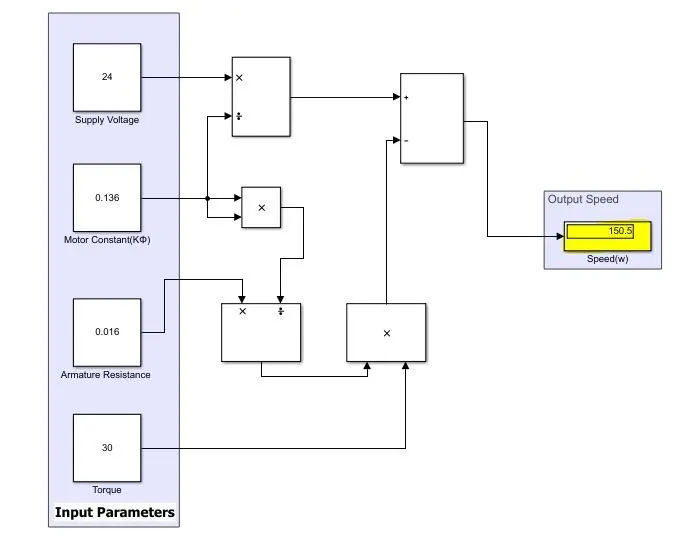
3.Develop a mathematical model of a DC Motor for the below equation using Simulink.
`omega = V/(k*phi)-((k.phi)^2*T)/R_a`
Simulink Model of the given equation is;
4. refer to the blog on the below topic:
Induction Versus DC brushless motors by Wally Rippel, Tesla
Explain in brief about author’s perspective.
According to the blog “Induction versus DC Brushless motor by Wally Rippel, Tesla”, the author wants to highlight topics related to EV technology, especially related to DC brushes and motors.
In this report, the author explained the changes regarding the battery from lead-acid to lithium, motor type from DC motor to DC brushless, or induction motors. and replacement of the contactor in the inverter.
DC Brushless Motor:
The technology behind the DC Brushless motor is that it has more than 2 permanent magnets which generate a DC magnetic field. For better Torque generation in rotor and stator, a current flow in winding and this happens due to magnetic field near the stator. According to him, the brushless motor needs a proper flow of current into the rotor and stator if it will be not in a proper way then the current will not generate and there will be a decrease in torque. To maintain electrical to mechanical conversion there should be a smooth flow of current otherwise the brushless motor is not useful. A brushless motor does not create any starting torque.
The advantage of the DC Brushless motor is that there is low heat generation in the rotor, its cooling capacity is better as compared to the induction motor drive; Also Peak Power efficiency is high. Another difference is that the DC Brushless drive can also operate at a unity power factor, whereas the best induction drive is about 85%, this means that the peak point energy efficiency for a DC Brushless drive will typically be a Few % points higher than for an Induction drive.
INDUCTION MOTOR:
The technology behind the induction motor is that it basically uses a 3-phase Induction motor which was Discover by “Nikola Tesla” in 1889. In the Induction motor, there is the use of steel laminated device instead of Magnets. Currents flowing in the stator windings produce a rotating magnetic field that enters the rotor. In an Induction, the motor current interacts with the Magnetic field generated by the stator to produce a force that is required for rotor torque. The induction motor is compatible with a power source. An induction motor cannot operate from DC voltage it always requires AC voltage.
The induction motor does not have any magnets and in this the B field is adjustable. In an induction, the motor B field is proportionate to V/f (Voltage to frequency). This technology is used to reduce the magnetic losses and conduction losses, due to which efficiency will maintain at maximum peak. This all leads to increasing the performance, induction motor is very useful and efficient for high performance. In an induction motor, the peak efficiency is less but it works smoothly better. The controlling of the induction motor or mechanism is more complex. Also, the Torque generated is low and the motor temperature increases when it works at high speed.
Conclusion on DC motor and Induction motor:
Now, the question is which one is the best brushless DC motor or Induction motor, then during 1990s General Motor EV-1 and Tesla Roadster work by using induction motors, and the rest all HEV were using DC Brushless motors. Both the drives mean DC and Induction motor using 3-phase modulating inverters. The only difference is in the rotor and inverter controller of the motors.
According to Sensors, the DC Brushless motor requires an absolute position sensor whereas the induction motor only needs speed sensors.
Another factor is related to the cost of permanent magnets it is costly in Kg. Also, the permanent magnet rotor needs more careful maintenance and it’s difficult to handle. So the cost of an induction motor is less.
The conclusion according to the author is that the induction motor drive is only best for Pure High-Performance EV whereas, the DC Brushless drive is beneficial for all hybrid as well as Plug-In Hybrid vehicles.