Week-6 Challenge: EV Drivetrain
1. Which types of power converter circuits are employed in electric and hybrid electric vehicle?
Types of Power Converter circuits:
Rectifier(AC-DC Converter)
A boost converter charges the battery in Electric Vehicles(EV). A conventional OBC (Onboard Charging System) has a bridge rectifier to convert the input AC voltage to DC but, during the rectification process, there is high conduction, and switching losses and heating issues are also attached to it.
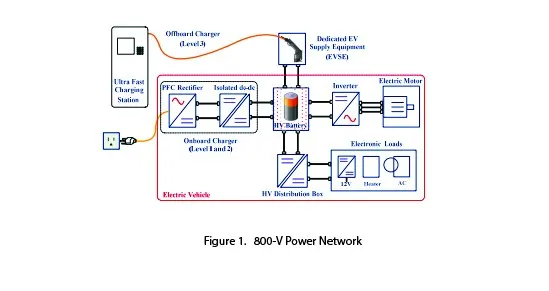
Inverter(DC-AC Converter):
An inverter is a device that converts DC power to the AC power used in an electric vehicle motor. The inverter can change the speed at which the motor rotates by adjusting the frequency of the alternating current.
Chopper (DC-DC Converter):
The buck converter is used for voltage step-down, while the boost converter is used for voltage step-up. The buck-boost and Cuk converters can be used for either step-down or step-up. The charge-pump converter is used for either voltage step-up or voltage inversion, but only in relatively low power applications.
Regulator (AC-AC Converter):
AC to AC converters is used for converting the AC waveforms with one particular frequency and magnitude to AC waveform with another frequency at another magnitude. This conversion is mainly required in the case of speed controlling of machines, for low frequency and variable voltage magnitude applications as well.
2. An Electric Vehicle's powertrain with a 72V battery pack in shown in the diagram below. The duty ratio for acceleration operation is 'd1' and for the braking operation the duty ratio is 'd2'.
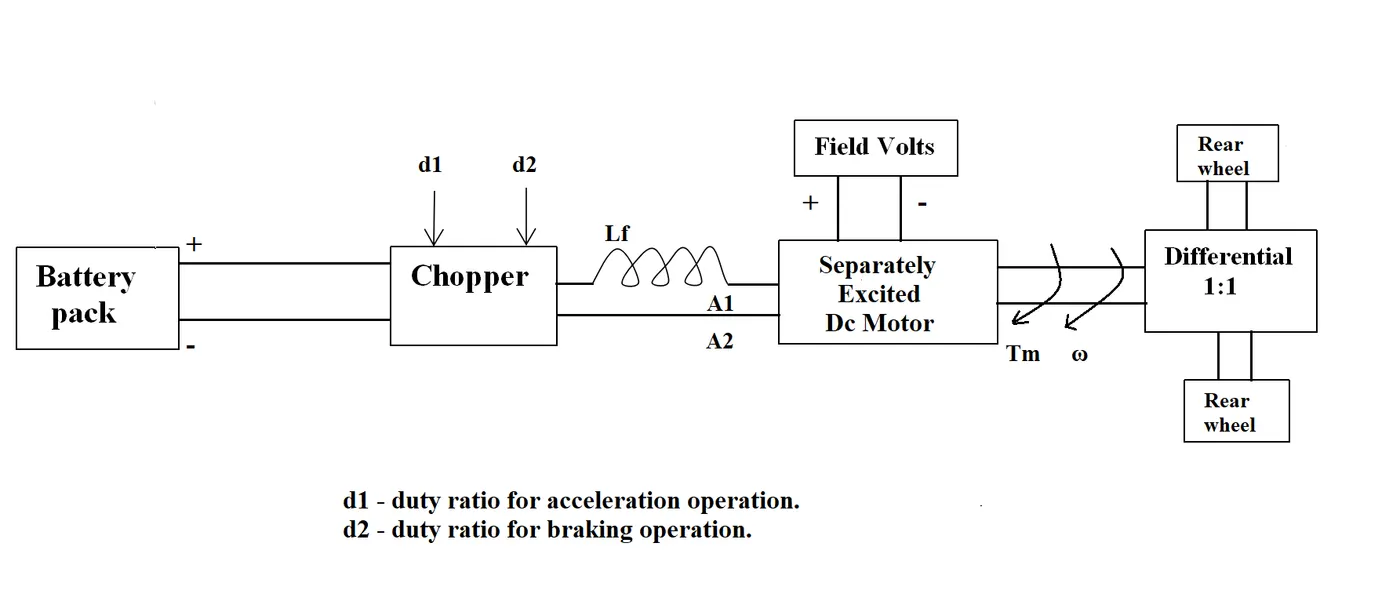
The other parameters of the electric vehicle is given below,
Motor and Controller Parameters:
Rated Armature voltage= 72 V
Rated armature current= 400 A
Ra= 0.5Ω, KΦ= 0.7 Volt second
Chopper Switching frequency= 400 Hz
The vehicle speed-torque characteristics are given by the below equation

What is EV steady-state speed if duty cycle is 70%?
Solution:
Average voltage Vo = V*Duty Cycle
= 72 *0.7
Average Voltage is 50.4V
Torque Speed equation:
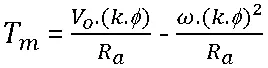
= (50.4 * 0.7/ 0.5) - (w (0.7)^2 /0.5)
Tm = 70.56 -0.98w
Torque equation given is
Comparing Tm and Tv
70.56 -0.98w = 24.7 + 0.0051 w^2
Solving the above equation
w= 38.92 rad/s or -231.08 rad/s
Accepting the positive value and rejecting the other
Therefore, Speed of the vehicle os 38.92 rad/sec
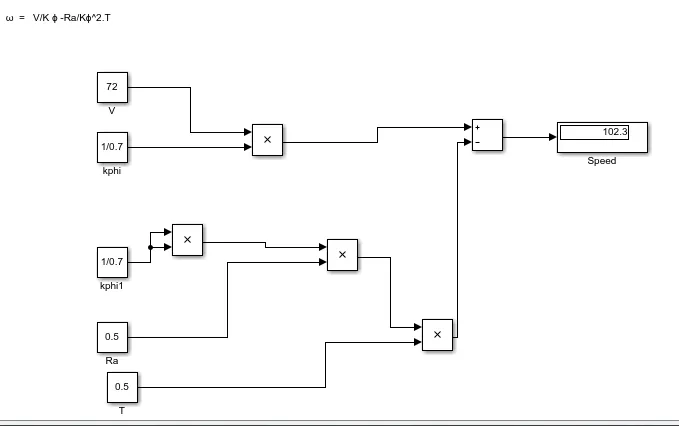
3. Develop a mathematical model of a DC Motor for the below equation using Simulink.
ω= V/Kϕϕ -Ra/Kϕϕ^2 .T
4. Refer to the blog on the below topic:
Induction Versus DC brushless motors by Wally Rippel, Tesla
Explain in brief about author’s perspective.
Author compared the DC brushless motors and Induction motors to implement for Electric vehicles and Hybrid Electric vehicles.
Explained the Evolution of Electric motors and discussed that DC motors are replaced with Brushless DC and Induction motors.
Inverter is used in the place of commutator and the brushes are replaced. So the DC motor became Brushless DC motor.
Induction motor which is invented by Nikola Tesla, is identical with Brushless DC motor virtually. but IM rotor does not have magnets.
IM has an ability to get started under load condition and No inverter is needed in the motor. They also produce starting torque.
BLDC motors doesn't produce Statting torque.
IM can't operate from DC. And shaft speed is proportionate to line frequency. They are constant speed machines. They have limited starting torque and limited running peak torque capabilities when compared with DC machines.
The Debatic advantages and limitations are there with BLDC motor and IM.
Author concluded that DC brushless continued its domination in Hybrid ad plugin hybrid markets.
Induction motor dominated in High Performance pire electrics.
As hardware is common for both drives, IM and BLDC motor are running side by side in this era for Hybrid and ELectric vehicles.