Week-11 Challenge: Braking
- For a defined driving cycle, calculate the energy required for braking.
Answer:
One of the predefined drive cycles is UDDS.
UDDS stands for Urban Dynamometer Driving Schedule and refers to the United States Environmental Protection Agency mandated dynamometer test on fuel economy that represents city driving conditions that are used for light-duty vehicle testing.
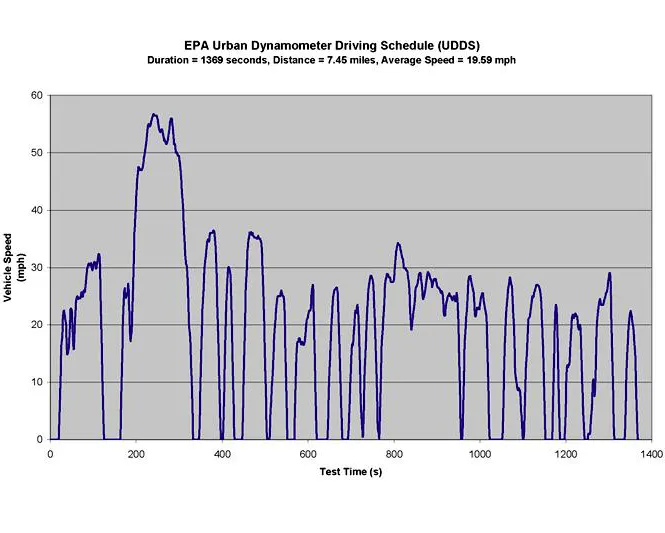
Drive cycle affects based on the braking power and braking energy required.
The energy of traction of wheels mainly comprises of Air drag and braking energy. The vehicle requires energy during deceleration also which takes place with the help of braking.
The driving cycle shown above is having many starts and stops of the vehicle.
The below spreadsheet shows the information related to the braking energy calculations.
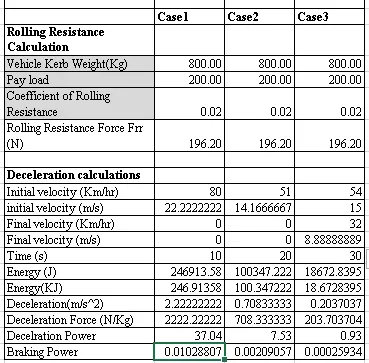
As per the calculations shown above,
Case1: initial velocity 80 km/hr to 0 km/hr requires the energy if 246.9KJ
Case2: initial velocity 51 km/hr to 0 km/hr requires the energy if 100.3KJ
Case 3: initial velocity 54 km/hr to 15 km/hr requires the energy if 18.6KJ
The above analysis says that the braking energy requirements of a vehicle depend on the vehicle's initial velocity to final velocity. It also depends on the time taken to stop the vehicle.
If the time required to stop the vehicle is less then the energy requirement increased.
2. Why electric motor can’t develop braking torque at a high speed similar to starting? How electric and mechanical brakes are coordinated?
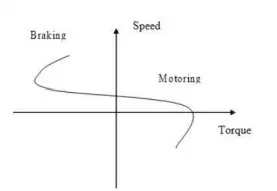
The shown figure is the torque-speed characteristics of the Induction motor. As per the characteristics, the motor generates less torque at high speed. So electric motor cant develop braking torque at high speed similar to starting.
In regenerative braking of induction motor, if the motor rotates in the same direction as that of the stator magnetic field, but the speed is greater than the synchronous speed.
This occurs during the flux weakening mode of operation of the Induction motor. During this mode, the motor acts as a generator and the induction generator generates electric power and this power is fed back to the supply.
Braking of Induction Motors:
The braking of induction motors can be classified mainly in three types
Regenerative braking.
Plugging or reverse voltage braking
Dynamic braking
Dynamic braking is further classified as
AC dynamic braking
Self-excited braking using capacitors
DC dynamic braking
Zero sequence braking
Electrical and mechanical brakes are coordinated by using the Brake strategy
Serial Braking system:
Series Brake with Optimal feel:
The series braking system with an optimal feel consists of a braking controller that controls the braking forces on the front and rear wheels. The control objective is to minimize the stopping distance and optimize the driver’s feel. This requires braking on front and rear wills to follow the ideal braking force.
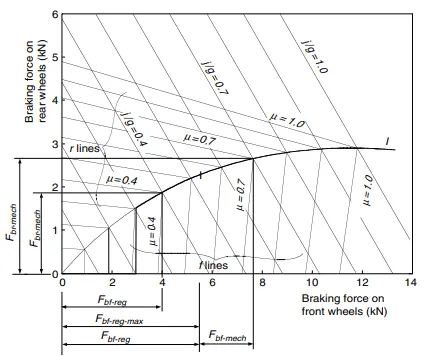
Braking applied on front wheels is mentioned on x-axis and Rear wheel-braking force is on y-axis.
If braking force demanded < the maximum braking force that the electric motor can produce
Then only electrically regenerative braking will apply.
If the commanded braking force > available
regenerative braking force, the electric motor will operate to produce its maximum braking torque, and the remaining braking force is met by the mechanical brake system.
At low speed (lower than its base speed), the maximum torque is constant.
However, at high speed (higher than its base speed), the maximum torque decreases hyperbolically with its speed. Therefore, the mechanical brake torque at a given vehicle deceleration varies with vehicle speed
Series brake with optimal recovery :
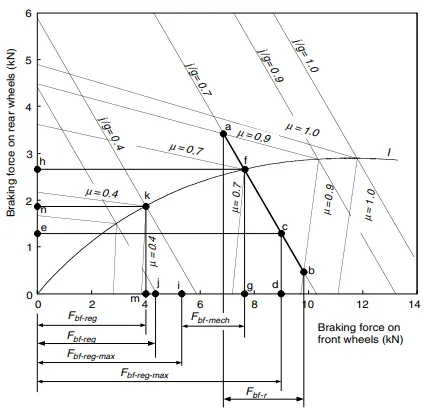
When the vehicle is braked with an acceleration rate of j/g < µ, the braking forces on the front and rear wheels can be varied in a certain range, as long
as the Fbf+Fbr = Mvj is satisfied.
When the commanded deceleration rate, j/g, is much smaller than the road adhesive coefficient (j/g=0.3 in Figure ), and the regenerative braking force can meet the total braking force demand, only regenerative braking is used without mechanical braking on the front and rear wheels.
When the commanded deceleration rate, j/g, is equal to the road adhesive coefficient µ, the operating point of the front and rear braking forces must be on the curve I. On a road with a high adhesive coefficient (µ=0.7, operating point
f, in Figure ), the maximum regenerative braking force is
applied and the remaining is supplied by the mechanical brake. On a road with a low adhesive coefficient (µ=0.4, operating point k, in Figure 11.8, ), regenerative braking alone is used to develop the front braking force.
When the commanded deceleration rate, j/g, is greater than the road adhesive coefficient µ, this commanded deceleration rate will never be reached due to the limitation of the road adhesion. The maximum deceleration that
the vehicle can obtain is (a/g)max=µ. The operating point of the front and rear braking forces is on the curve I, corresponding to µ (µ=0.4 and j/g=0.4 in Figure ); the operating point is point k and the maximum
deceleration rate is j/g=0.4.
Parallel Braking:
The parallel brake system includes both an electrical (regenerative) brake and a mechanical brake, which produce braking forces is parallel and simultaneously.
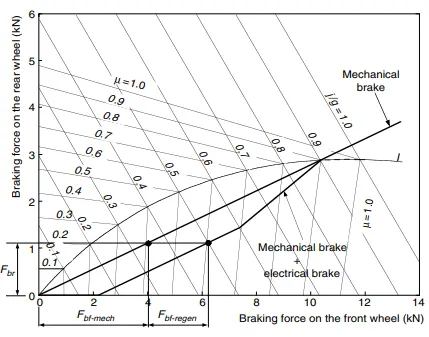
The parallel brake system has a conventional mechanical brake which has a fixed ratio of braking force distribution on the front and rear wheels.
Regenerative braking adds additional braking force to the front wheels, resulting in the total braking force distribution curve.
The mechanical braking forces on the front and rear axles are proportional to the hydraulic pressure in the master cylinder. The regenerative braking force developed by the electric motor is a function of the hydraulic pressure of the master cylinder, and therefore a function of vehicle deceleration. Because the regenerative braking force available is a function of motor speed and because almost no kinetic energy can be recovered at low motor speed, the
regenerative braking force at high vehicle deceleration (e.g., a/g0.9) is designed to be zero so as to maintain braking balance. When the demanded deceleration is less than this deceleration, regenerative braking is effective.
When the braking deceleration commanded is less than a given value, say 0.15 g, only regenerative braking is applied. This emulates the engine retarding in a conventional vehicle.
In Figure, the regenerative braking force, Fbf-regen, and mechanical braking forces on the front and rear wheels, Fbf-mech and Fbr, are illustrated.
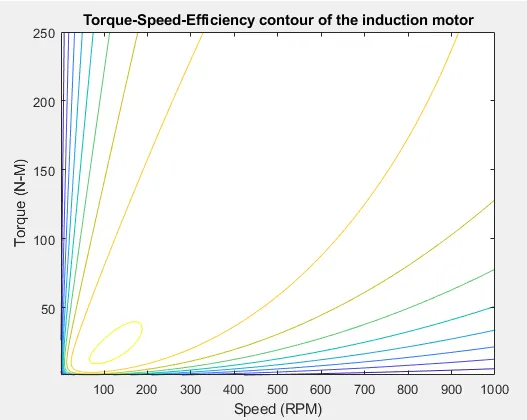
3. Make a MATLAB program which plots contour of given motor speed, torque, and efficiency values. Attach the code as a .m file attach a screenshot of all the plots.
Aim:
Let induction motor is considered for the calculations of speed torque and efficiency. The contour is to be built among motor speed torque and efficiency values.
Equations:
Torque equation of induction motor.
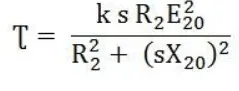

Torque speed characteristics
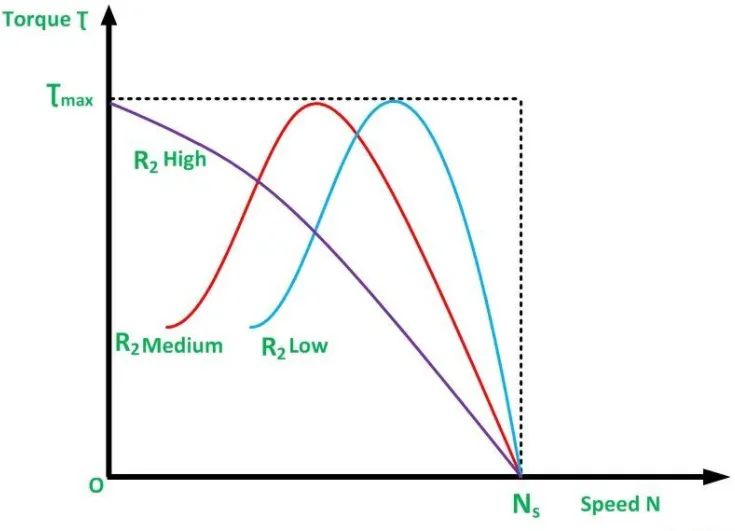
Matlab code:
clear all;
close all;
clc;
torque = linspace(1,250,250); % input torque
speed = linspace(1,1000,250); %Input speed
[W,T] = meshgrid(speed,torque); % converting into 2D array
Kc = 0.3; %Copper loss constant
Ki = 0.009; % Iron loss constant
Kw = 0.00005; %windage loss constant
C = 30; %constant loss
Pout = W.*T; %Output Power
C_loss=Kc*(T.^2); %Copper loss
I_loss = Ki*W; %Iron loss
W_loss = Kw*(W.^3);%windage loss
Pin = Pout + C_loss + I_loss + W_loss+ C;
eff = Pout./Pin;
contour(speed,torque,eff)
title('Torque-Speed-Efficiency contour of the induction motor');
xlabel('Speed (RPM)');
ylabel('Torque (N-M)')
Contour: