Week-6 Challenge: EV Drivetrain
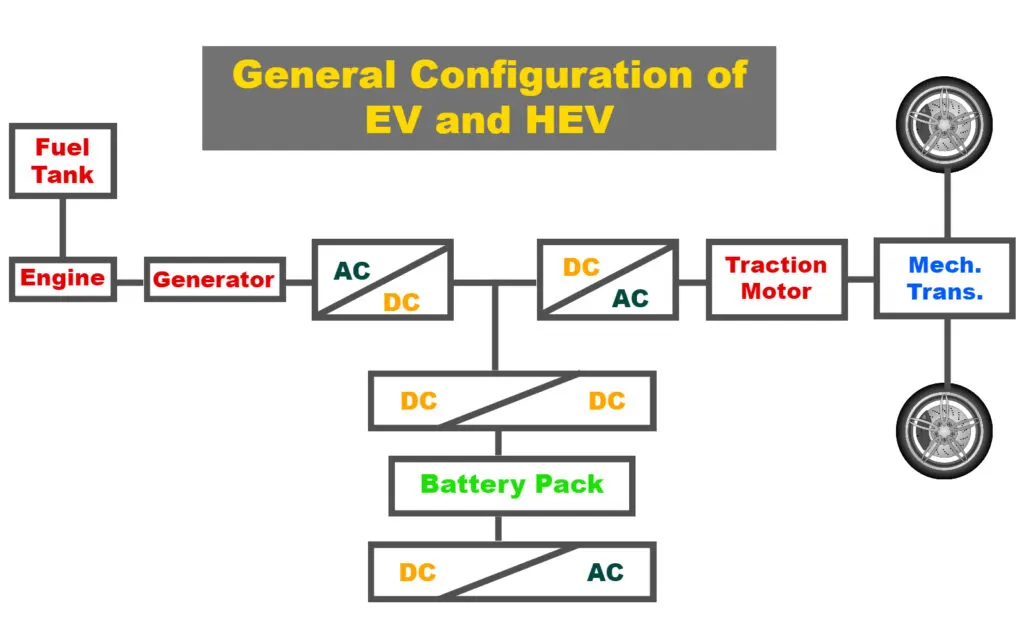
1) Which types of power converter circuits are employed in electric and hybrid electric vehicle?
There are dour types of power converter circuits used in electric and hybrid electric vehicle are:
1) AC - DC converter( Rectifier)
2) DC - AC converter(Inverter)
3) DC - DC converter ( Chopper)
(i) Step up chopper
(ii) Step down chopper
4) AC - AC converter
AC - DC converter( Rectifier)
These are the converter used in while charging of electric and hybrid electric vehicle were it converts the ac supply source to dc supply to battery of vehicle while charging.
DC - AC converter(Inverter)
Thes are the converter used in vehicle to convert dc supply to ac supply for example to run a motor in electric and hybrid electric vehicle it need ac supply but the source from battery is dc supply so in those place this type of inverter is used.
DC - DC converter ( Chopper)
These are the converter used in vehicle to convert one level fo DC supply to another level of DC supply. If they increase the DC supply then they are called as Step up Chopper, when they decrease the DC supply they are called Step Down Chopper.
AC - AC converter
These converter are used to one level of voltage and frequency in AC supply to other level of voltage and frequency in AC supply they are similar as chopper, example for this converter is fan regulator.
2) What is EV steady state speed if duty cycle is 70%?
An Electric Vehicle's powertrain with 72V battery pack in shown in the diagram below. The duty ratio for acceleration operation is 'd1' and for the braking operation the duty ratio is 'd2'.
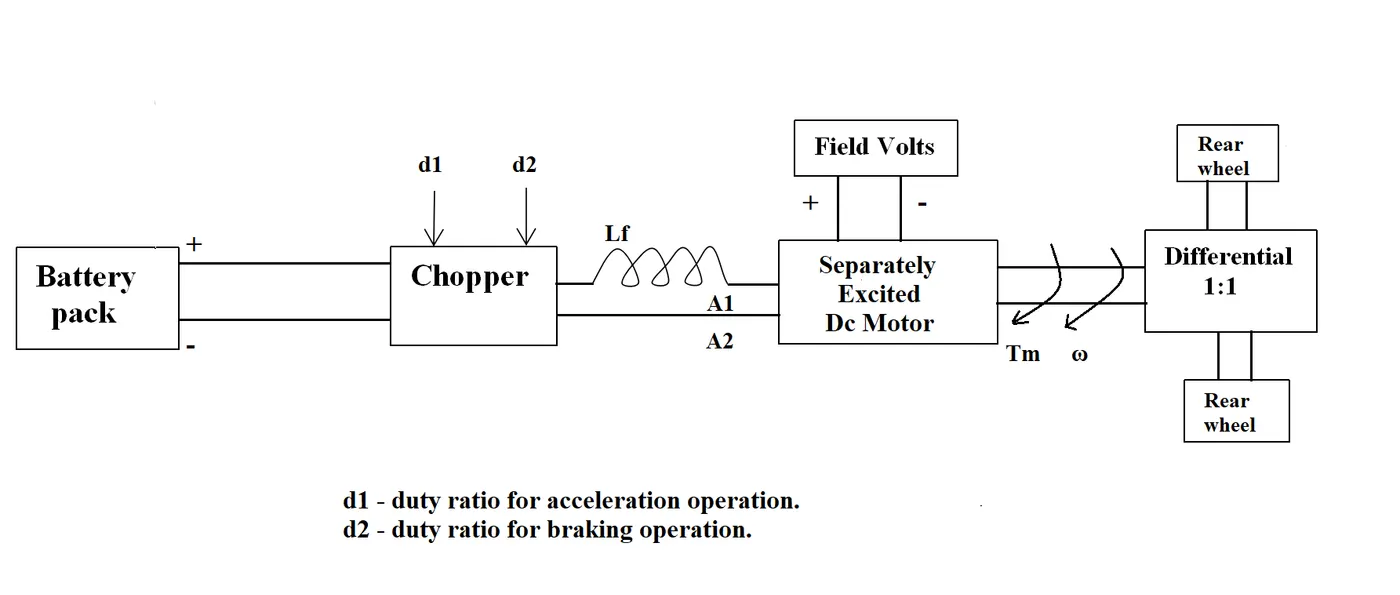
The other parameters of the electric vehicle is given below,
Motor and Controller Parameters:
Rated Armature voltage= 72 V
Rated armature current= 400 A
Ra= 0.5Ω,
KΦ= 0.7 Volt second
Chopper Switching frequency= 400 Hz
The vehicle speed-torque characteristics are given by the below equation
`T_υ=24.7+(0.0051)×ω^2` --- 1
The torque euation of DC motor is
`T=((V×K∅)/R)-((K∅^2×ω)/R)`---- 2
By equating eqaution 1 and equation 2
`24.7+(0.0051)×ω^2 = ((V×K∅)/R)-((K∅^2×ω)/R)`
By susbstituting the values of voltage, Resistance, constant we get the equation
`24.7+(0.0051)×ω^2 = ((72×0.7×0.7)/0.5)-((0.7^2×ω)/0.5)`
`24.7+(0.0051)×ω^2 = (70.56)-(0.98×ω)`
By rewriting the above equation we get
`ω^2 + (192.15×ω) - 8992.15 = 0`
The above equation is the quadratic equation by solving that equation we will get the value of steady state speed if duty cycle is 70%
ω = 38.95 rad/sec
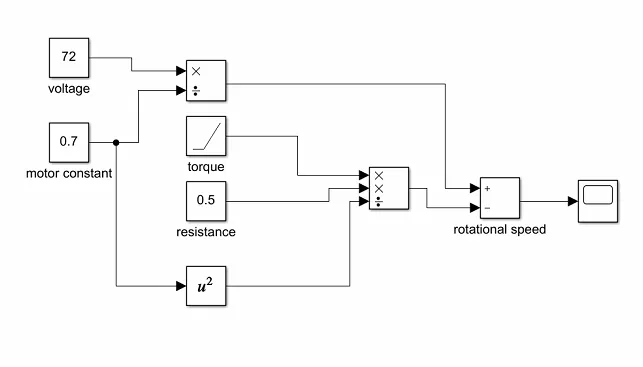
3)Develop a mathematical model of a DC Motor for the below equation using Simulink.
`ω = ( V/K_ϕ) -(R_a/K _ϕ ^2 .T)`
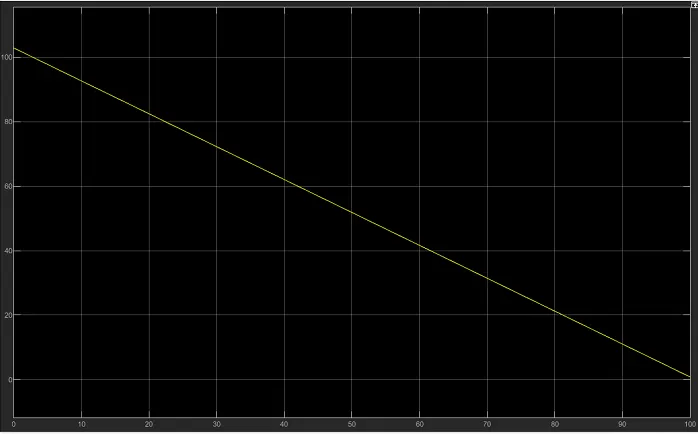
The model is made in simulink it consists of constant block, Ramp block, square block, divide block, add block, scope block and the stimulation time is 100 Seconds
After running the model we get this plot
4) Refer to the blog and Explain in brief about author’s perspective.
In the above blog the author first explain about himself and then discussed about normal commerical vehicle and then about the changes which happend in new vehicle and also about electrical vehicle. Then the main topic he discussed in the blog is about Brsuhless Dc motor and Induction Motor which is used in Hybrid electrical vehicle and Electrical vehicle. Then he discussed baout the bascis concept and working of Brushless DC motor and Induction Motor and then discussed about efficiency, positive and negative of both Brushless DC motor and Induction Motor.
Brushless DC motor:
Brushless DC motor consists of two or more permanent magnets which is present in rotor taht generates magnetic field which reactes with current flowing in winding which produce torque. All the elctrical energy produced are then converted to mechanical energy with good efficiency. Brushless DC motor produce no starting torque when it is connected to fixed frequency utility power. Since brushless dc motor has rotor cooling system the heat produced by motor is low so there is less loss of enegry in form of heat which in turns works more efficient. Brushless dc motor will also oprates with unity power which give more efficiemcy than induction motor. In brushless dc motor the strength of magnetic field produced is hard to adjust so there will me more loss compared to induction motor. The cost of permanent magnet present in brushless dc motor is costs more so it may require moe cost to build.
Induction Motor:
The 3 phase induction motor looks similar to brushless dc motor, they have same type of windind within stator but the difference between both is with in rotor. Induction motor does not use magnets they only have steel laminations with the buried peripheral conductors, Current flowing in stator windings produce a rotating magnetic field that enters rotor. If the three phase induction motor is connected to three phase power it will produce torque. The main reason for induction motor success is because it can directly compatible with conventional power. The induction motor cannot operate in dc it must require AC. If we add inverter and feed back loop it wil be in equal efficiency to brushless dc motor. In induction motor magnetic field strength is adjustable and it is preferable for high performance operation. The average efficiency of induction motor is better than brushless dc motor. The cost of this motor is less when compared to brushless motor but it requires more control than brushless dc motor.
Finally author concludes that both Brushless DC motor and induction motor has some advantages and disadvantages in future we can see the working of both Brushless dc motor and induction motor in live by working it side by side and we can see the performance of both.