Week-6 Challenge: EV Drivetrain
1) Which types of power converter circuits are employed in electric and hybrid electric vehicle?
Power Converters in EV and HEV:
The important components in Electric and Hybrid Electric Vehicle are Power converters which interface their power sources to drive train. The main components of an Electric Vehicle are DC-AC inverter, DC-DC converter, battery, and electric motor.
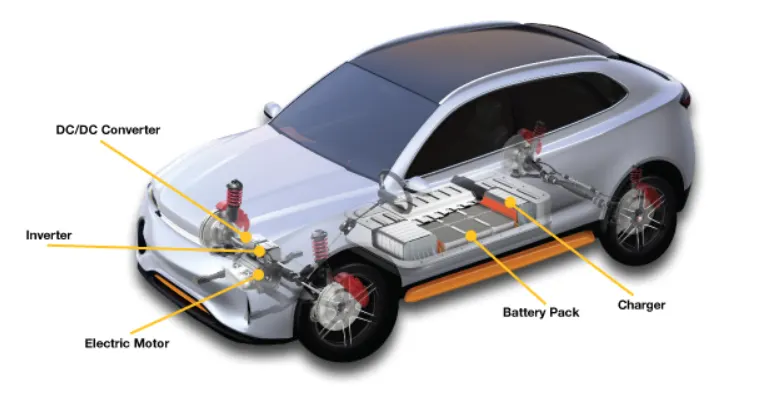
The main power electronics units are :
1) DC - DC Converter
2) DC - AC Inverter
3) AC - DC Converter
1) DC-DC Converter : can be based on number of different designs, the underlying function remains the same which could be a step up converter or step down converter.
Boost Converter - Stepup converter - which turns low voltage input into a high voltage output.
Buck Converter - Stepdown converter - which turns high volatge into low voltage output.
Buck-Boost converter - stepup/stepdown - The output voltage can be either higher or lower than the input voltage.
The Batteries of an electric vehicle typically output several hundreds of volts of DC. However, the Electric components in the vehicle operates in the different voltage requirements with most running at much lower voltage. This Includes Infotainment system airconditioning system, Headlamps and indicators etc. In electric vehicles which use a DC motor, actually running the motor can use up to three times the voltage provided by the battery. With the help of the right converter, we can bridge this gap without having to resort to a larger heavy battery.
2) DC - AC Inverter : An inverter is a device that converts DC power from the battery to AC power used in an electric vehicle motor. The inverter can change the speed at which the motor rotates by adjusting the frequency of the alternating current.
The use of Inverters can increase or decrease the power / torque of the motor by adjusting the amplitude of the signal. It plays a significant role in capturing energy from regenerative braking and feeding it back to the battery. It has a direct impact on on-road performance, driving range and reliability of the vehicle also as a consequence of their weight and size.
3) AC -DC Conterter :This types of converter takes AC power and converts it into DC. For Example in Plug- in Hybrid Electric Vehicle.These Vehicle gets propulsion power from External energy source which is AC supply. The Battery needs to be charged using direct current source. therefore AC to DC converter (Onboard Charger) is required.
2) An Electric Vehicle's powertrain with 72V battery pack in shown in the diagram below. The duty ratio for acceleration operation is 'd1' and for the braking operation the duty ratio is 'd2'.
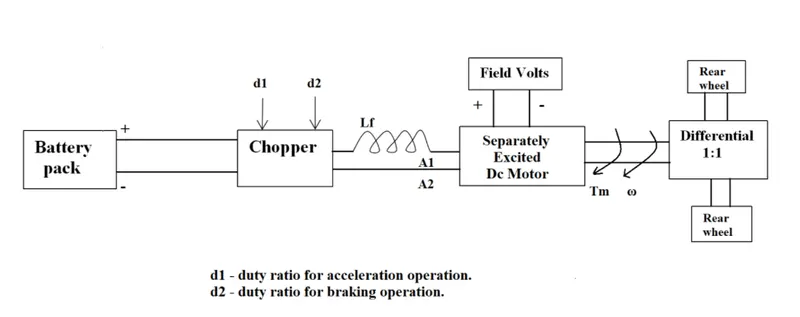
The other parameters of the electric vehicle is given below,
Motor and Controller Parameters:
Rated Armature voltage= 72 V
Rated armature current= 400 A
Ra= 0.5Ω, KΦ= 0.7 Volt second
Chopper Switching frequency= 400 Hz
The vehicle speed-torque characteristics are given by the below equation.
 - --- What is EV steady state speed if duty cycle is 70%?
A duty cycle or power cycle is the fraction of one period in which a signal is active.It is commonly expressed as percentage or ratio.
Calculating the supply volatge for 70% of duty cycle
V1 =Battery Voltage x Duty cycle
=72 x 0.7
=50.4
Calculating Vehicle Torque
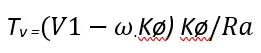
Tv = Vechicle torque
V1 = Vehicle Voltage
ꙍ = steady state speed
Kø = Motor Constant
Ra = Armeture Resistance
Therefore
Tv = (50.4-0.7*ꙍ)*0.7/0.5
= 70.56-0.98*ꙍ
Tv = 24.7+0.0051*ꙍ^2
70.56-0.98*ꙍ = 24.7+0.0051*ꙍ^2
0.0051*ꙍ^2+0.98*ꙍ-45.86 = 0
This equation represents the quadratic eqaution of form =
`ax^2+bx+c`
where a = 0.0051 b = 0.98 c =-45.86
using these values
`omega=(-bpmsqrt(b^2-4ac))/(2a)`
`omega =`38.91rad/sec
EV steady state speed is 38.91rad/sec.
The author Wally Ripple explain the DC Brushless motor and AC Induction motor and compare its pros and cons.
Author describe the merits and demerits of both type.
BLDC - Brushless motor
In a brushless motor, we have permanent magnets instead of electromagnets. A permanent magnet generates a DC (direct current) magnetic field instead of an AC (alternative current) magnetic field.
So now the magnetic field formed interacts with the magnetic field of the stator to generate motion and the current produced in the electromagnet is dependent upon the speed of motion. When the rotor creates a DC magnet field, the stator should also generate a DC magnetic field.
However, the current that is produced through our electricity is an alternative current (AC). So here comes the role of “Inverter” and an electronic circuit that converts AC to DC depending upon the speed of the motor to make it function properly.
BLDC motor is lighter compared to its conventional parts, which have the same output and also do not produce much noise and they are very efficient. Power to weight ratio is good in BLDC. Effeciency is almost 100% in BLDC.
INDUCTION MOTOR -
Coming to induction motors, their main difference in comparison to BLDC is that this motor has an electromagnet based rotor. So, in this case, both the rotor and stator are an electromagnet.
In an induction motor, an electric current produces torque (or a rotation) by maintaining electromagnetic induction. This electromagnetic induction is provided from the magnetic field through its winding and this is the reason this motor is known as an induction motor.
An induction motor has the capacity to work in alternating current (that is from direct electricity which comes to our house) the voltage from the line vary to get different speed from the motor and this is why we use the regulator for our fan to change the speed of its rotation according to the coolness required in our house. Since this motor directly supports AC (alternating current), it does not need an invertor like BLDC motor.
Authors Conclusion :
According to him DC brushless drives will likely continue to dominate in the hybrid and coming plug-in hybrid markets, and that induction drives will likely maintain dominance for the high-performance pure electric vehicle. The question is what will happen as hybrids become more electrically intensive and as their performance levels increase? The fact that so much of the hardware is common for both drives could mean that we will see induction and DC brushless live and work side by side during the coming golden era of hybrid and electric vehicles.