Week-6 Challenge: EV Drivetrain
Aim: - Study of EV Drivetrain.
Objective: -
- Which types of power converter circuits are employed in electric and hybrid electric vehicles.
- An Electric Vehicle's powertrain with 72V battery pack in shown in the diagram below. The duty ratio for acceleration operation is 'd1' and for the braking operation the duty ratio is 'd2'. The other parameters of the electric vehicle are given below,
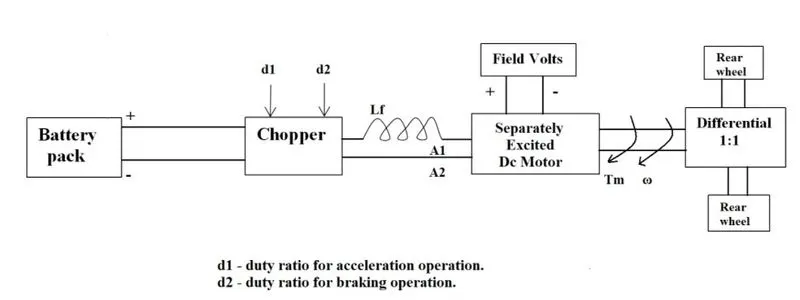
Motor and Controller Parameters:
Rated Armature voltage= 72 V
Rated armature current= 400 A
Ra= 0.5Ω, KΦ= 0.7 Volt second
Chopper Switching frequency= 400 Hz
The vehicle speed-torque characteristics are given by the below equation

What is EV steady state speed if duty cycle is 70%?
- Refer to the blog on below topic:
Induction Versus DC brushless motors by Wally Rippel, Tesla
Explain in brief about author’s perspective.
1) Types of power converter circuits which are employed in electric and hybrid electric vehicle:-
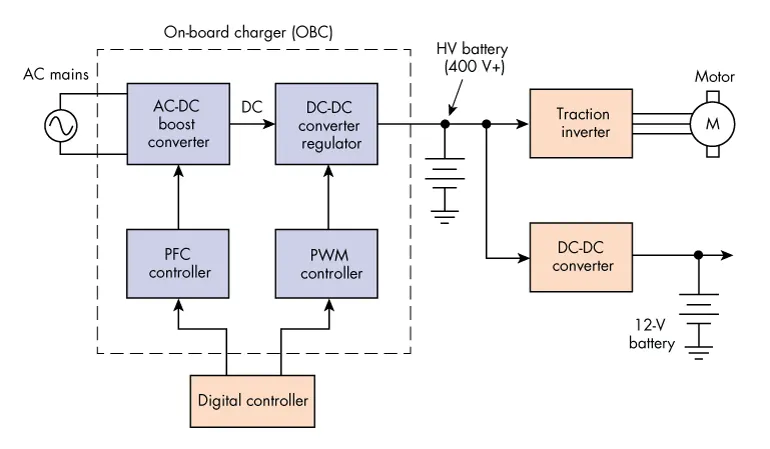
Conveter used in Electric Vehicle
|
S.No |
Type of Converter |
Type of Circuit |
Application in EV & Hybrid EV |
|
1. |
AC to DC Converter |
Rectifier Circuit |
Chargers used in EV |
|
2. |
DC to AC Converter |
Inverter Circuit |
AC Motor Drive and Control |
|
3. |
DC to DC Converter |
Chopper Circuit |
Power auxiliary loads like headlamps, USB Phone charging etc. |
AC to DC Converter: -
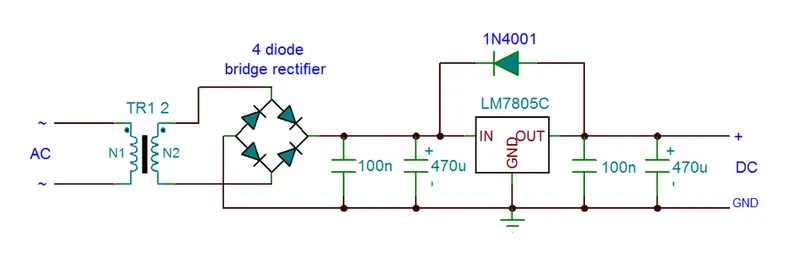
A rectifier is an electrical device that converts alternating current (AC), which periodically reverses direction, to direct current (DC), which flows in only one direction. The reverse operation is performed by the inverter.
The process is known as rectification, since it "straightens" the direction of current. Physically, rectifiers take a number of forms, including vacuum tube diodes, wet chemical cells, mercury-arc valves, stacks of copper and selenium oxide plates, semiconductor diodes, silicon-controlled rectifiers and other silicon-based semiconductor switches. AC to DC conversion waveform in MATLAB is shown below.
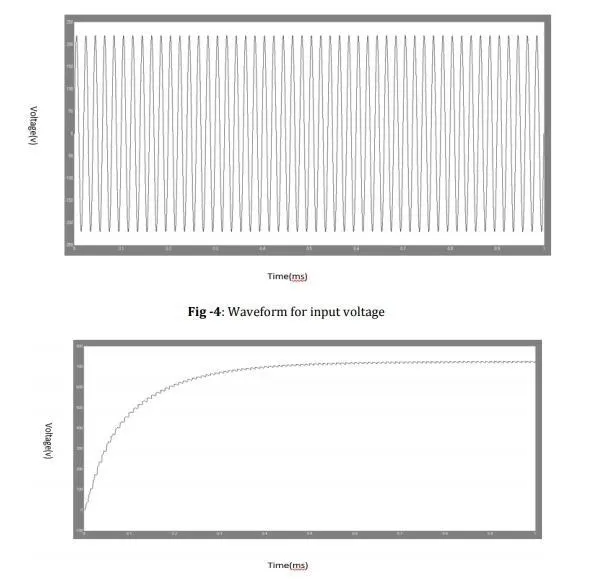
Rectifiers have many uses, but are often found serving as components of DC power supplies and high-voltage direct current power transmission systems. Rectification may serve in roles other than to generate direct current for use as a source of power. As noted, detectors of radio signals serve as rectifiers. In gas heating systems flame rectification is used to detect presence of a flame.
Depending on the type of alternating current supply and the arrangement of the rectifier circuit, the output voltage may require additional smoothing to produce a uniform steady voltage. Many applications of rectifiers, such as power supplies for radio, television and computer equipment, require a steady constant DC voltage (as would be produced by a battery). In these applications the output of the rectifier is smoothed by an electronic filter, which may be a capacitor, choke, or set of capacitors, chokes and resistors, possibly followed by a voltage regulator to produce a steady voltage.
DC to AC Converter :-
A power inverter, or inverter, is a power electronic device or circuitry that changes direct current (DC) to alternating current (AC). The resulting AC frequency obtained depends on the particular device employed. Inverters do the opposite of “converters” which were originally large electromechanical devices converting AC to DC.
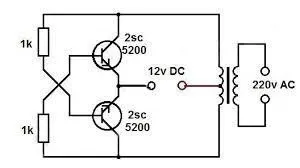
The input voltage, output voltage and frequency, and overall power handling depend on the design of the specific device or circuitry. The inverter does not produce any power; the power is provided by the DC source.
A power inverter can be entirely electronic or may be a combination of mechanical effects (such as a rotary apparatus) and electronic circuitry. Static inverters do not use moving parts in the conversion process.
Power inverters are primarily used in electrical power applications where high currents and voltages are present; circuits that perform the same function for electronic signals, which usually have very low currents and voltages, are called oscillators. Circuits that perform the opposite function, converting AC to DC, are called rectifiers.
DC to DC Converter :-
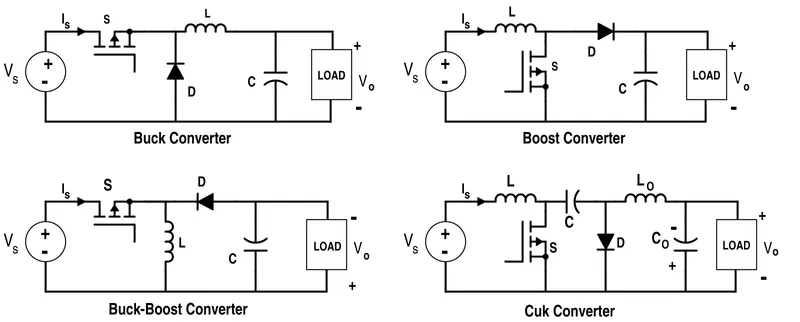
A DC-to-DC converter is an electronic circuit or electromechanical device that converts a source of direct current (DC) from one voltage level to another. It is a type of electric power converter. Power levels range from very low (small batteries) to very high (high-voltage power transmission). they are basically four types
1)Buck Converter
2)Boost Converter
3)Buck-Boost Converter
4)Cuk Converter
2) An Electric Vehicle's powertrain with 72V battery pack in shown in the diagram below.
Given Motor and Controller Parameters are
Rated Armature voltage (V)= 72 V
Rated armature current (I)= 400 A
Ra= 0.5Ω,
KΦ= 0.7 Volt second
Chopper Switching frequency= 400 Hz
The vehicle speed-torque characteristics are given by the below equation

As we know that, the torque equation for DC machine is
Tv= (V0* KΦ)/Ra - ((KΦ^2) * ω)/Ra ---------------- (2)
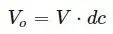
the average voltage is the product of battery voltage and the duty cycle
 --------------------------(3)
= 72*0.7
=50.4 Volt
solving equation (1) & (2) to get the value of speed (ω)
24.7 + (0.0051)*ω^2 = (V0* KΦ)/Ra - ((KΦ^2) * ω)/Ra
=> 24.7 + (0.0051)*ω^2 = (50.4*0.7)/0.5 - ((0.7^2)*ω)/0.5
=> 24.7 + (0.0051)*ω^2 = 70.56 - 0.98*ω
=> (0.0051)*ω^2 + 0.98*ω - 45.86 = 0 --------------------(4)
The equation (3) is in the quadratic equation form ax2 + bx + c = 0
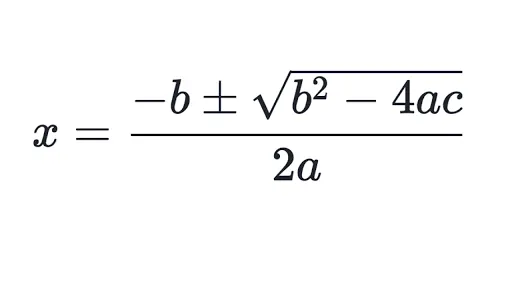
x = −b + √(b2 − 4ac)/ 2a or x = −b − √(b2 − 4ac)/2a
x = (-0.98 + 1.377)/0.0102 or x = (-0.98 - 1.377)/0.0102
x= 38.91 rad/sec or -231.07 rad/sec
as the value of ω cannot be negitive, Therefore ω=38.91 rad/sec
3) Refering to the blog on topic ' Induction Versus DC brushless motors by Wally Rippel, Tesla '
About author’s perspective:-
Now a days due to Globalization and large R&D in the feild of Electric Vehicle we have replaced older Lead acid batteries with Li-ion batteries and supercapacitors . There are different types of engines to suit personal requirements, such as price and performance.
DC Brushless Motors are best suited for the hybrid and coming plug-in hybrid markets where as induction drives will likely maintain dominance for the high-performance pure electrics.
author clearly discribed the merits and demerits of both brushless DC and induction motors in the field of Electric Vehicles.
- Induction machines have no magnets and B fields are “adjustable,” since B is proportionate to V/f (voltage to frequency).whereas brushless DC (BLDC) motors uses permanent magnets which increases the total cost of motor. as the size of BLDC motor increases the losses also increases but in the case of induction motors the losses are still minimum.
- Induction drives may be the favored approach where peak efficiency will be a little less than with DC brushless, but average efficiency may actually be better.
- Achieving stability over the entire torque-speed range and over temperature is more difficult with induction than with DC brushless.
Conclusion:-
In the present day the DC brushless drives will likely continue to dominate in the hybrid and coming plug-in hybrid markets, and that induction drives will likely maintain dominance for the high-performance pure electrics.But as the performance levels increases due to competition in EV market in the near future we are going to see both induction and DC brushless live and work side by side during the coming golden era of hybrid and electric.