Week-6 Challenge: EV Drivetrain
AIM:
- Which types of power converter circuits are employed in electric and hybrid electric vehicle?
- To calculate the steady state speed of the EV if the duty cycle is 70%.
- Author’s perspective on Induction vs Dc brushless motors.
ANS 1
TYPES OF POWER CONVERTER CIRCUITS EMPLOYED IN ELECTRIC AND HYBRID VEHICLE
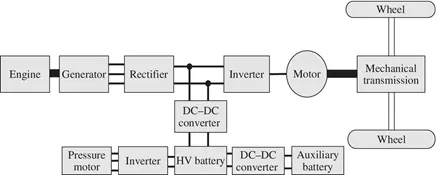
The types of power electronics circuits used in an HEV, we use the configuration of a typical series HEV powertrain as shown in figure In this configuration, the internal combustion engine (ICE) drives a three‐phase permanent magnet synchronous generator, whose output is a three‐phase voltage with variable frequency and variable voltage. This output needs to be rectified to DC.
Power electronics are a key technology for hybrids and represent 20% of the material costs. It is even bigger for EV cars. HEV/EV power devices are used in DC/DC converters and DC/AC inverters. There are various configurations depending on the hybrid version and car makers.
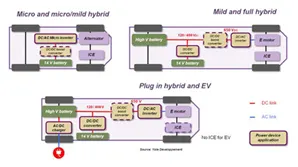
The power electronic converters play an important role in the electric and Hybrid electric vehicles and are considered key elements that interface their power source to the drivetrain.
These converters help in providing the required output voltage and current levels with high power quality such that the control of the vehicle drivetrain is smooth and steady.
The 3 types of converters used in the EV and HEVs are:
AC-DC converter:
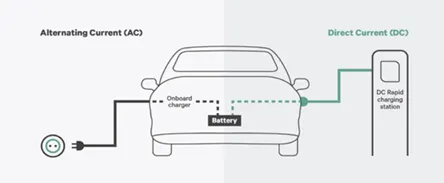
This is mainly used in the on-board charger or the charging stations. These are commonly used in plug-in hybrid electric vehicles (PHEVs)and plug-in electric vehicles (PEV).The vehicle gets its propulsion power from an external electricity source (power grid) which is alternating current. To charge the battery it requires DC power ,so for this purpose the DC-AC converters are employed in a PHEV an PEV.
On-board chargers consist of AC-DC converters that convert an AC voltage (100V to 240V) to a DC voltage in order to charge the high voltage battery. To ensure worldwide compatibility, the permissible input voltage for many on-board chargers ranges from 85V to 265V. And, to meet market needs for shorter charge times, the voltage specified under fast charging standard is increased, along with battery voltage.
DC/DC converters:
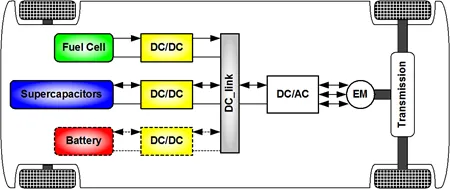
In EVs, the engine is replaced by a high voltage battery and motor. The DC-DC converter switches power elements and utilizes a transformer to convert the high battery voltage to a lower voltage. To protect low voltage electronic circuits, it is necessary to electrically isolate both the signal and ground from the low and high voltage boards.
DC/DC converter is necessary to interface the FC, the Battery or the Supercapacitors module to the DC-link. DC to DC converter is a category of power converters and it is an electric circuit which converts a source of direct current (DC) from one voltage level to another, by storing the input energy temporarily and then releasing that energy to the output at a different voltage.
DC/DC converters can be designed to transfer power in only one direction, from the input to the output. However, almost all DC/DC converter topologies can be made bi-directional. A bi-directional converter can move power in either direction, which is useful in applications requiring regenerative braking.
DC-AC Converter (inverter):
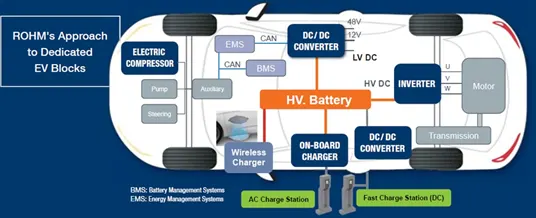
The DC-AC converter is used to convert the DC power from the battery/fuel cell/supercapacitors to appropriate AC power required to run the electrical motor. The DC to AC conversion can be done among 12V, 24V, 48V to 110V, 120V, 220V, 230V, 240V with supply frequency 50Hz/60Hz. For a better understanding of this concept here is a simple 12V DC to 220V AC Converter circuit which is designed to convert DC to AC.
REFERENCES:
- https://www.mouser.com/new/rohm-semiconductor/rohm-electronic-vehicle-solutions/
- https://www.intechopen.com/books/electric-vehicles-modelling-and-simulations/dc-dc-converters-for-electric-vehicles
- https://www.powersystemsdesign.com/articles/power-electronics-in-electric-hybrid-vehicles/35/5338
.
.
.
ANS2:
Given: input parameters
Battery voltage= 72V
Rated armature current = 400A
Rated armature current= 400 A
Armature resistance Ra= 0.5Ω,
Motor constant, KΦ= 0.7 Volt second
Chopper Switching frequency= 400 Hz
The vehicle speed-torque characteristics are given by the below equation. `T_v=24.7+0.0051.ω^2`
Duty cycle,
`d=70%`
Motor terminal voltage= Armature voltage x Duty cycle
`Vv=72 X 0.7 = 50.4V`
Torque-speed relation of the DC machine is given by
`T_v=((V_v-ωK_Ф ).K_Ф)/R_a`
Now substituting given data,
`T_v=((50.04-ω.0.7).0.7)/0.5`
`T_v=70.056-0.98.ω`
We have,
`T_v=24.7+0.0051.ω^2`
Equating the above two equations we get,
`70.056-0.98.ω=24.7+0.0051.ω^2`
we get a quadratic equation, solving it we get,
`0.0051ω^2+0.98.ω-45.356=0`
Therefore steady state speed of the vehicle
`ω=38.54 rad/s`
.
.
.
ANS 3:
The author ‘Wally Rippel’ has a broader view on the evolution of the electric vehicles and its changing technologies. He has had been witnessing the changes that have been occurring in the automotive industry about the powertrain especially the motor powering the automobile.
The change in the battery and motor technologies with different preferences by various industries have brought his attention and led him to this question about which drive is better whether the Brushless DC or induction motor. He does a comparison between these two technologies and states some advantages and disadvantages of each.
Induction motor have some advantages like it has no magnets. The motor has the ability to start under load. No inverter is needed. disadvantages of Induction motors are: They cannot operate from DC, AC is a must. Shaft speed is proportionate to line frequency, Hence, when used with utility power, they are constant speed machines. When operated from utility power, they have limited starting torque and somewhat limited running peak torque capabilities, when compared to DC type machines
Brushless DC motor have some advantages like: much less rotor heat is generated with the DC brushless drive. The peak point energy efficiency for a DC brushless drive will typically be a few percentage points higher than for an induction drive Some disadvantages of Brushless DC motor are: as machine size grows, the magnetic losses increase proportionately and part load efficiency drops. Permanent magnets are expensive and difficult to handle due to very large forces that come into play when anything ferromagnetic gets close to them.
At the end the author couldn’t come to a conclusion on which drive is better rather he makes it clear that DC brushless drives will likely continue to dominate in the hybrid and coming plug-in hybrid markets, and that induction drives will likely maintain dominance for the high-performance pure electrics.