Week-6 Challenge: EV Drivetrain
Question 1: Which types of power converter circuits are employed in electric and hybrid electric vehicle?
Solution 1: There different types of power converter used in EV and HEV:
- AC to DC converter: A rectifier is a device that converts an oscillating two-directional alternating current (AC) into a single-directional direct current (DC). Use of Rectifier in EV as Charging of batteries.
- DC to AC converter: An inverteris a device that converts DC power to the AC power used in an electric vehicle The inverter can change the speed at which the motor rotates by adjusting the frequency of the alternating current.
- DC to DC converter: DC to DC converter is a category of power converters and it is an electric circuit which converts a source of direct current (DC) from one voltage level to another, by storing the input energy temporarily and then releasing that energy to the output at a different voltage. The storage may be in either magnetic field storage components (inductors, transformers) or electric field storage components (capacitors) DC-DC converters can be used to interface the elements in the electric power train by boosting or chopping the voltage levels. Used for auxiliary of EV.
Question 2: An Electric Vehicle's powertrain with 72V battery pack in shown in the diagram below. The duty ratio for acceleration operation is 'd1' and for the braking operation the duty ratio is 'd2'.
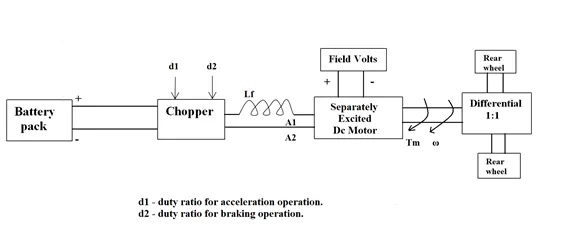
The other parameters of the electric vehicle is given below,
Motor and Controller Parameters:
Rated Armature voltage= 72 V
Rated armature current= 400 A
Ra= 0.5Ω, KΦ= 0.7 Volt second
Chopper Switching frequency= 400 Hz
The vehicle speed-torque characteristics are given by the below equation

What is EV steady state speed if duty cycle is 70%?
Solution 2: We know Torque speed characteristics of motor
Tm= Motor torque
ω = speed
ϕ = Flux density
V = Effective voltage
k = Motor constant
R = Armature resistance
We also know,
Vb.duty =Ve
Where,
Ve = Effective voltage
Vb = 72 V
Duty = 70/100
Therefore,
`ω=V/kφ-(T_m R)/〖(kφ)〗^2`
`ω=50.4/0.7-(T_m 0.5)/〖(0.7)〗^2`
`ω=72-〖1.02T〗_m`
`70.5-0.98ω=T_m`
At steady state we know that Tm = Te
i.e., `70.5-0.98ω=24.7-0.0051ω^2`
Solving the quadratic equation, we get ω = 38.87 rad/s
Question 3: Refer to the blog on below topic:
Induction Versus DC brushless motors by Wally Rippel, Tesla
Explain in brief about author’s perspective.
Solution 3: In the blog Induction vs DC brushless motors by Wally Rippel, Tesla tell about the difference of induction motor and DC brushless motors used in pure electric vehicle and hybrid electric vehicle respectively. He describes the difference by comparing the both motors on the basis of structure, performance, merits and demerits. On the basis of comparison he concludes that DC brushless motor dominants hybrid electric vehicle, whereas induction motor widely used in pure electric car as per their high performance and nature of requirements. And in last he concludes by saying that as the fact that so much of the hardware is common for both drives could mean that we will see induction and DC brushless live and work side by side during the coming golden era of hybrid and electric vehicles.