Literature review: EV Drivetrain components
AIM: To Understand EV drivetrain components by answering the following questions.
OBJECTIVE:
- Which types of power converter circuits are employed in an electric and hybrid electric vehicle?
- Read and review the blog on the topic 'Induction Versus DC Brushless Motors'
- For the given data What is EV steady-state speed if the duty cycle is 70%?
SOLUTION:
- Which types of power converter circuits are employed in an electric and hybrid electric vehicle?
The main components of an Electric Vehicle are DC-AC inverter, DC-DC converter, battery, and electric motor. There are two major power electronic units in the general configuration
DC-AC inverter
DC-DC converter
AC-DC rectifier
Usually, AC motors are used in HEVs or EVs for traction and they are fed by inverter and this inverter is fed by a DC-DC converter
In electric engineering, a DC to DC converter is a category of power converters and it is an electric circuit which converts a source of direct current (DC) from one voltage level to another, by storing the input energy temporarily and then releasing that energy to the output at a different voltage. The storage may be in either magnetic field storage components (inductors, transformers) or electric field storage components (capacitors).
DC/DC converters can be designed to transfer power in only one direction, from the input to the output. However, almost all DC/DC converter topologies can be made bi-directional. A bi-directional converter can move power in either direction, which is useful in applications requiring regenerative braking.
DC-AC converter(inverter), An inverter is a device that converts DC power from the battery to AC power used in an electric vehicle motor. The inverter can change the speed at which the motor rotates by adjusting the frequency of the alternating current. The use of Inverters can increase or decrease the power or torque of the motor by adjusting the amplitude of the signal. It plays a significant role in capturing energy from regenerative braking and feeding it back to the battery.A rectifier is used in a charger to convert the AC current to DC which is used to charge the battery. electric vehicles generally use a 3 phase rectifier.
- Read and review the blog on the topic 'Induction Versus DC Brushless Motors'
- BLDC is more efficient than an induction motor.
- BLDC requires an inverter for operation, and an induction motor can work directly from a 3 phase supply.
- induction motors can start under load, BLDC's do not produce starting torque.
- induction motors cannot work from DC, and the shaft speed is dependent on the frequency.
- Both DC brushless and induction drives use motors having similar stators. Both drives use 3-phase modulating inverters. The only differences are the rotors and the inverter controls. And with digital controllers, the only control differences are with control code. (DC brushless drives require an absolute position sensor, while induction drives require only a speed sensor; these differences are relatively small.)
- BLDC motors generate less heat as compared to induction motors.
- With DC brushless, as machine size grows, the magnetic losses increase proportionately and part load efficiency drops. With induction, as machine size grows, losses do not necessarily grow. Thus, induction drives may be the favored approach where high-performance is desired;
- permanent magnet motors are more expensive ie BLDC is more expensive.
The conclusion is that DC brushless drives will likely continue to dominate in the hybrid and coming plug-in hybrid markets, and that induction drives will likely maintain dominance for the high-performance pure electrics.
- For the given data What is EV steady-state speed if the duty cycle is 70%?
GIVEN:
An Electric Vehicle's powertrain with 72V battery pack . The duty ratio for acceleration operation is 'd1' and for the braking operation the duty ratio is 'd2'.
Motor and Controller Parameters:
Rated Armature voltage= 72 V
Rated armature current= 400 A
Ra= 0.5Ω, KΦ= 0.7 Volt second
Chopper Switching frequency= 400 Hz
The vehicle speed-torque characteristics are given by the below equation
 --- (1)
We know that the speed-torque equation is derived as
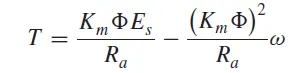
For 70% duty cycle the voltage is V= 72*0.7 = 50.4;
substituting the above given values in the speed torque equation we get is
`T= 70.56 - 0.98omega` ----- (2)
solving equation (1) and (2) we get
`0.0051 omega^2 + 0.98 omega -45.89=0`
Thus the value of 'omega' is
`omega =` -231.07 rad/s & 38.92 rad/s
The +ve value represents the torque generated by the motor.
CONCLUSION:
The concepts of EV drivetrain components were thoroughly understood.