EV Drivetrain
Question 1:
Which types of power converter circuits are employed in an electric and hybrid electric vehicle?
AC to DC converter(Rectifiers): App: EV charger(battery)
Here, in plug-in type electric or hybrid electric vehicle, the external power source is also used to charge the battery. The battery requires power in the form of DC but the conventional power to the charging port is in the form of AC. To convert the AC to DC, a rectifier is used.
DC to AC converter(Inverter): App: EV motor drive(induction motor)
Here, in high-performance electric vehicles, induction motor drive trains are used. Known as 3 phase induction motor which requires AC supply to run. But the power coming from the battery is in the form of DC.So a converter circuit is provided to convert DC to AC which in this case, it is known as an inverter.
DC to DC converter(chopper): App: Auxillary sources
Here, the voltage coming from the battery is higher than the required/rated voltage for some units like sensor, horn, dashboard and lights. To step down or step up the voltage based on the requirement, a chopper is used which converts input DC voltage to lower or higher voltage DC based on the requirements.
Question 2:
An Electric Vehicle's powertrain with 72V battery pack in shown in the diagram below. The duty ratio for acceleration operation is 'd1' and for the braking operation the duty ratio is 'd2'.
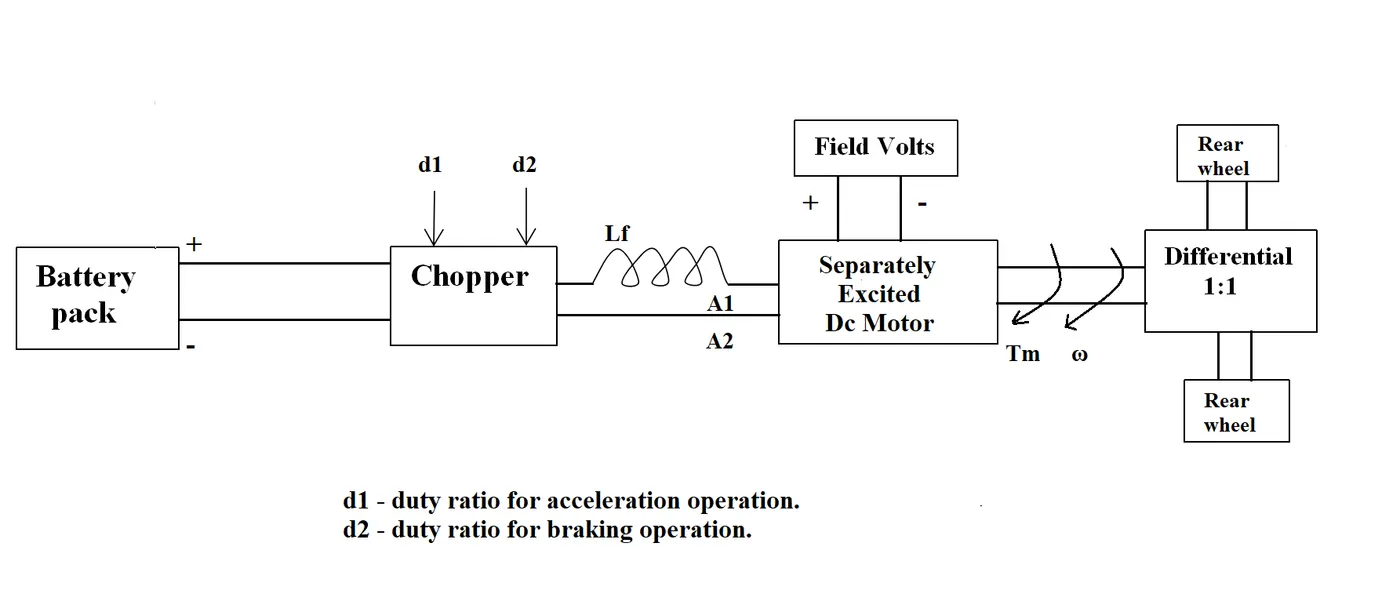
The other parameters of the electric vehicle are given below,
Motor and Controller Parameters:
- Rated Armature voltage= 72 V
- Rated armature current= 400 A
- Ra= 0.5Ω, KΦ= 0.7 Volt second
- Chopper Switching frequency= 400 Hz
The vehicle speed-torque characteristics are given by the below equation

What is EV steady-state speed if the duty cycle is 70%?
W.K.T,
`T_v = (V-(omega.k_phi))/R_a*k_phi`
where,
T is the motor torque
`omega` is the motor speed
`k_phi`is the motor constant
`R_a`is the armature resistance.
The torque equation for the motor based on 7- % duty cycle:
here the voltage changes to 70% of the rated motor voltage.
`T_m = 70.56-1.58*omega`
at steady state speed, the motor torque and the vehicle torque are equal so;
`70.56-1.58*omega=24.7+0.0051*omega^2`
On rearranging the terms and solving the equation to determine the roots, we get the speed of EV as 26.721.
Question 3:
Refer to the blog on the below topic:
Induction Versus DC brushless motors by Wally Rippel, Tesla
Explain in brief about the author’s perspective.
The author mainly tries to compare the different electric drive train configurations namely DC brushless motor and the induction motor based on their advantages, disadvantages and the areas of applications. Starting from the evolution of different models of conventional motors to electric drive trains. Starting from DC brushed motor to DC brushless and induction motor with its working principle.
Advantages of DC brushless over induction motors:
BLDC motors don't heat up a lot so they are more efficient compared to the induction motors. BLDC motors can be easily controlled compared to the complex operation of a 3 phase induction motor. Induction motor needs an AC source to run so inverters are used to convert the DC to AC.
Advantages of induction motor over BLDC:
The magnetic field can be varied providing efficient without magnetic field loss at light loads. Induction motors are cost-efficient compared to the permanent magnet BLDC motor.
The author couldn't come to a conclusion to pick up the best one as both the BLDC and induction motors have their own advantages and disadvantages with the stator remaining almost identical, the differences in rotor construction. BLDC motor for hybrid EV and Induction motors for high-performance electric vehicle based on the load requirements.