Week-6 Challenge: EV Drivetrain
AIM: To study about Electric Vehicle drivetrain.
Objective:
1. Which types of power converter circuits are employed in electric and hybrid electric vehicle?
The main aim of the converter is to produce conditioning power with respect to a certain application. A power converter is an electrical circuit that changes the electric energy from one form into the desired form optimized for the specific load. It is used to increase or decrease the magnitude of the input voltage, invert polarity, or produce several output voltages of either the same polarity with the input, different polarity, or mixed polarities such as in the computer power supply unit. The converter acts as the link or the transforming stage between the power source and the power supply output.
Depending on the type of function performed, power electronic converters are categorized into following types.
- AC to DC = Rectifier: It converts AC to unipolar (DC) current. This converts one value of DC voltage into other value of DC voltage ( increase/ decrease) .
- DC to AC = Inverter: It converts DC to AC of desired frequency and voltage.
- DC to DC = Chopper: It converts constant to variable DC or variable DC to constant DC.
- AC to AC = Cycloconverter, Matrix converter: It converts AC of desired frequency and/or desired voltage magnitude from a line AC supply.
2. An Electric Vehicle's powertrain with 72V battery pack is shown in the diagram below. The duty ratio for acceleration operation is 'd1' and for the braking operation the duty ratio is 'd2'.
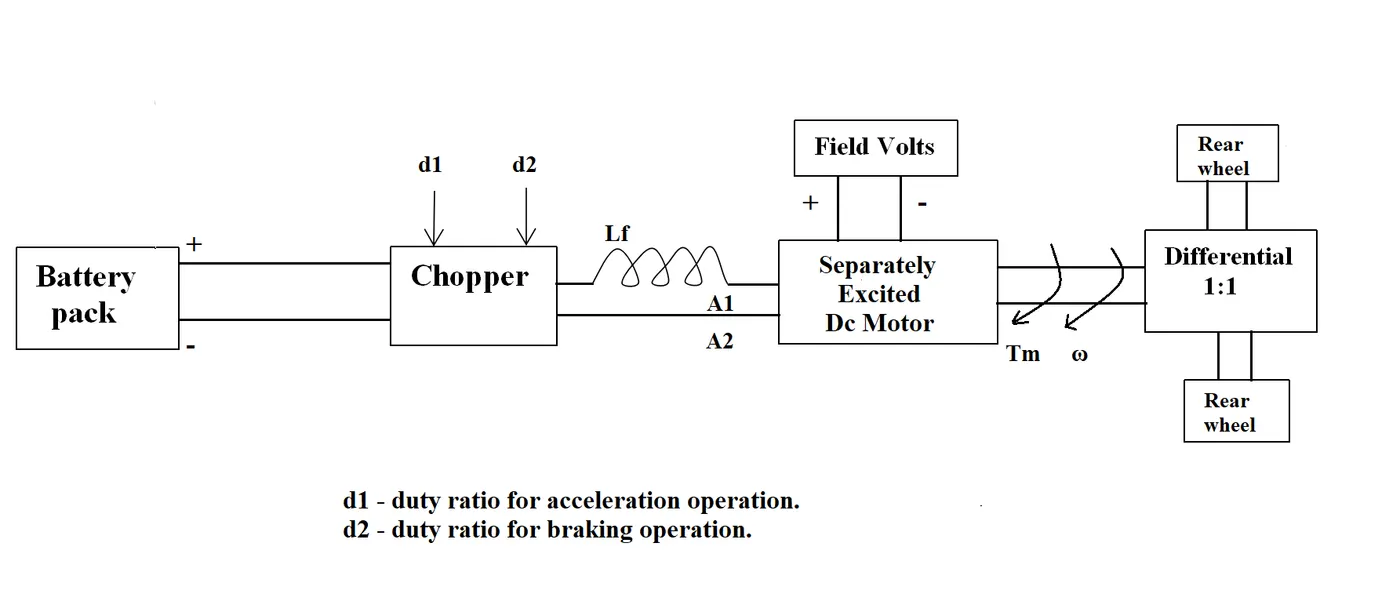
The vehicle speed-torque characteristics are given by the equation,  ...............(1)
The equation representing characteristics of Direct Current(DC) motor is 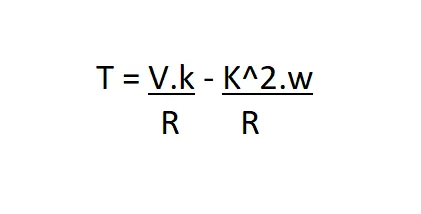 ...............(2)
where, T = Torque (N-m)
R = Resistance (ohms)
w = speed (rad/s)
V = Armature voltage(Volts)
The Motor and Controller Parametersparameters of the electric vehicle is given below,
Rated Armature voltage= 72 V
Rated armature current= 400 A
Ra= 0.5Ω, KΦ= 0.7 Volt second
Chopper Switching frequency= 400 Hz
Voltage of the motor = Voltage of armature * dutycycle
= 72*0.7
=50.4volts
T = 50.4*0.7/0.5 - ((0.7)^2* w)/0.5 = 70.56 - 0.98w
Substituting the above values in equation (2) and equating to equation (1)
24.7+(0.0051)w^2 = 70.56 - 0.98w
(0.0051)w^2 +0.98w - 45.86 = 0

x represents the angular speed ωω and by substituting the constants we get the values for ωω as 38.82 rad/s and -230.98 rad/s.
Since the speed should be positive, therefore ω = 38.915 rad/s
The steady state speed if duty cycle is 70% , ω = 38.915 rad/s.
3. Refer to the blog on below topic:
Induction Versus DC brushless motors by Wally Rippel, Tesla
Explain in brief about author’s perspective.
The article is about how the Induction motor and DC Brushless motor works and explained the working, limitatins ad difference between them.
According to Walley Rippel, Tesla , he differentiated in the following :
Induction Motor:
- The rotor includes two or more permanent magnets that generate a DC magnetic field.
- This magnetic field enters the stator core (a core made up of thin, stacked laminations) and interacts with currents flowing within the windings to produce a torque interaction between the rotor and stator.
- When the rotot rotates ,the magnitude and and polarity of the stator currents be continuously varied such that the torque remains constant and the conversion of electrical to mechanical energy is optimally efficient.
- The device that provides this current control is called an inverter.
DC Brushless motor:
- In the induction motor, the rotor has no magnets, just stacked steel laminations with buried peripheral conductors that form a shorted structure.
- Currents flowing in the stator windings produce a rotating magnetic field that enters the rotor.
Difference between Inductions and DC brushless motors:
| Induction Motor | DC Brushless motor |
|
|
|
|
|
|
- Since mostly all vehicles contain DC brushless motors now-a-days, only some vehicles like GM EV1 and tesla roadster etc uses induction motors.
- The differences between these two kinds are too small. Since the differences are in rotors and inverter controls. DC motors require absolute position sensor and induction requires speed sensor.
- The best power factor in induction is 85%. He also states the motor properties regarding eddy currents and hysteriesis.
- He states regarding permanent and ferromagnets used in EV's. Their cost and forces they gain in motors. Added development costs, but likely little or no recurring costs.
- Induction motors are difficult to control since laws are more and also achieving stability over the entire torque speed range is difficult.