Week-6 Calculate the Stretch Ratio by comparing the ELFORM (-2,-1,1,2) with Ogden_Material Model.
Aim: The aim of the challenge is to perform a tensile test on a cube of hyperelastic material and to compare the plots obtained after the simulation with the actual graph to validate the results.
Explanation:
For the analysis, a cube of dimensions 10mm*10mm* 10mm was created and meshed in LS PrePost using "Shape mesher" option in "Elements and mesh" tab. Each side of the cube has 10 elements of 1mm length each.
In "Model and Parts", the cube was given the boundary conditions. One face was given the single point constraint (spc) boundary condition, in which the cube's x-translational motion was constrained, but it was allowed in Y and Z directions to allow for the lateral compression. Also the rotations around the 3 axes were constrained.
Using "Prescribed_Motion_Set" keyword, the opposite face of the cube was given a displacement of 50mm in positive x-direction to model the tensile test.
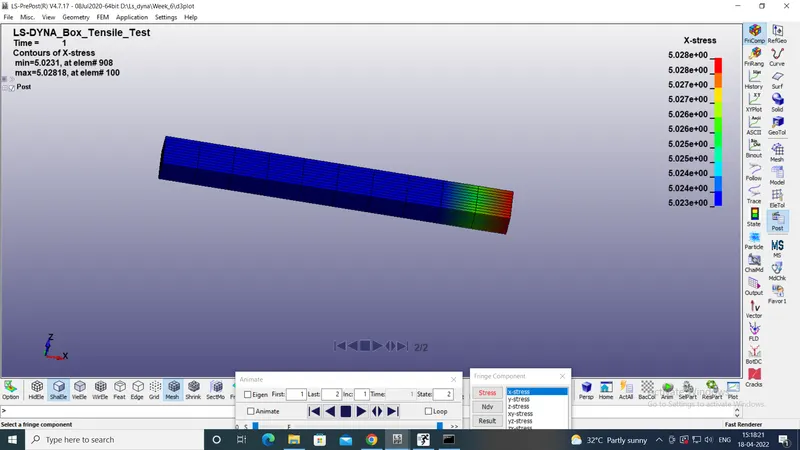
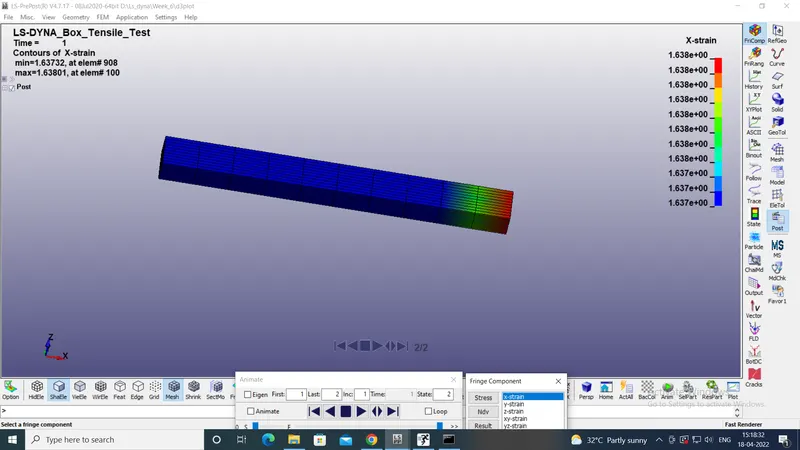
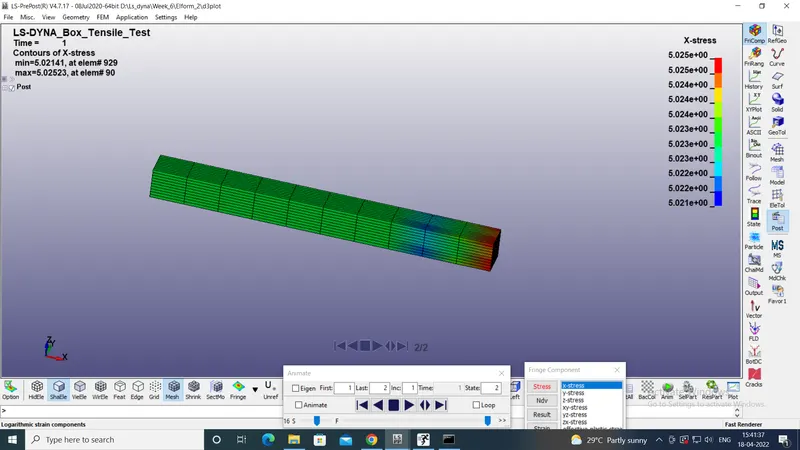
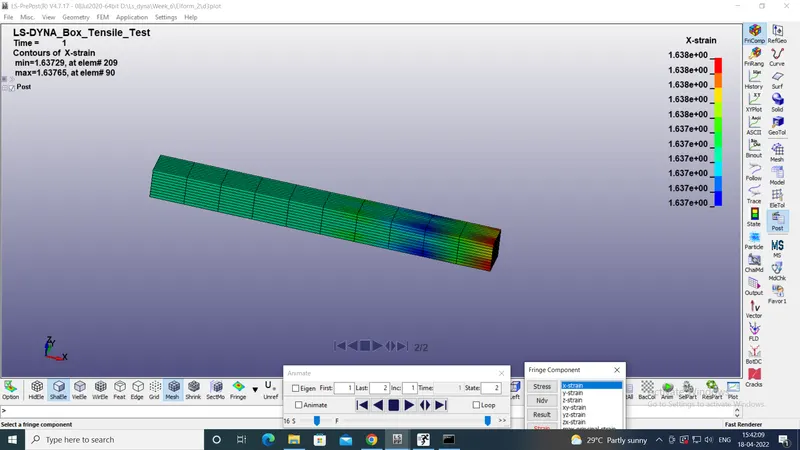
The material card given in the question i.e. "Ogden_Material.k" was used for the cube. Also the solid section was used for the elements with 4 different element formulations of: 1, 2, -1 and -2. The results of stress and strain in x-direction were calculated for all the 4 element formulations. The results are shown below:
Elform 1:
Elform 2:
Elform -1:
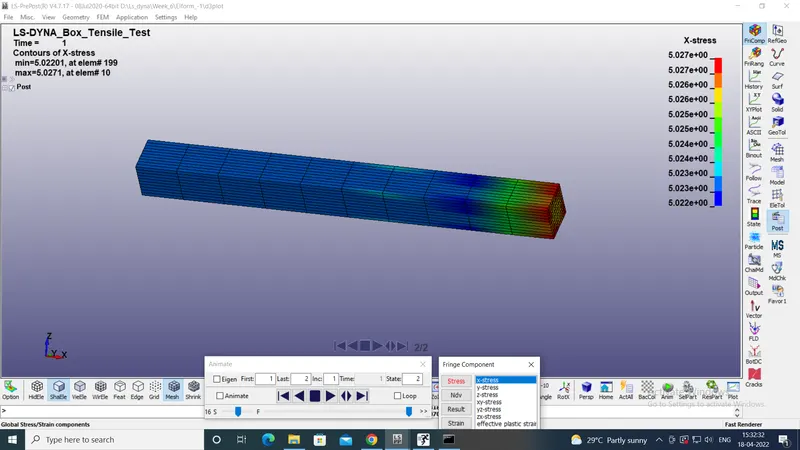
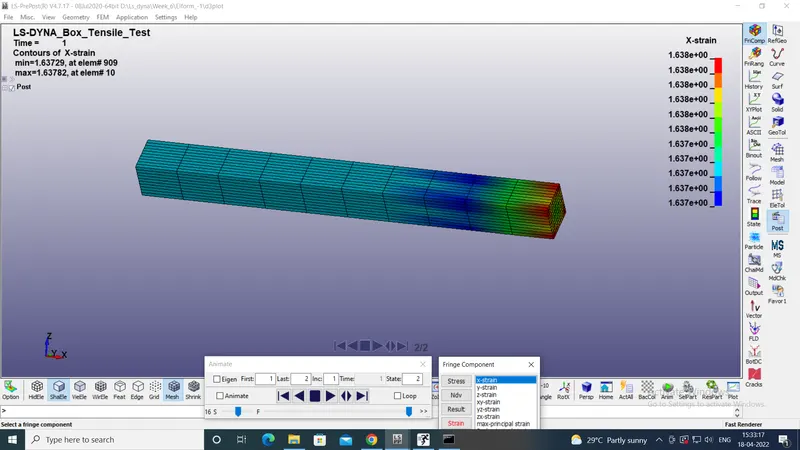
Elform -2:
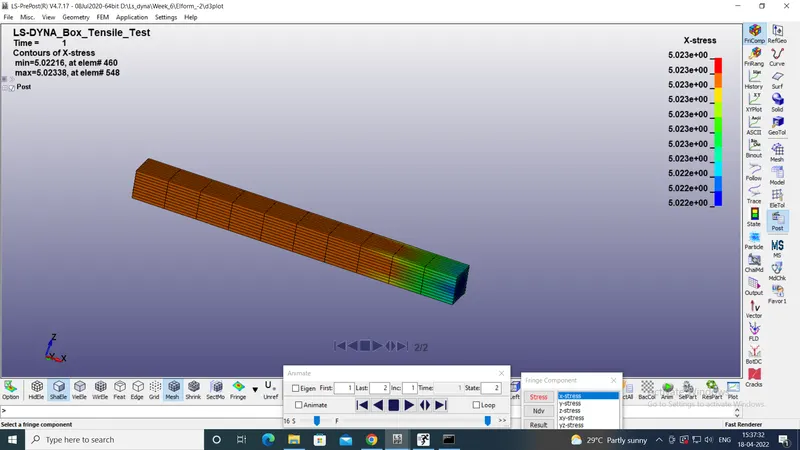
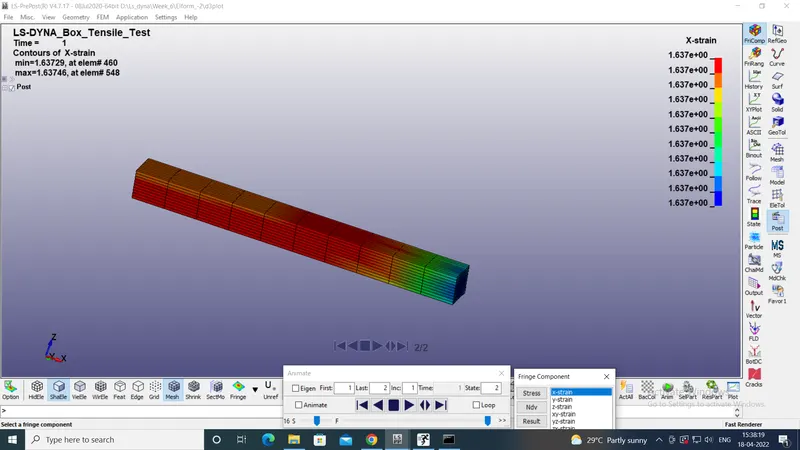
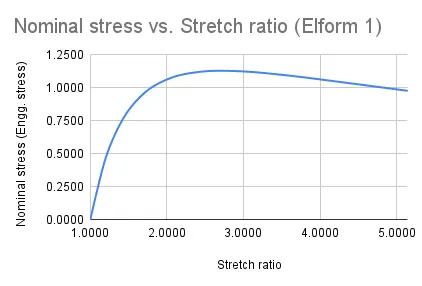
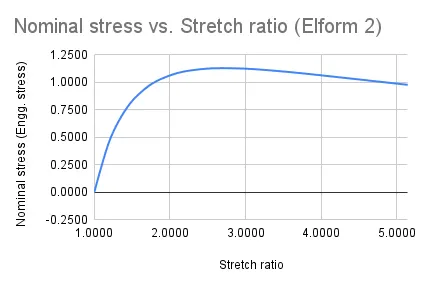
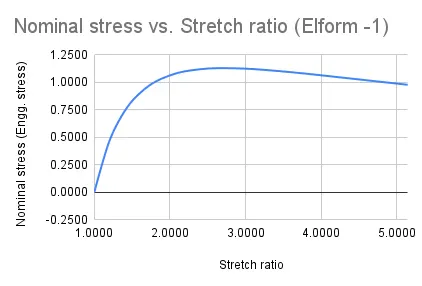
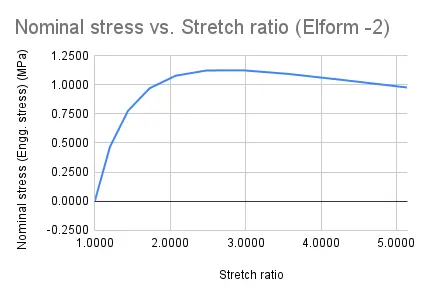
It is clear from the images above, that the values of stress and strain as well as the graph of stretch ratio vs. nominal stress is similar for all the element formulations.
However the distribution of stress and strain within the part is different in case of different element formulations due to their different properties.
Elform 1 is a constant stress element, in which the stress is constant in all directions. This gives a uniform distribution of stress and strain.
Elform 2 is prone to shear locking in case of bad aspect ratios, which leads to excessive stiffness of the element. Hence under the given tensile conditions, when the elements are skewed, the elform 2 offers stiffness, showing the stress and strain distribution as shown in the image.
Elform -1 and -2 are insensitive to a bad aspect ratio but become very stiff if they are skewed or distorted. They employ an assumed strain approach to avoid the shear locking behavior seen in Elform 2 that have poor aspect ratios. Hence Elforms -1 and -2 also offer stiffness during tensile test showing the above mentioned stress and strain distribution.
Elform -2 is more accurate than elform -1.
The graph of stretch ratio vs. nominal stress for each of the elforms are given below:
Comparing the stretch ratio vs. nominal stress graph obtained from simulation with the actual graph of uniaxial loading:
It is clear that the stress vs. stretch ratio graph is similar for all the element formulations. The graph matches with the actual uniaxial graph up to the stretch ratio of 2.5.
But after this, as per the actual plot, the stress increases with increase in stretch ratio, while as per the simulation, the stress goes on decreasing with increase in stretch ratio.
The reason of this might be the strain rate given in the simulation. The displacement of 50 mm was given in just 1 second. Such a strain rate is too high, reducing the strength of the part too quickly. Hence the stress goes on decreasing after the stretch ratio of 2.5.
The excel sheet for detailed calculations is attched herewith.
Conslusion:
The simulation made it clear, the differences among the different element formulations of solid section. While Elform 1 is constant stress elform, the elforms 2, -1, -2 offer stiffness, when skewed. This distributes the stresses and strains towards the fixed boundary of the cube also, unlike the elform 1. Also it underscored the importance of strain rate in affecting the stress and strain distribution within the part. Finally, it was a good learning experience to understand the conversion between true and engineering stress and strain.