Week-6 Calculate the Stretch Ratio by comparing the ELFORM (-2,-1,1,2) with Ogden_Material Model.
AIM: To calculate the stretch ratio by comparing the ELFORM (-2,-1,1,2) for the given material model.
Modelling: A 10 x 10 x 10 mm cube was modelled with 10 elements on each side using solid elements and the ELFORM was varied to determine the effect of the element formulation on the Nominal Stress vs Stretch Ratio curve.
Boundary Conditions: The cube was fixed on one end with all DOFs constrained and in the positive y-axis, the load was applied in the form of velocity to the nodes which replicated the uniaxial tensile testing conditions.
Result:
- A node at the top of the cube was selected to obtain the Resultant Displacement vs Time curve.
- 10mm was added to the result to obtain the change in length.
- Finally, to determine the stretch ratio, the ratio of final length to initial length i.e. 10mm was obtained.
Comparison of experimental and Numerical results:
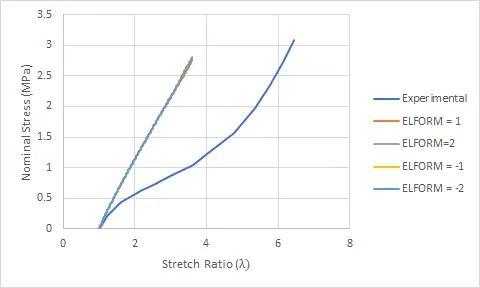
Fig: Comparision of ELFORM with Experimental data
The figure represents the effect of element formulation on the Stress vs Stretch Ratio curve. There is a large deviation between the Experimental and Numerical results. Though the stretch ratio in the experimental curve is high, the Nominal stresses in both the numerical and experimental values were significantly close. Further investigating the element formulation, it is clearly evident that the ELFORM parameter had a negligible effect on the curve as most of the curves overlapped each other.
Stress vs Strain Curve Comparison:
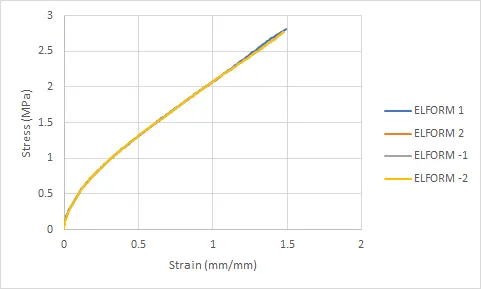
Fig: Stress vs Strain comparison for different ELFORM
A similar trend was obtained as in the case of Nominal Stress vs Stretch Ratio, the effect of ELFORM was negligible for Stress vs Strain Curve for the given material model.
Conclusion
In the given problem, the effect of element formulation on stretch ratio and stress vs strain curve was studied and it was determined that the ELFORM had a negligible effect. This can be attributed to the fact that the loading was within the elastic limit of the material and no failure was evident thus leading to a linear curve for both cases.