Week 5 - Turbulence modelling challenge
AIM:
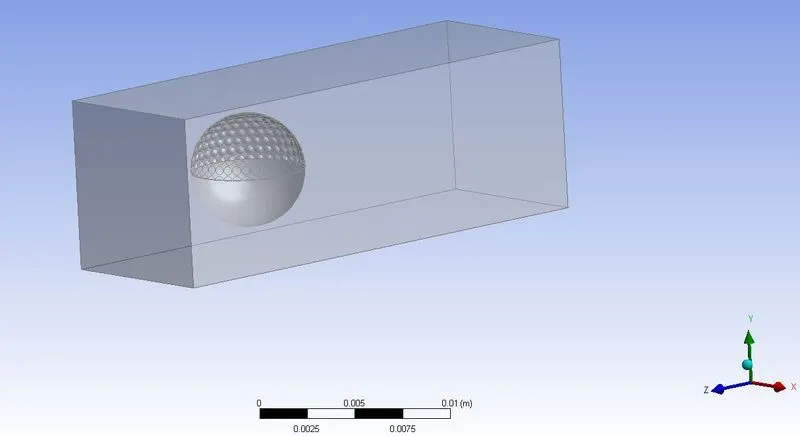
To understand the concept of turbulence model and to simulate flow over a a ball which as dimples around the body.
THEORY:
Spalart–Allmaras (S–A):
The Spalart–Allmaras model is a one-equation model that solves a modeled transport equation for the kinematic eddy turbulent viscosity. The Spalart–Allmaras model was designed specifically for aerospace applications involving wall-bounded flows and has been shown to give good results for boundary layers subjected to adverse pressure gradients. It is also gaining popularity in turbomachinery applications.
k–ε (k–epsilon):
K-epsilon (k-ε) turbulence model is the most common model used in computational fluid dynamics (CFD) to simulate mean flow characteristics for turbulent flow conditions. It is a two-equation model which gives a general description of turbulence by means of two transport equations (PDEs). The original impetus for the K-epsilon model was to improve the mixing-length model, as well as to find an alternative to algebraically prescribing turbulent length scales in moderate to high complexity flows.
k–ω (k–omega):
In computational fluid dynamics, the k–omega (k–ω) turbulence models a common two-equation turbulence model that is used as a closure for the Reynolds-averaged Navier–Stokes equations (RANS equations). The model attempts to predict turbulence by two partial differential equations for two variables, k, and ω, with the first variable being the turbulence kinetic energy (k) while the second (ω) is the specific rate of dissipation (of the turbulence kinetic energy k into internal thermal energy).
SST (Menter’s Shear Stress Transport):
SST (Menter's shear stress transport) turbulence model is a widely used and robust two-equation eddy-viscosity turbulence model used in computational fluid dynamics. The model combines the k-omega turbulence model and K-epsilon turbulence model such that the k-omega is used in the inner region of the boundary layer and switches to the k-epsilon in the free shear flow.
FLOW SIMULATION OVER THE BALL:
GEOMETRY:
MESH GENERATION:
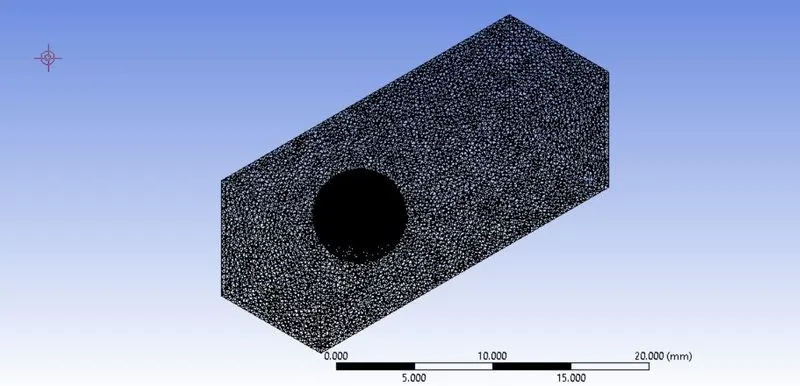
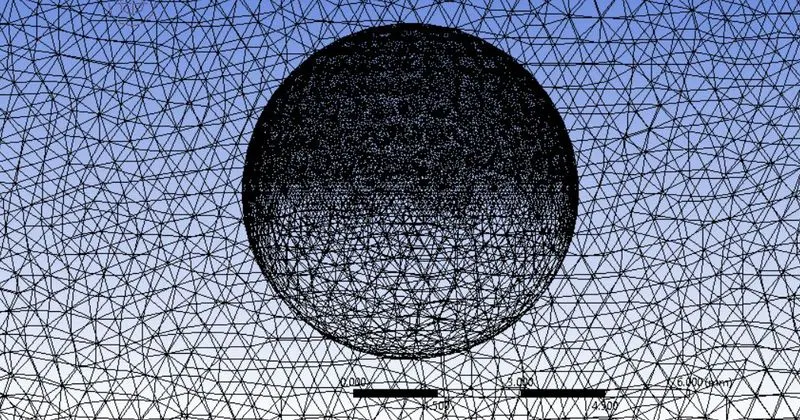
- 5mm mesh size is used to generated mesh.
- Boundaries are also defined after mesh generation.
RESULTS:
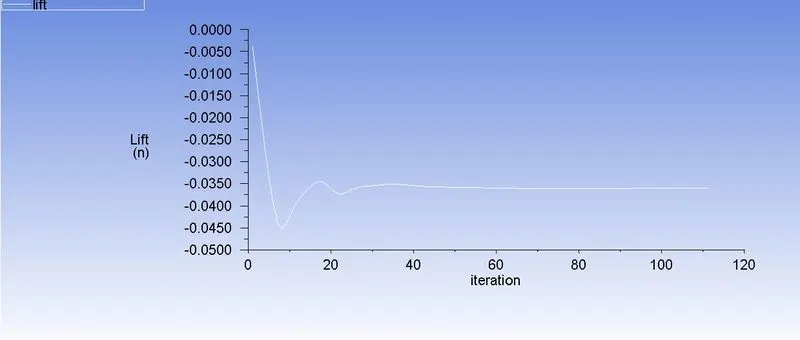
Lift Vs Iteration Plot:
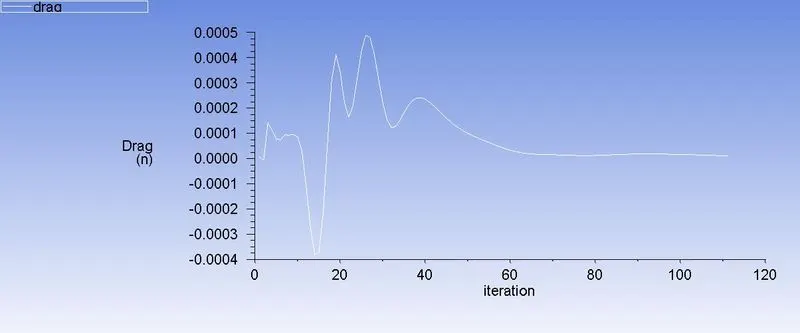
Drag Vs Iteration Plot:
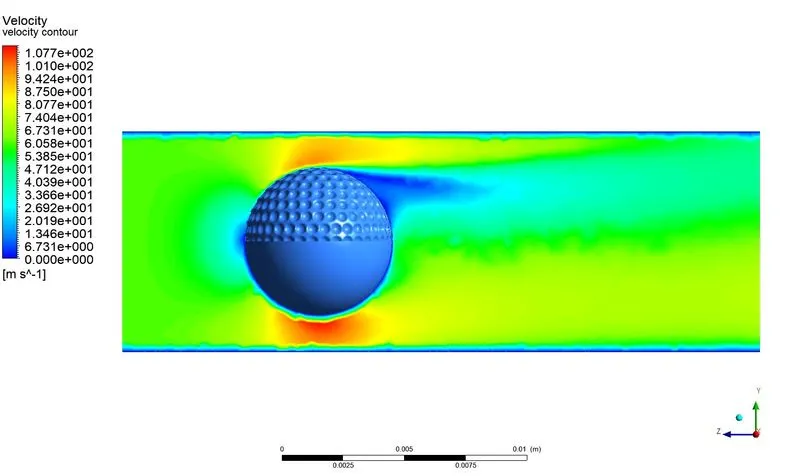
Velocity Contour:
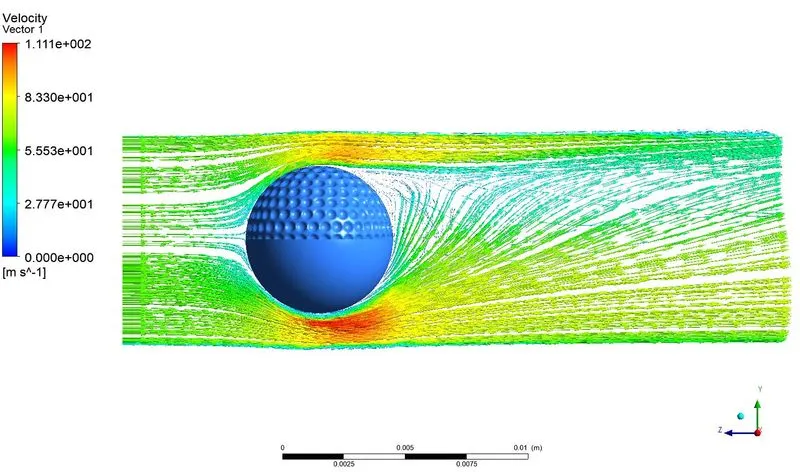
Vector Contour:
DISCUSSION:
- While seeing the velocity contour we can find that the ball is moving downwards.
- The dimples on the golf ball help to reduce the drag by reducing the wake region (recirculation).
- It also helps the flow to be attached and tries to separate the flow away from the golf ball.
CONCLUSION:
From this simulation, we came to know about the turbulence model and flow physics at the dimples over the golf ball.