Week 5 Sphere pressing on a plate
Theory:
The expected conclusions typically take a long time to converge and manifest since finite element analysis is a time-consuming operation. This situation typically arises when a geometry has a large number of nodes and elements because the solver needs a little longer to converge. In the meantime, if a symmetrical item is taken into account, one can replicate it using its half or quarter-half size, and the output results can then be mirror. This will undoubtedly cut down on overall time spent and allow for faster completion of tasks that produce exact outcomes.
Here, a similar technique is used by importing a Sphere-Plate model in a quarter-size to do the simulation. After the simulation is complete, the resulting data is mirrored to provide results that are as close to plausible as possible. First, the quarter-size sphere and plate are taken into consideration, together with the appropriate target and contact connections. The symmetric option is then assigned to it after that.
Elasticity and Plasticity
A body's elastic properties refer to its capacity to regain its former shape and size after being subjected to deforming pressures. Plastic bodies typically do not revert to their original structure when deforming stresses are eliminated. A body's ability to be plastic results in it losing its elasticity and developing a permanent distortion after the deforming force has been withdrawn. Deformation is the term used to describe the act or process of deforming or distorting. An object will either compress or stretch in response to a force when applied. In mechanics, the force applied to a unit area is referred to as stress. The amount of stretching or compressing brought on by a stress reaction is known as strain. Each material responds to stress in a unique way.
- Elasticity
A body's ability to regain its original size and shape after deformation forces are removed is known as elasticity. The occurrence of elasticity is a molecular phenomenon. Elastic deformation is reversible and non-permanent. Chemical links should lengthen or adapt to a substance's stress in order to suit its needs. Stretching and bending of chemical bonds should only be momentary. However, while an object is being stretched or bent, atoms do not collide. The material can lose its ductility and become brittle when its elastic properties deteriorate with time. - Plasticity
When a deforming force is withdrawn, a body's capacity to retain its elasticity and produce a permanent distortion is known as plasticity. When a material is subjected to a lot of tension, this occurs. Plastic deformation is irreversible and permanent. The capacity to be permanently shaped or formed is known as plasticity. A few chemical bonds between the atoms that make up the material fall apart as a result of plastic deformation. As a result of plastic deformation, atoms may squeak past one another. When the applied tension is released, the material doesn't move because of atom dislocations.
Plastic deformation starts at the elastic limit of ductile material. The maximum that a solid may be stretched without fundamentally altering its size or shape is known as its elastic limit. The material will distort plastically if the force is applied beyond the elastic limit.
Objectives:
- Getting ready with the SPhere and Plate assembly model developed in Solidworks and importing it into the Ansys Workbench for static structural Analysis.
- Apply Boundary Conditions by setting up the contacts and applying the fixed and displacement boundary conditions.
- Determine Directional Deformation, Equivalent Stress and Elastic Strain results for the performed simulation.
- Repeating the simulation for other cases of different material
Analysis Setup:
A static structural analysis is to be conducted for the sphere pressing on a plate. The material of Plate is set to be structutal steel Non Linear and that of the Sphere is Structural Steel.
Geometry
The 3D assembly model of the Sphere and Plate is developed in SOLIDWORKS is shown in figure below: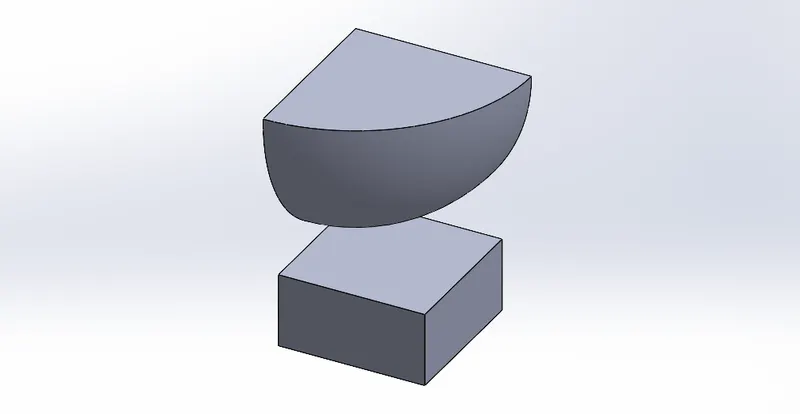
These models are then imported to Ansys Mechanical Static Structural Workbench for the analysis.
Material Properties
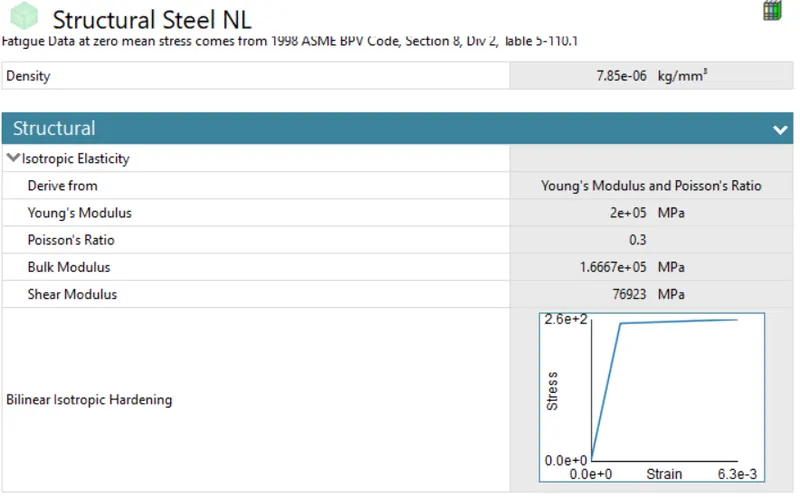
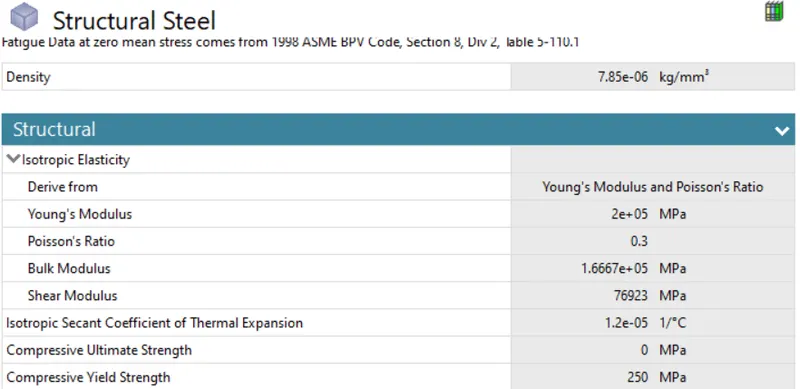
The material of Plates is set to be structural steel NL for the analaysis while the material of Sphere is set to normal Structural Steel material. The material properties are given below:
- Structural Steel NL:
- Structural Steel:
Contact Details:
A new contact between the sphere and plate has been established which is defined as frictional. There there exist an impact between the sphere and plate, a frictional coefficient of 0.74 was assigned (By referring to Roymech Tribology Table). The contact and target must be specified in an interface. Remember that ANSYS considers the contact body to be the one that is not permitted to enter into the target body when choosing between these two. However, the target is permitted to enter the contact body. You can select the symmetric type of interaction if you are unclear of how your system will behave. Otherwise, an Asymmetric type of contact can be used.
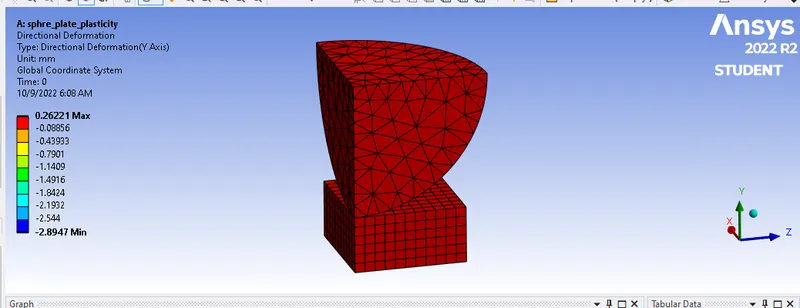
Press the sphere onto plate 2mm downwards.
DIRECTIONAL DEFORMATIONE
Equivalent Strain
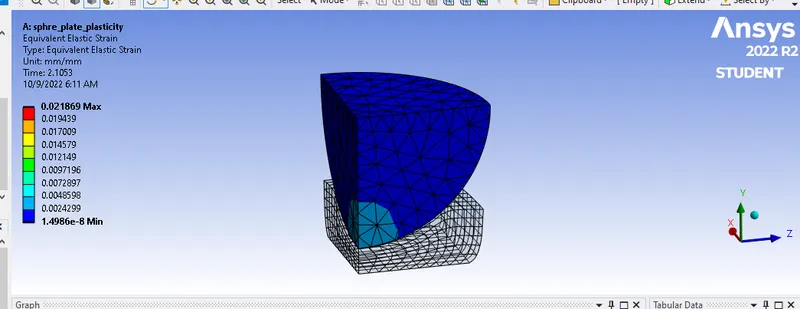
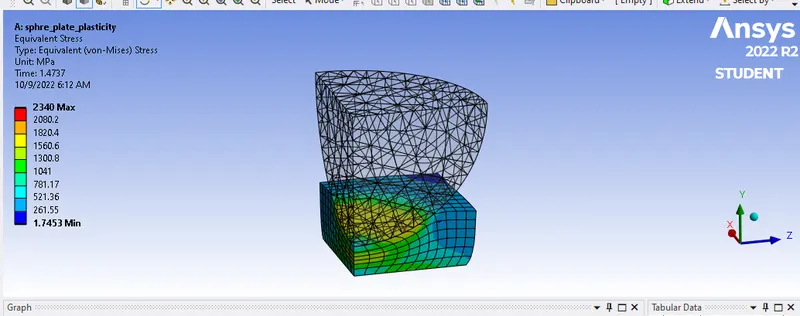
Equivalent Stress
Press the sphere onto plate 4mm downwards
Directional DEFORMATIONE
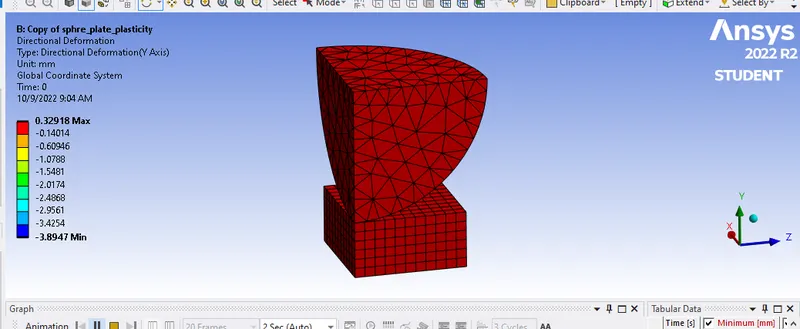
Equivalent Strain
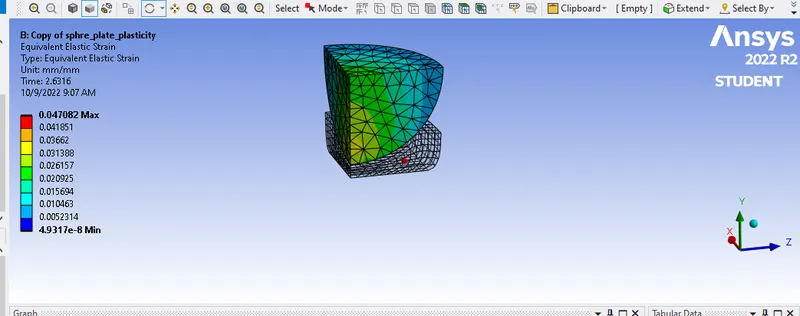
Equivalent Stress
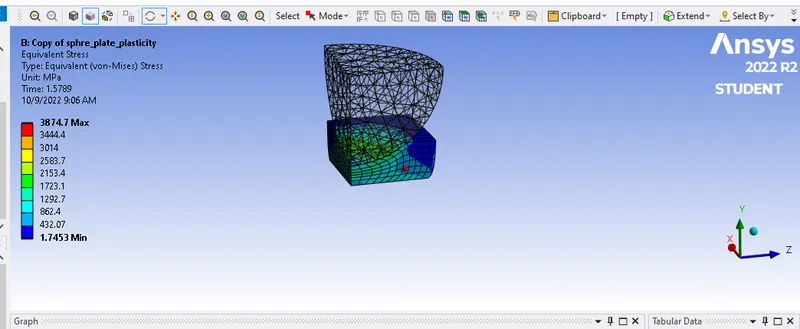
Compared 2mm mesh size and 4 mm mesh size.
|
MESH SIZE |
2 MM |
4 MM |
|
Directional max Deformation min |
0.26221 -2.8947 |
0.32918 -3.8947 |
|
Equivalent max Strain min |
0.021869 1.4986e-8 |
0.047082 4.9317e-8 |
|
Equivalent max stress min |
2340 1.7453 |
3874.7 1.7453 |
Conclusion:
Simulation of sphere pressing flat plate process conducted successfully with structural steel as sphere material and structural steel NL as plate material. From the analysis it is found that beyond the elastic limit the material remains in the plastic state, even after removal of load.
The performance of materials, such as non-linear structural steel, under dispalement loads is demonstrated through structural analysis. It can also highlight flaws in a design's structural composition that could shorten the model's life. A design engineer can create a more accurate performance estimate of the component or product being simulated from the findings of a structural analysis and adjust the design as necessary.
The nonlinear materials can deform plastically and that idealized stress-strain behavior is essential for conducting a practical engineering analysis of deformation processes was also learned.