Week 5 Sphere pressing on a plate
Aim: To perform the analysis to simulate a sphere pressing on a plate.
Objective: Press the sphere onto the plate 4mm downwards and retract it. The plastic deformation must be captured by you.
Procedure:
1) For wire bending analysis, we use the static structural tools in the analysis system toolbox to define the geometry and other input parameters for the same.
2) In the engineering data we input the material and its properties. In this case, we are using Structural Steel of non-linear material and its properties are shown below.
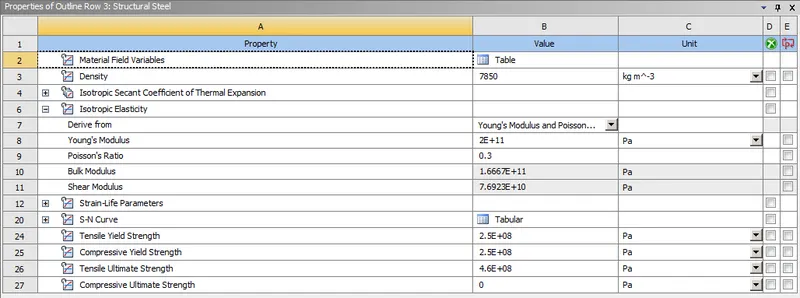
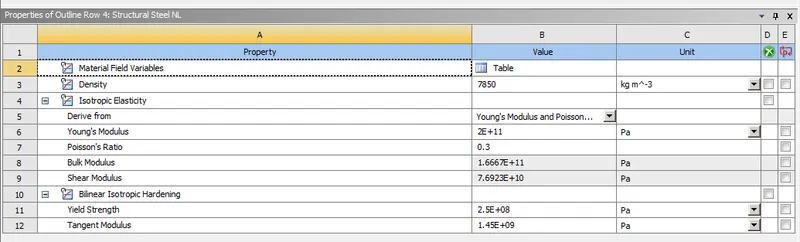
3) Verifying the geometry of the figure.
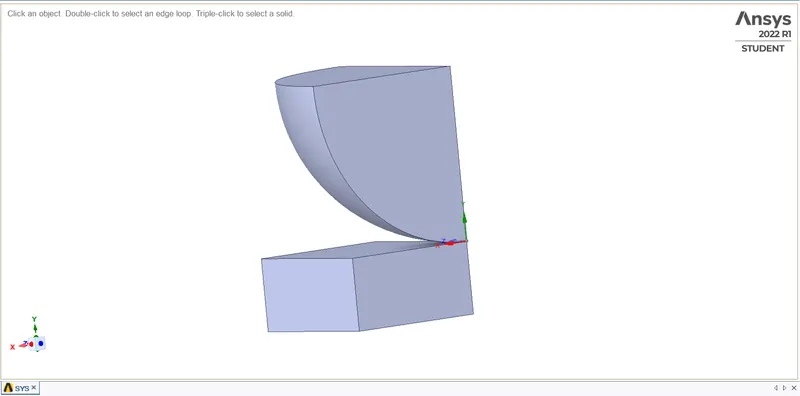
4) In the geometry of the model, the Sphere is made up of Structural Steel and Plate is made up of Structural Steel NL metal.
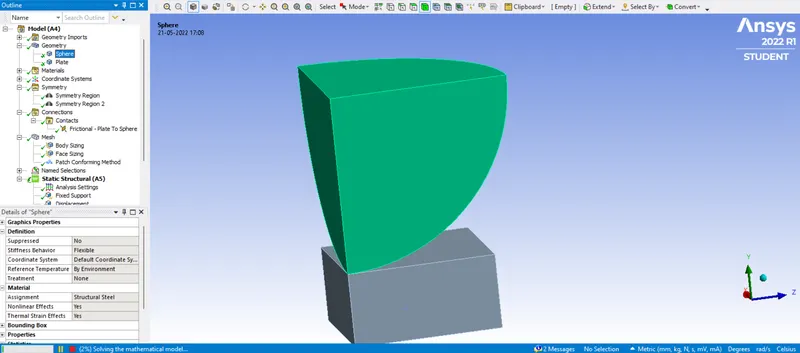
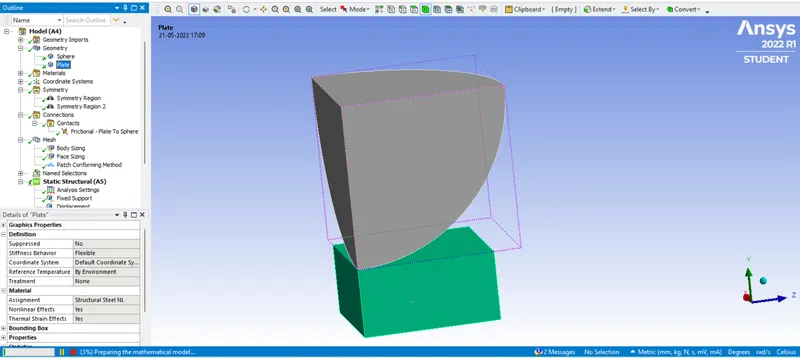
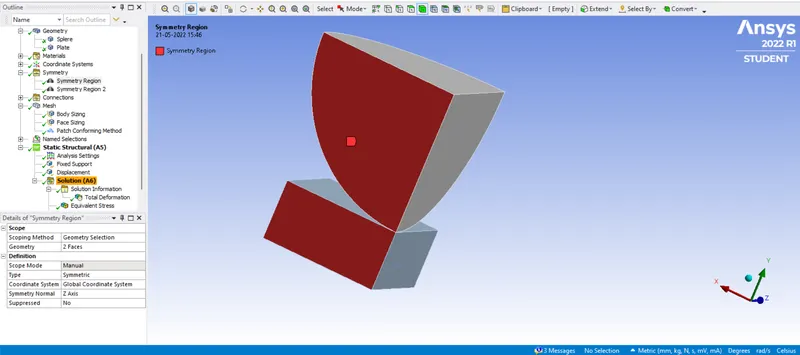
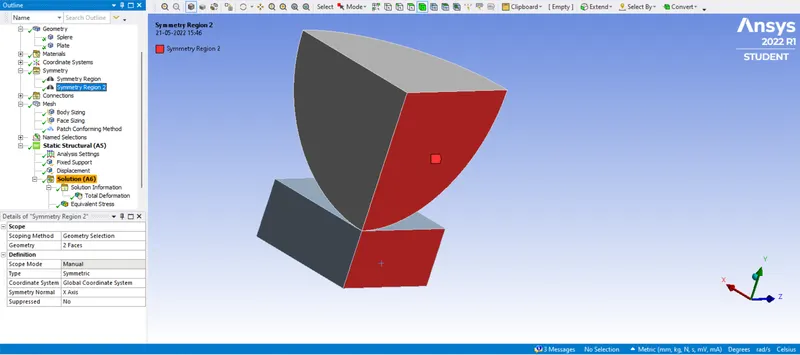
5) Since this model is one-fourth of the original, we are to introduce a symmetry attribute to complete the model on the X and Y-axis.
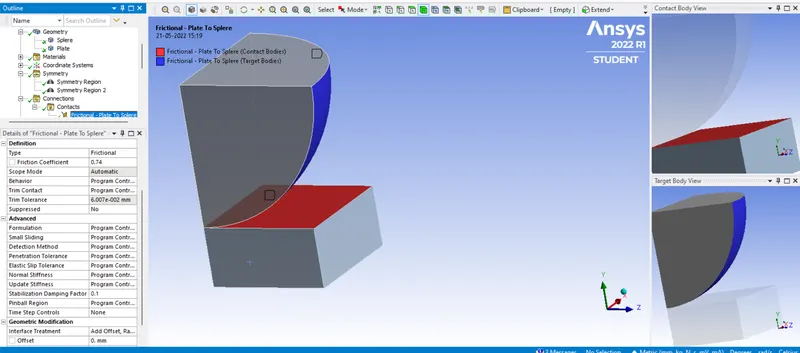
6) In connection, we have to define the contact faces of the geometry by selecting and deselecting contact or target bodies. In contacts under the connection tab, we define the type of contact as frictional contact. The frictional coefficient is taken at 0.74.
7) By opening the modelling tab, we mesh the geometry with element size as default and finer mesh size where contacts are present. Generating the mesh thereafter by right-clicking on the Mesh icon. Finer mesh is used for the sheet which is going to get deformed and wherever the sheet comes in contact.
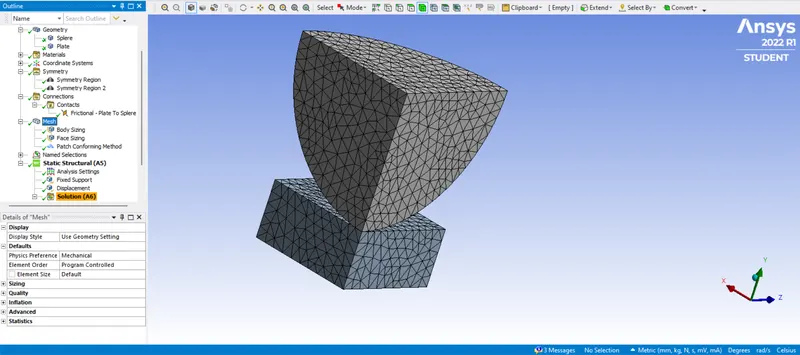
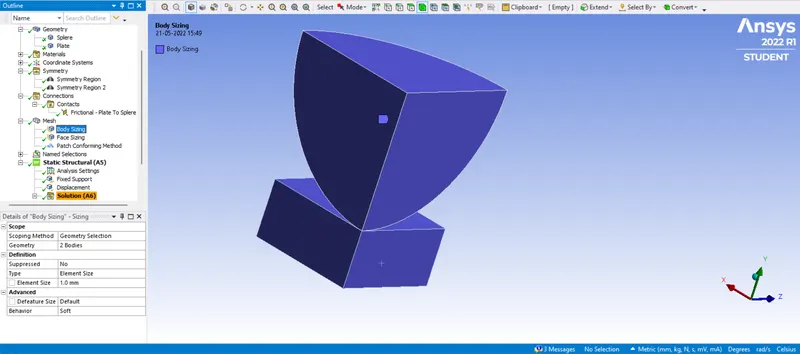
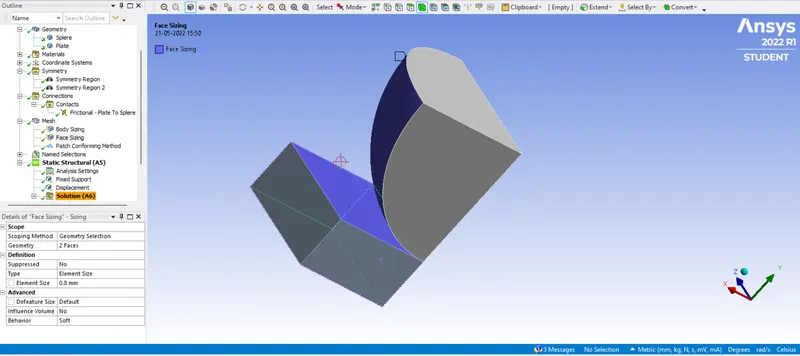
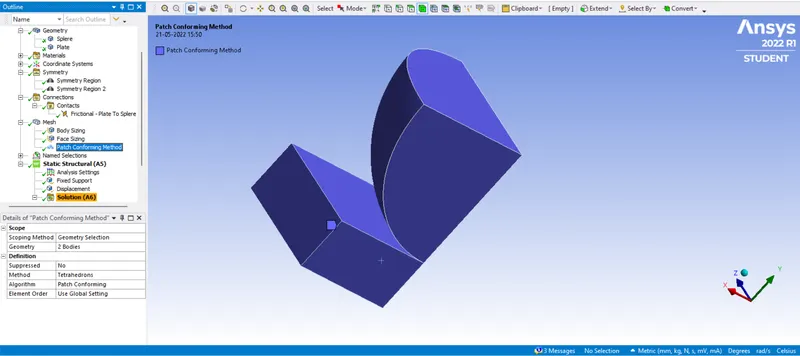
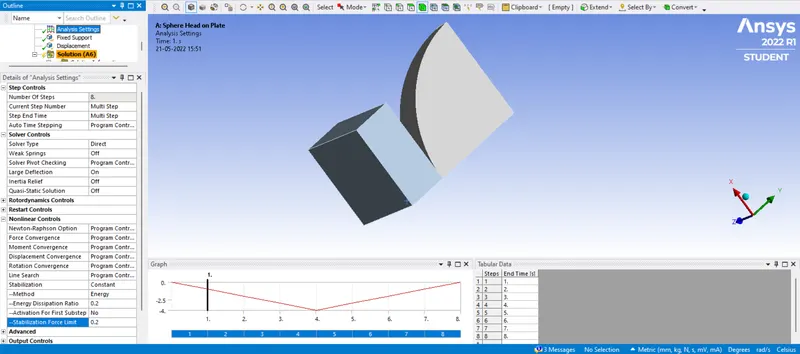
8) We open the analysis setting where we define the Displacement and Fixed Supports for 8-steps
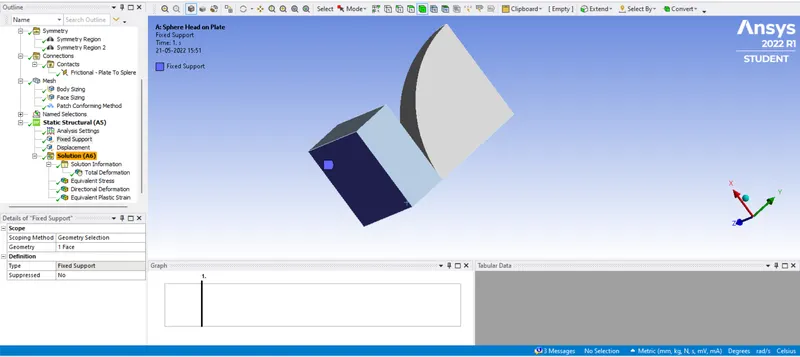
Fixed Support: We select the base of the plate for fix support.
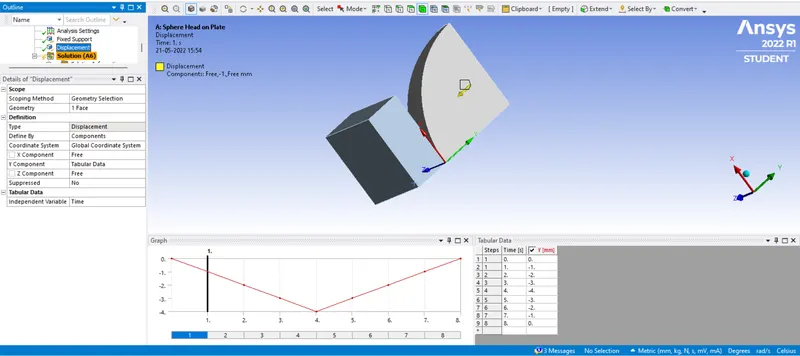
Displacement: The sphere is moved in negative Y-direction as it press plate up to 4 mm. The values given are -1, -2, -3, -4, -3, -2, -1 and 0.
9) The solutions obtained are shown below
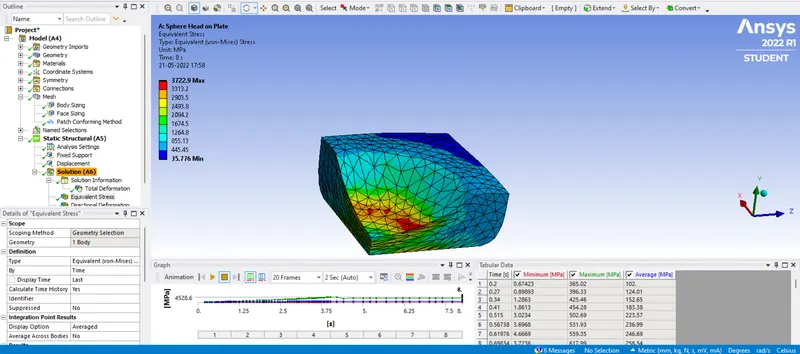
Equivalent Stress:
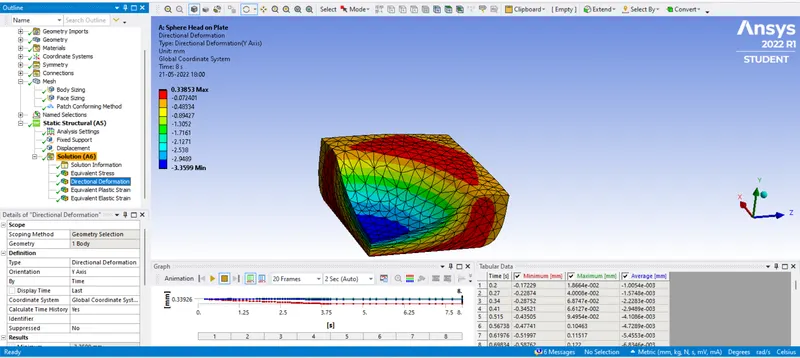
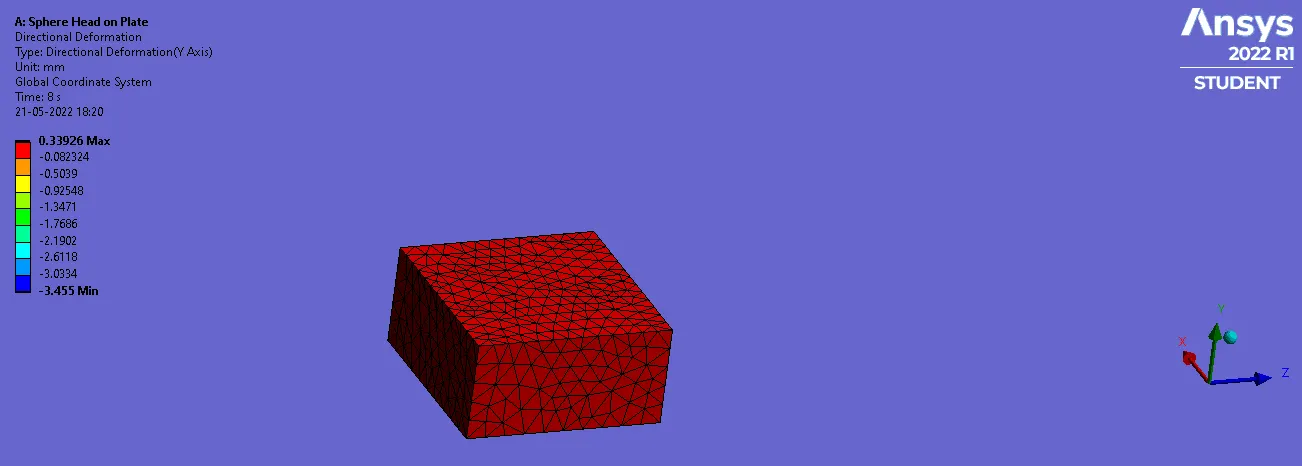
Directional Deformation in Y-axis:
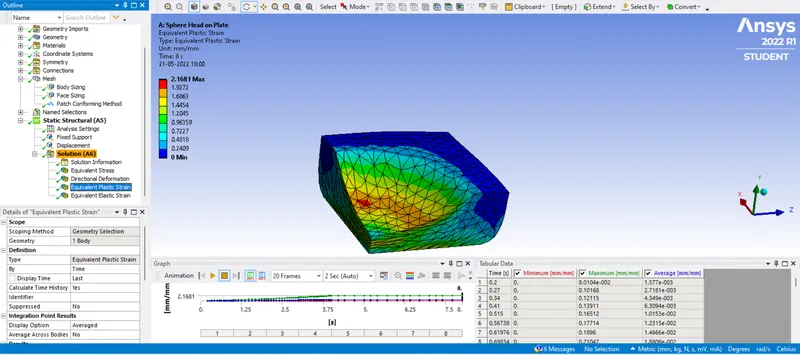
Equivalent Plastic Strain:
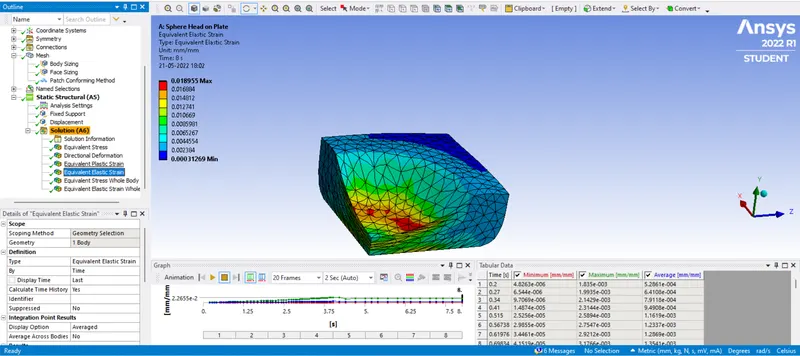
Equivalent Elastic Strain:
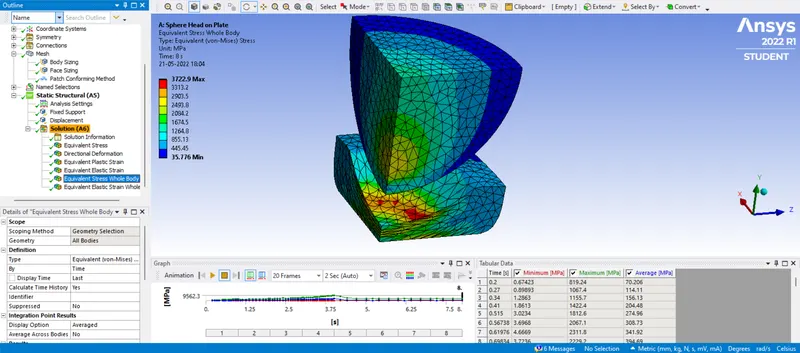
Equivalent Stress for Whole Body:
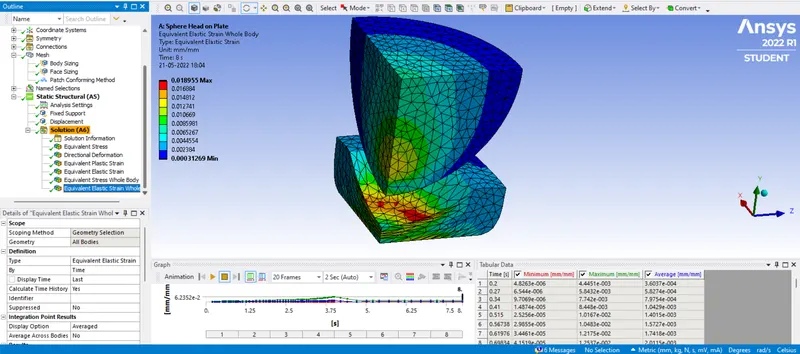
Equivalent Elastic Strain for Whole Body:
Results:
| Materials | Structural Steel NL |
| Equivalent Plastic Strain for Plate (Maximum) in mm/mm | 2.1681 |
| Equivalent Plastic Strain for Plate (Minimum) in mm/mm | 0 |
| Directional Deformation in Y-axis(Maximum) in mm | 0.33853 |
| Directional Deformation in Y-axis(Minimum) in mm | -3.3599 |
| Equivalent Stress for Plate (Maximum) in MPa | 3722.9 |
| Equivalent Stress for Plate (Minimum) in MPa | 35.776 |
| Equivalent Elastic Strain for Plate (Maximum) in mm/mm | 1.8955e-002 |
| Equivalent Elastic Strain for Plate (Maximum) in mm/mm | 3.1269e-004 |
Conclusion:
As it can be seen from the outputs, there was a maximum deformation of 3.3599 mm into the plate. The sphere was given a displacement condition of a maximum of 4 mm as required, which does not translate into an exact 4mm deformation on the plate due to there being an initial gap between the sphere and the plate.
The plate was deformed permanently. In other words, plastic deformation occurred after the sphere was retracted to its original position.
And hence, a static structural analysis of a plate pressing on a sphere was carried out with the outputs of stresses, strains and deformations on the plate (of material Non-Linear Structural Steel) being generated.
Note: google drive link is provided below in a text file. Please check the link for the model.
Thank You...