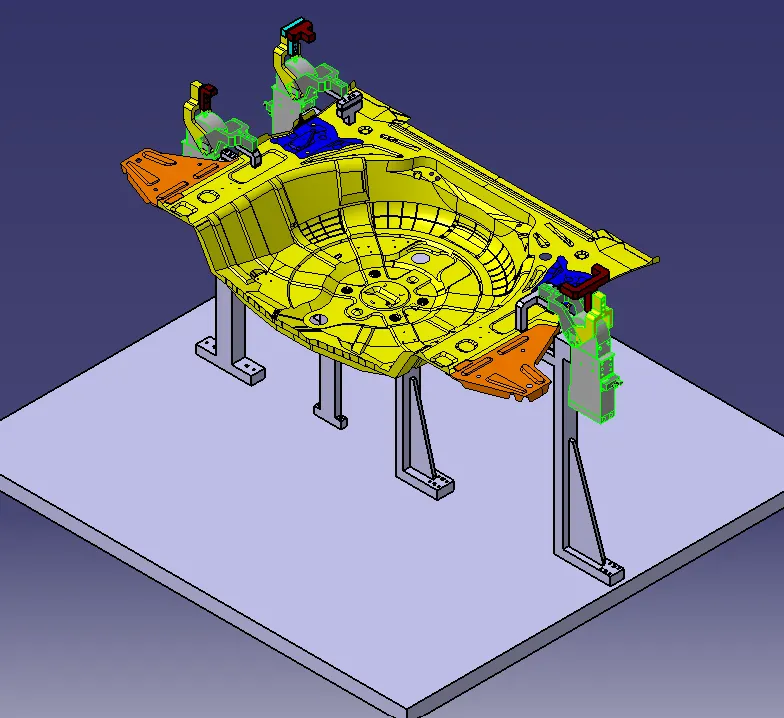
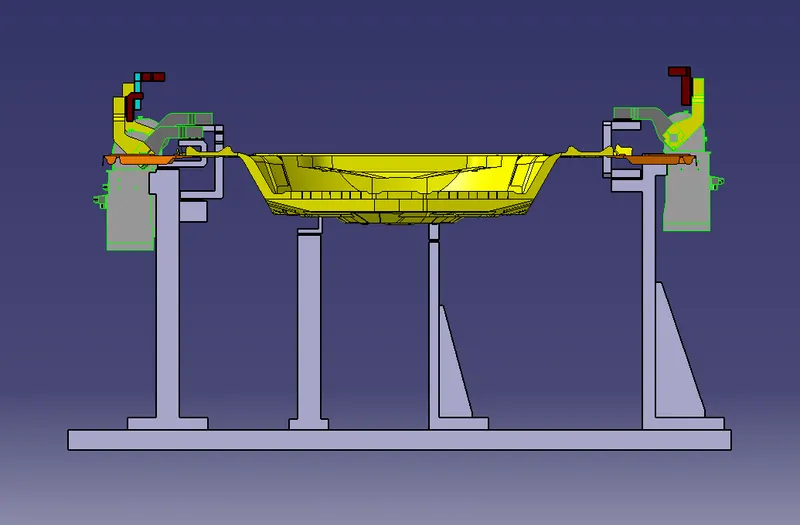
Week 5:- Rest Unit & Clamp Unit Design Challenge
Aim: To design 3 Different types of Power Clamp Unit with different Riser, Blade, Clamp Arm and also Design 2 Different types of Rest Unit for the given Car Panel.
Introduction:
Mylars are the components which are used to hold the panel when placed on a fixture. Mylars are of two types, clamping mylar and resting mylar. The clamping mylar is clamps the panel from above it to hold it in place while the resting mylar is located on the underside of the panel. Every clamping mylar must have resting mylar as it is necessary for safe and proper clamping.
Clamp Unit: The clamp unit is designed to clamp or hold the car panel with the help of the above spoken mylars, the clamp and rest mylars. In this challenge we use the tuenkers pneumatic cylinders for the clamp units and the design shows both the closed and open position of the clamp arm. The opening angle of a clamp is 90 degrees. 4 way shims are provided in the clamp unit and this is done to adjust the position of the mylars to compensate for the tolerance stack up.
Rest Unit: The rest unit has a rather simple prinicple to work with and that is, to aid in supporting the work panel to keep it in place. The work panel will be resting on the rest units which are then attached to the base unit. The rest unit is similar in design to the clamp unit, but in this unit's case, thhe presence of a clamping unit is absent. Hence the rest unit comprises of only a a rest mylar.
Components of a Clamp Unit:
- Clamp Mylar
- Rest Mylar
- Blade
- Shim
- Riser
- Cylinder
Components of a Rest Unit:
- Rest Mylar
- Blade
- Shim
- Riser
The above list of components shows the differences in the components between the rest and clamp units.
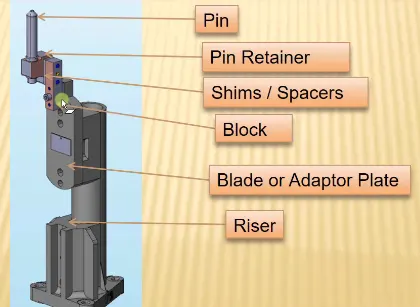
Locating Principle:
The 3-2-1 principle of location is used to constrain the movement of workpiece along the three axes XX, YY and ZZ. This is achieved by providing 6 locating points, 3 pins in base plate, 2 pins in the vertical plane and 1 pin in a plane which is perpendicular to the first two planes. The degree of freedom is the defines the ability of a body to move. Every body has 12 degrees of freedom or 12 possible movements and these twelve are broken down into 6 translational degrees of freedom and 6 rotational degrees of freedom. The 3-2-1 method is the fundamental principle for all types of fixture design.
Consider a body in a 3-axis coordinate system where we have the X, Y & Z as the respective axes. The image below shows the body in this coordinate system
From this we can infer that the 6 translational degrees of freedom are about:
+X, -X, +Y, -Y, +Z, -Z.
The 6 rotational degrees of freedom:
- Clockwise about X-axis (CROT-X)
- Anticlockwise about X-axis (ACROT-X)
- Clockwise about Y-axis (CROT-Y)
- Anticlockwise about Y-axis (ACROT-Y)
- Clockwise about Z-axis (CROT-Z)
- Anticlockwise about Z-axis (ACROT-Z)
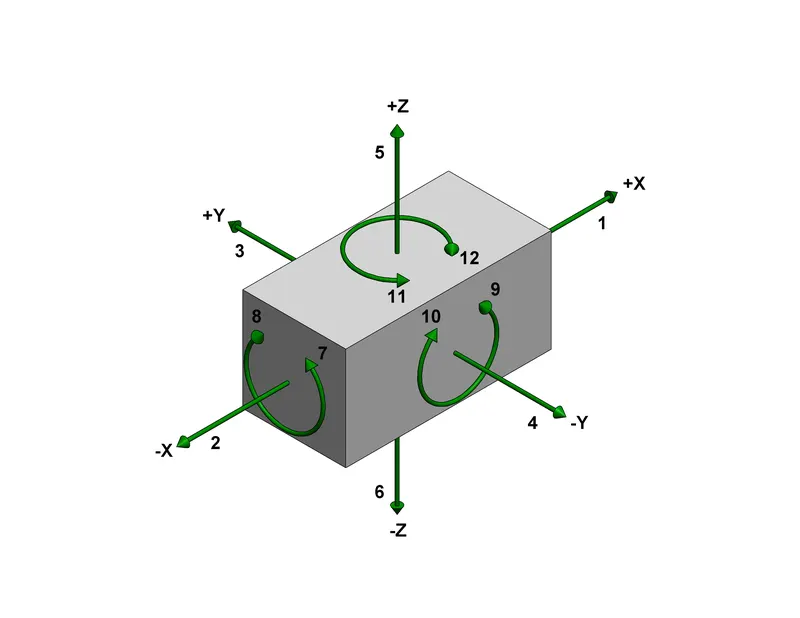
What this infers is that this body in space will have translational motion about any of the 3 mutually perpendicular axes in both directions and this provides the body with its 6 translational motions. The body can also rotate, clockwise or anticlockwise, about any of these 3 axes and this is what gives the body its 6 possible rotational motions.
We use locators, which are devices to establish and maintain the position of the workpiece properly to ensure that the work done it is accurate and repeatable.
The holding fixture used in an assembly operation often follow the 3-2-1 locating scheme to position parts. The first locators position a part in the primary plane, the next 2 locators then position the part in the secondary plane and final locators fixes the part in the tertiary plane and hence we lock the part in all its degrees of freedom.
The image below shows how the locators fix the part in all possible motion.
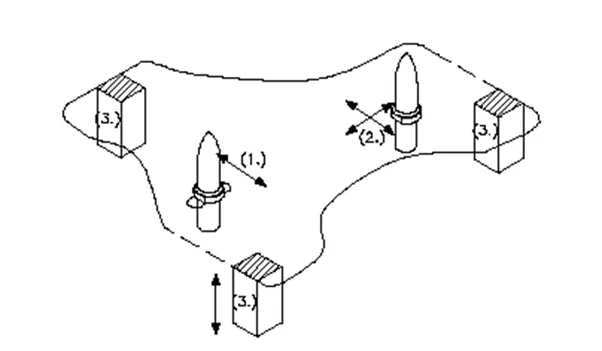
It can be observed in the image above that the 3-2-1 principle was followed to fix the workpiece. The first 3 pins placed at the bottom on the base plane (a plane parallel to the X & Y axis) restrict the rotation of the component about the X and Y axis. It also limits the downward movement of the component along the Z-axis.
The next 2 pins are in a plane parallel to the plane containing the X & Z axes. It prevents the rotation of the component about the Z axis and the movement of the body along Y axis in direction.
Design of Clamp Units:
1) Clamp Unit (1)
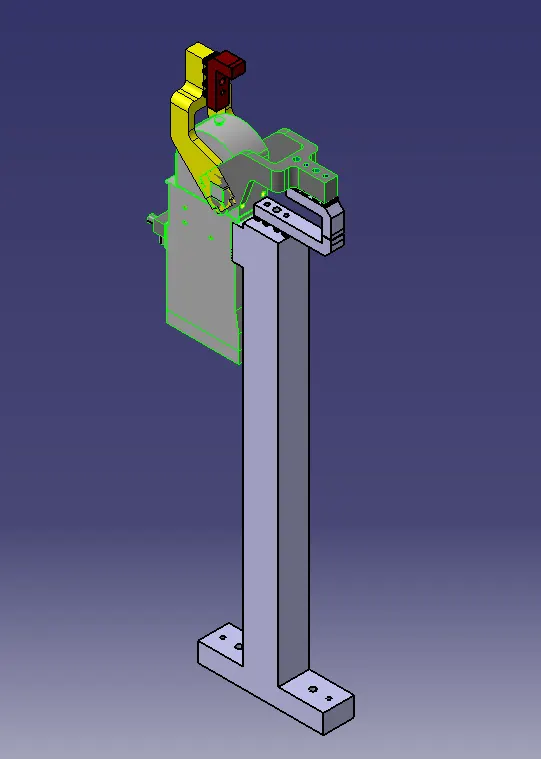
Isometric View
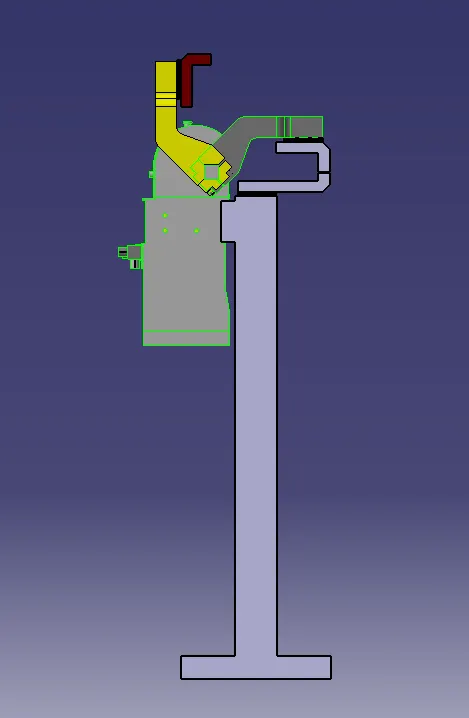
Front View
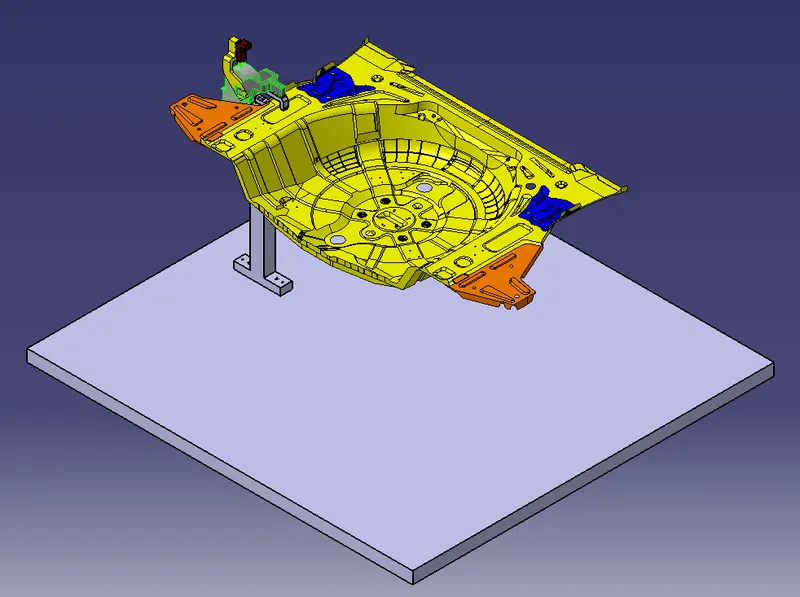
Clamp Unit 1 with the Car Panel
2) Clamp Unit (2)
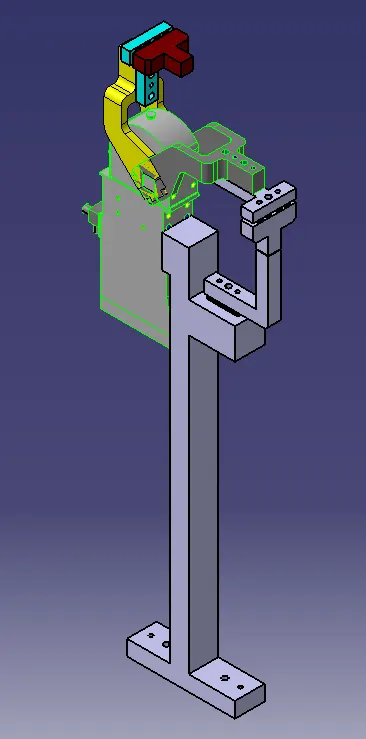
Isometric View
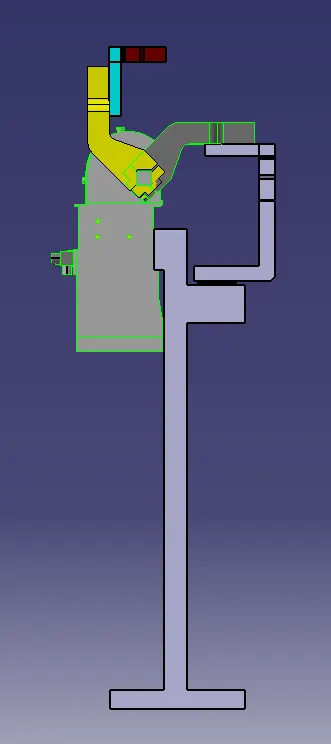
Front View
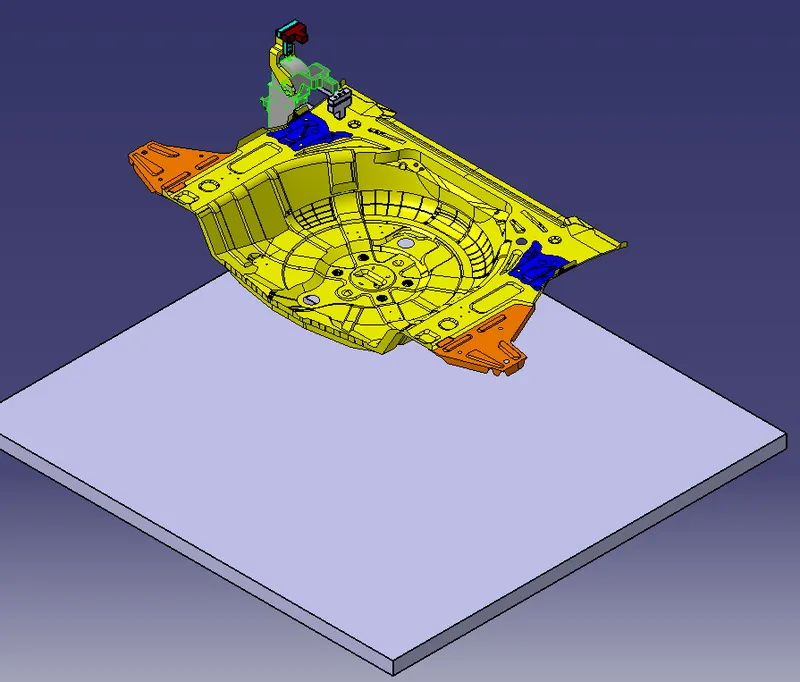
Clamp Unit 2 with the Car Panel
3) Clamp Unit (3)
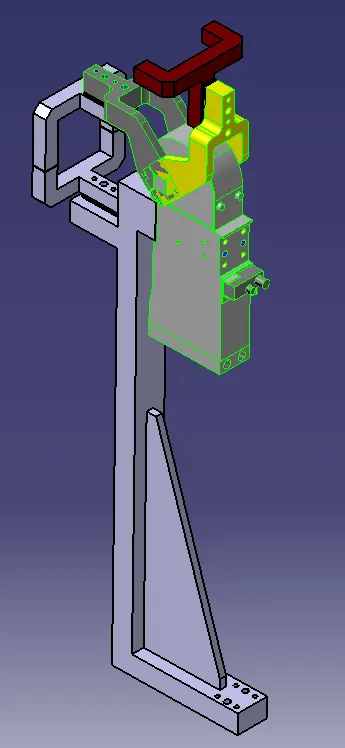
Isometric View
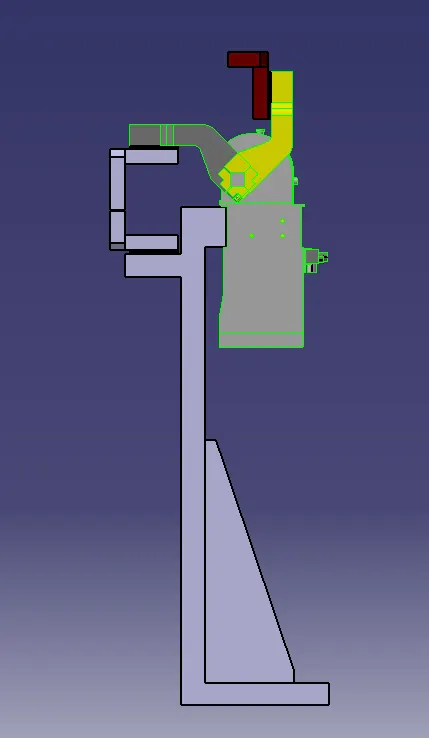
Front View
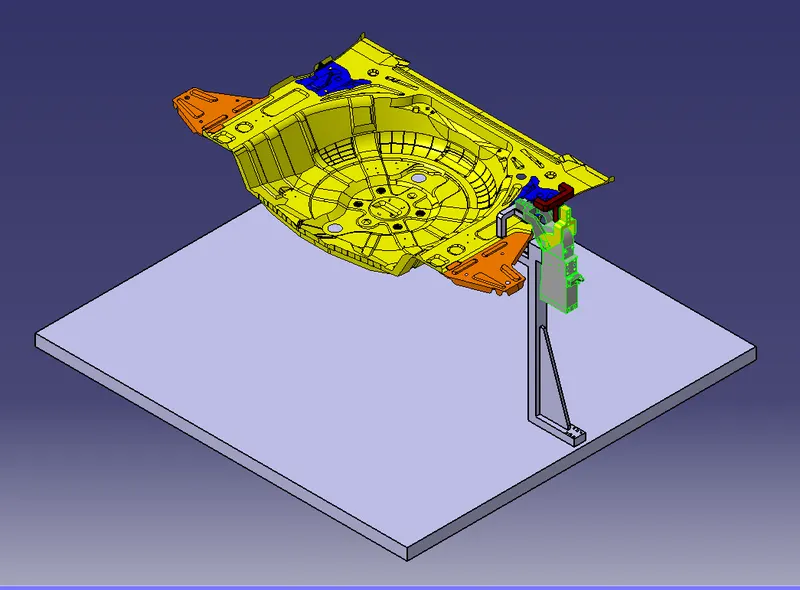
Clamp Unit 3 with the Car Panel
4) Rest Unit (1)
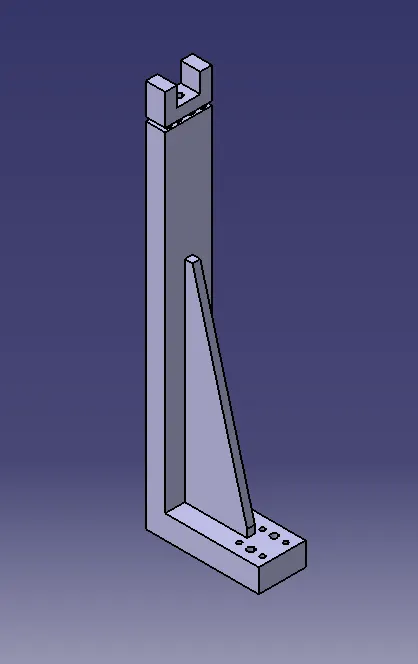
Isometric View
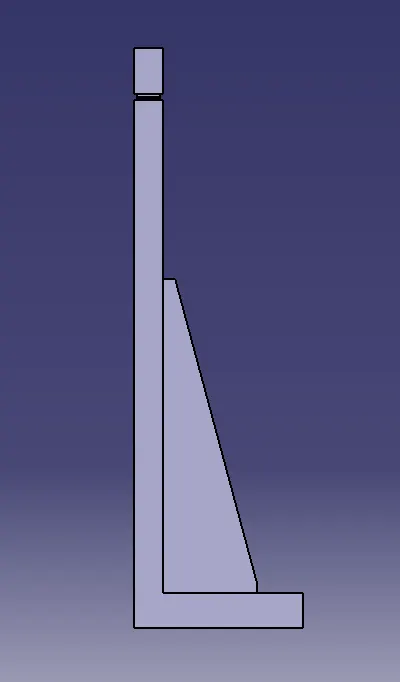
Front View
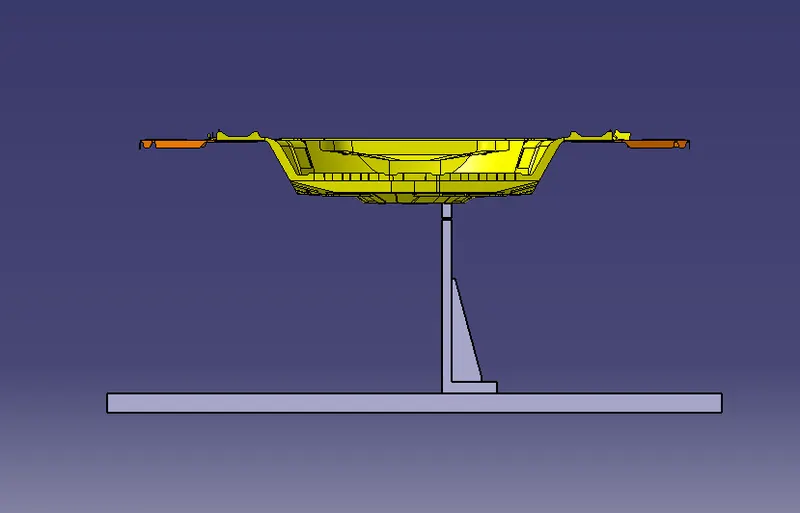
Rest Unit 1 with the Car Panel
4) Rest Unit (2)
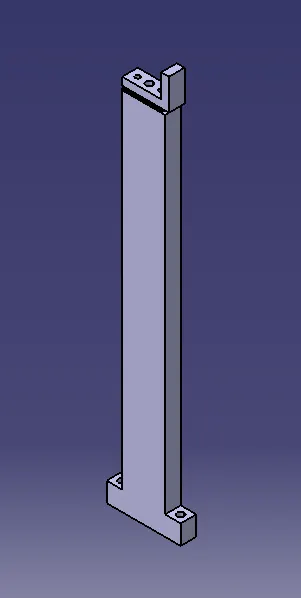
Isometric View
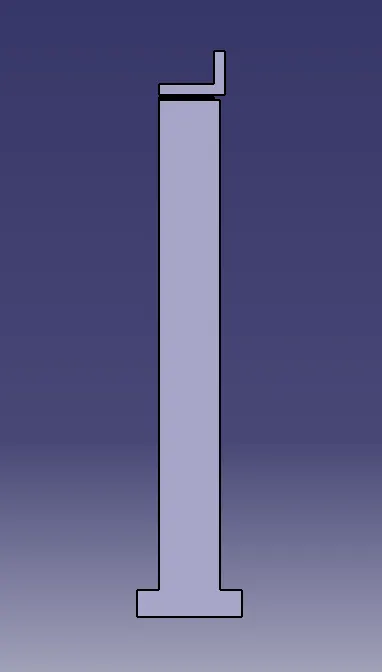
Front View
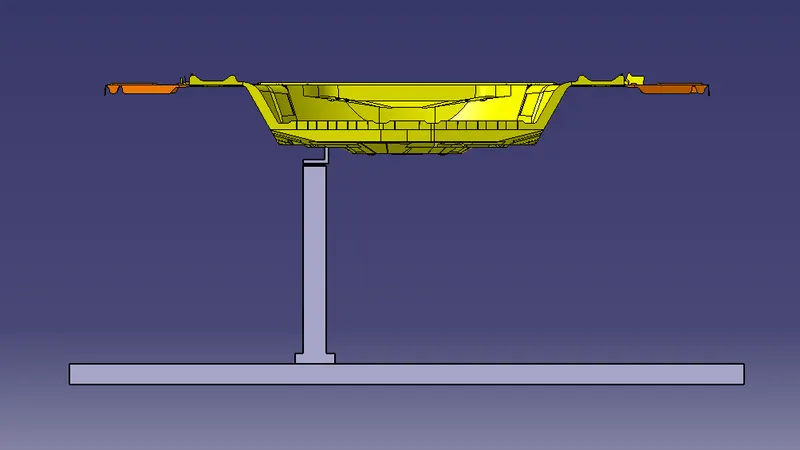
Rest Unit 2 with the Car Panel
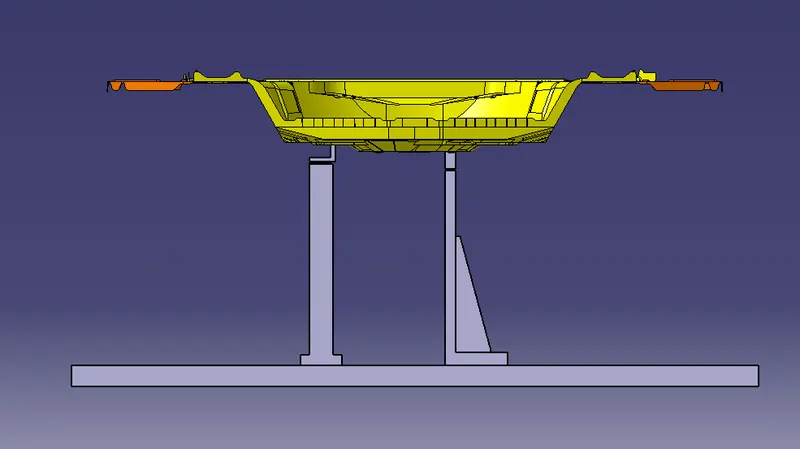
All Rest Units with the car panel
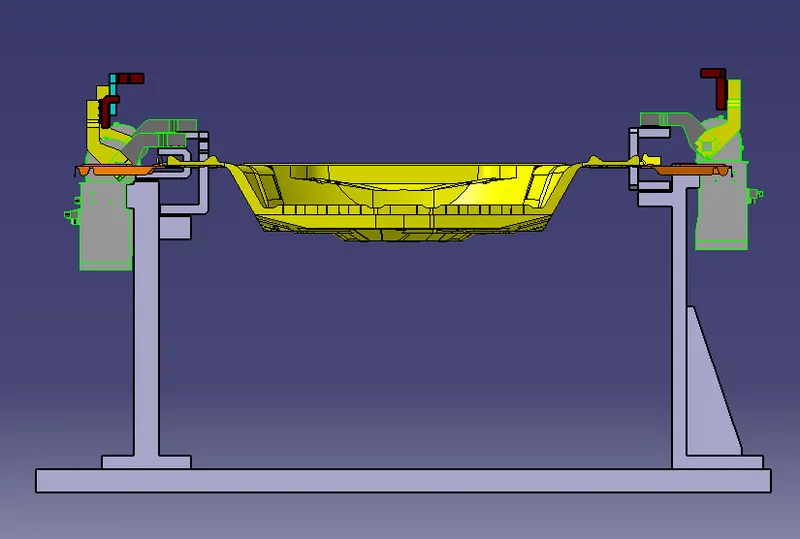
All Clamp Units with the car panel
Final Design & Conclusion: The 3 different clamp units as well as the 2 different rest units were created as per the design requirements and the images of the final design with all the units in place is shown below.